
GATE Civil Engineering (CE) 2027 Test: Flow Over Notches & Weirs Free Online
MCQ Practice Test & Solutions: Test: Flow Over Notches & Weirs (7 Questions)
You can prepare effectively for Civil Engineering (CE) GATE Civil Engineering (CE) 2027 Mock Test Series with this dedicated MCQ Practice Test (available with solutions) on the important topic of "Test: Flow Over Notches & Weirs". These 7 questions have been designed by the experts with the latest curriculum of Civil Engineering (CE) 2026, to help you master the concept.
Test Highlights:
- - Format: Multiple Choice Questions (MCQ)
- - Duration: 20 minutes
- - Number of Questions: 7
Sign up on EduRev for free to attempt this test and track your preparation progress.

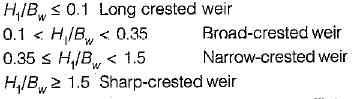
Consider the following measuring structures:
1. Submerged broad-crested weir
2. Free broad-crested weir
3. Free sharp-crested weir
4. Free ogee spillway
The correct sequence of the increasing order of the discharge coefficient of these structures is
1. Submerged broad-crested weir
2. Free broad-crested weir
3. Free sharp-crested weir
4. Free ogee spillway
Detailed Solution: Question 1
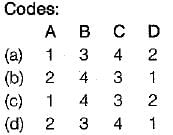
Match List-I with List-ll and,select the correct answer using the codes given below the lists:
List-I
A. Rehbock formula
B. Francis formula
C. A special trapezoidal weir
D. Linear proportional weir
List-lI
1. Sutroweir
2. Rectangular suppressed weir
3. Rectangular side-contracted weir
4. Cippolietti weir
List-I
A. Rehbock formula
B. Francis formula
C. A special trapezoidal weir
D. Linear proportional weir
1. Sutroweir
2. Rectangular suppressed weir
3. Rectangular side-contracted weir
4. Cippolietti weir
Detailed Solution: Question 2


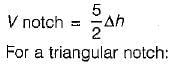
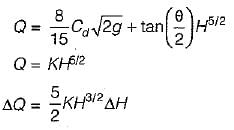
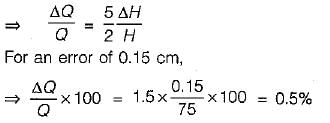
The head over a V notch at the end of a channel is 75 cm. If an error of 0.15 cm is possible in the measurement of head, the percentage error. in computing the discharge will be
Detailed Solution: Question 3

A hemispherical tank of radius R has an orifice of cross - sectional area ‘a’ at its bottom and is full of liquid. The time required to empty the tank completely is
A triangular notch is a more accurate measuring device than a rectangular notch
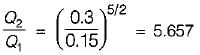
The head over a 90° V notch weir is increased from 0.15 m to 0.30 m. The ratio of new discharge to the original discharge will be
Detailed Solution: Question 6
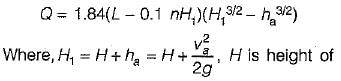
The discharge through a Cipolletti weir is given by where symbols have their, usual meanings.
33 docs|280 tests |
