NEET Exam  >  NEET Test  >  Chemistry Class 11  >  Test: Geometrical Isomerism - 1 - NEET MCQ

Geometrical Isomerism - 1 - Free MCQ Practice Test with solutions, NEET


MCQ Practice Test & Solutions: Test: Geometrical Isomerism - 1 (10 Questions)

You can prepare effectively for NEET Chemistry Class 11 with this dedicated MCQ Practice Test (available with solutions) on the important topic of "Test: Geometrical Isomerism - 1". These 10 questions have been designed by the experts with the latest curriculum of NEET 2026, to help you master the concept.

Test Highlights:

  • - Format: Multiple Choice Questions (MCQ)
  • - Duration: 15 minutes
  • - Number of Questions: 10

Sign up on EduRev for free to attempt this test and track your preparation progress.

Test: Geometrical Isomerism - 1 - Question 1

How many different stereoisomers exist for 1-chloro-2-(3-chlorocyclobutyl) ethene? 

Detailed Solution: Question 1

Combining the geometrical isomers with the orientations of the cyclobutyl substituent results in a total of 4 distinct stereoisomers for 1-chloro-2-(3-chlorocyclobutyl)ethene.

Answer:
B: 4

Test: Geometrical Isomerism - 1 - Question 2

Which of the following best explains why cis-trans isomerism arises?

Detailed Solution: Question 2

Answer: (c) Restricted rotation around a double bond.- Cis-trans isomerism, also known as geometric isomerism, occurs due to the restricted rotation around a double bond.
- In a double bond, the presence of a pi bond prevents the atoms from rotating freely, unlike the sigma bonds in single bonds.
- This lack of rotation allows for distinct spatial arrangements of groups attached to the carbons involved in the double bond.
- Cis isomers have substituents on the same side, whereas trans isomers have them on opposite sides, leading to different physical and chemical properties.

Test: Geometrical Isomerism - 1 - Question 3

Which of the following has three different stereoisomers?

Detailed Solution: Question 3

The correct answer is Option B.
 
 
CH3−CH=CH−CH=CH−CH3
          2,4-hexadiene
 
Three different geometrical isomers of cis-cis, trans-trans and sic-trans are possible.
 

Test: Geometrical Isomerism - 1 - Question 4

Identify the trans isomer of 2-butene:

Detailed Solution: Question 4

Answer: (b) The isomer with hydrogen atoms on opposite sides of the double bond.- 2-Butene has a double bond between the second and third carbon atoms, allowing for cis-trans isomerism.

- Trans isomer: The two identical groups (in this case, hydrogen atoms) are on opposite sides of the double bond.

- Option B is correct because it describes the structure where hydrogen atoms are on opposite sides, matching the definition of a trans isomer.

- Cis isomer: Would have both hydrogens on the same side, which is not the case here.

Test: Geometrical Isomerism - 1 - Question 5

 Which among the following does not exhibit geometric isomerism

Detailed Solution: Question 5

  • Double Bond Location: Between C1 and C2.
  • Substituents:
    • C1: Attached to two hydrogen atoms (H and H) and the C2 carbon.
    • C2: Attached to a hydrogen atom (H) and the C3 carbon.
  • Analysis:
    • C1 has two identical substituents (both hydrogens).
    • Since one of the carbons in the double bond (C1) does not have two different substituents, geometric isomerism is not possible.
  • Conclusion: Does not exhibit geometric isomerism

Test: Geometrical Isomerism - 1 - Question 6

Which of the following molecules can exhibit cis-trans isomerism?

Detailed Solution: Question 6

- Cis-trans isomerism occurs in alkenes with restricted rotation around the double bond and different groups attached to each carbon of the double bond.
- Ethane: No double bond, so no cis-trans isomerism.
- Propene: One end of the double bond has two identical hydrogen atoms, preventing cis-trans isomerism.
- 2-butene: Has two different groups on each carbon in the double bond, allowing for cis and trans isomers.
- Benzene: Aromatic ring with delocalized electrons, no cis-trans isomerism possible.

Test: Geometrical Isomerism - 1 - Question 7

Which of the following is a requirement for cis-trans isomerism?

Detailed Solution: Question 7

Answer: (c) The molecule must have restricted rotation and different groups on each doubly bonded carbon.

Test: Geometrical Isomerism - 1 - Question 8

A stereoisomer of cyclobutane-1,2-diol has lower solubility in water than its other stereoisomer. Which is this isomer and why?

Detailed Solution: Question 8

The correct answer is option c

The cis isomer is more likely to exhibit intramolecular hydrogen bonding between the two hydroxyl groups. This can make the molecule less soluble in water because hydrogen bonding with water molecules becomes less favorable when intramolecular hydrogen bonding is present.Considering the factors influencing solubility in water, the correct answer is option c. The cis stereoisomer has a higher dipole moment and is more likely to exhibit intramolecular hydrogen bonding, making it less soluble in water compared to the trans isomer.

Test: Geometrical Isomerism - 1 - Question 9

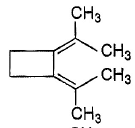
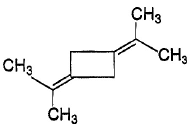
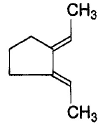
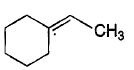
which compound below can show geometrical isomerism ?

Detailed Solution: Question 9
(a) 
We have the same arrangement if the -CHand -H are interchanged. So, no GI.
(b) 
Also in this compound we will get same arrangement across double bond if the positions of both -CH3 are interchanged around  a single bond
(c) 
Same case here as in the above two.
(d) 
Here, if we interchange -CH3 and -H around a double bond, then we will get a different arrangement with respect to other double bond. So it shows GI.

Test: Geometrical Isomerism - 1 - Question 10

Which of the following compounds will show geometrical isomerism?

[IIT JEE 1998]

Detailed Solution: Question 10

1. 2-butene

  • Conditions for geometrical isomerism:
    • A double bond must have restricted rotation.
    • The two carbons involved in the double bond must have different groups attached.
  • In 2-butene, both double-bonded carbons have different groups (CH3\text{CH}_3CH3​ and H\text{H}H), allowing cis-trans isomerism.
  • Conclusion: Geometrical isomerism is possible.

97 videos|243 docs|71 tests
Information about Test: Geometrical Isomerism - 1 Page
In this test you can find the Exam questions for Test: Geometrical Isomerism - 1 solved & explained in the simplest way possible. Besides giving Questions and answers for Test: Geometrical Isomerism - 1, EduRev gives you an ample number of Online tests for practice
97 videos|243 docs|71 tests
Download as PDF