Electronics and Communication Engineering (ECE) Exam  >  Electronics and Communication Engineering (ECE) Test  >  Digital Signal Processing  >  Test: LTI System Frequency Characteristics - Electronics and Communication Engineering (ECE) MCQ

LTI System Frequency Characteristics - Free MCQ Practice Test with solutions,


MCQ Practice Test & Solutions: Test: LTI System Frequency Characteristics (10 Questions)

You can prepare effectively for Electronics and Communication Engineering (ECE) Digital Signal Processing with this dedicated MCQ Practice Test (available with solutions) on the important topic of "Test: LTI System Frequency Characteristics". These 10 questions have been designed by the experts with the latest curriculum of Electronics and Communication Engineering (ECE) 2026, to help you master the concept.

Test Highlights:

  • - Format: Multiple Choice Questions (MCQ)
  • - Duration: 10 minutes
  • - Number of Questions: 10

Sign up on EduRev for free to attempt this test and track your preparation progress.

Test: LTI System Frequency Characteristics - Question 1

 If x(n)=Aejωn is the input of an LTI system and h(n) is the response of the system, then what is the output y(n) of the system? 

Detailed Solution: Question 1
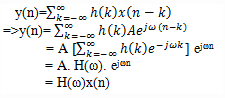
Explanation: If x(n)= Aejωn is the input and h(n) is the response o the system, then we know that

Test: LTI System Frequency Characteristics - Question 2

 If the system gives an output y(n)=H(ω)x(n) with x(n)= Aejωnas input signal, then x(n) is said to be Eigen function of the system.

Detailed Solution: Question 2

Explanation: An Eigen function of a system is an input signal that produces an output that differs from the input by a constant multiplicative factor known as Eigen value of the system.

Test: LTI System Frequency Characteristics - Question 3

What is the output sequence of the system with impulse response h(n)=(1/2)nu(n) when the input of the system is the complex exponential sequence x(n)=Aejnπ/2?
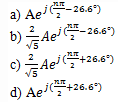
Detailed Solution: Question 3
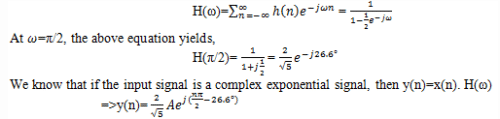
Explanation: First we evaluate the Fourier transform of the impulse response of the system h(n)

Test: LTI System Frequency Characteristics - Question 4

 If the Eigen function of an LTI system is x(n)= Aejnπ and the impulse response of the system is h(n)=(1/2)nu(n), then what is the Eigen value of the system? 

Detailed Solution: Question 4
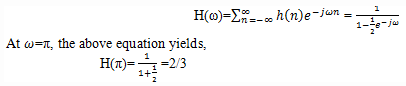
Explanation: First we evaluate the Fourier transform of the impulse response of the system h(n)

If the input signal is a complex exponential signal, then the input is known as Eigen function and H(ω) is called the Eigen value of the system. So, the Eigen value of the system mentioned above is 2/3.

Test: LTI System Frequency Characteristics - Question 5

If h(n) is the real valued impulse response sequence of an LTI system, then what is the imaginary part of Fourier transform of the impulse response?

Detailed Solution: Question 5

Explanation: From the definition of H(ω), we have

Test: LTI System Frequency Characteristics - Question 6

 If h(n) is the real valued impulse response sequence of an LTI system, then what is the phase of H(ω) in terms of HR(ω) and HI(ω)?

Detailed Solution: Question 6

Explanation: If h(n) is the real valued impulse response sequence of an LTI system, then H(ω) can be represented as HR(ω)+j HI(ω).
=>

Test: LTI System Frequency Characteristics - Question 7

What is the magnitude of H(ω) for the three point moving average system whose output is given by y(n)=1/3[x(n+1)+x(n)+x(n-1)]?

Detailed Solution: Question 7
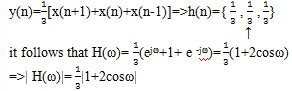
Explanation: For a three point moving average system, we can define the output of the system as

Test: LTI System Frequency Characteristics - Question 8

What is the magnitude of the frequency response of the system described by the difference equation y(n)=ay(n-1)+bx(n), 0<a<1?

Detailed Solution: Question 8
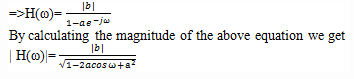
Explanation: Given y(n)=ay(n-1)+bx(n)

Test: LTI System Frequency Characteristics - Question 9

If an LTI system is described by the difference equation y(n)=ay(n-1)+bx(n), 0 < a < 1, then what is the parameter ‘b’ so that the maximum value of | H(ω)| is unity?

Detailed Solution: Question 9
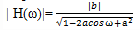
Explanation: We know that,

Since the parameter ‘a’ is positive, the denominator of | H(ω)| becomes minimum at ω=0. So, | H(ω)| attains its maximum value at ω=0. At this frequency we have,
(|b|)/(1-a) =1 =>b=±(1-a).

Test: LTI System Frequency Characteristics - Question 10

 If an LTI system is described by the difference equation y(n)=ay(n-1)+bx(n), 0

Detailed Solution: Question 10
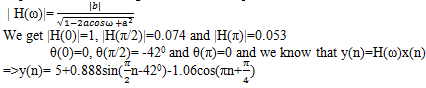
Explanation: From the given difference equation, we obtain

3 videos|75 docs|54 tests
Information about Test: LTI System Frequency Characteristics Page
In this test you can find the Exam questions for Test: LTI System Frequency Characteristics solved & explained in the simplest way possible. Besides giving Questions and answers for Test: LTI System Frequency Characteristics, EduRev gives you an ample number of Online tests for practice
3 videos|75 docs|54 tests
Download as PDF