CBSE Class 5  >  Class 5 Test  >  Mathematics  >  Test: Ratio and Proportion - Class 5 MCQ

Ratio and Proportion - Free MCQ Practice Test with solutions, Class 5 Mathematics


MCQ Practice Test & Solutions: Test: Ratio and Proportion (10 Questions)

You can prepare effectively for Class 5 Mathematics for Class 5 with this dedicated MCQ Practice Test (available with solutions) on the important topic of "Test: Ratio and Proportion". These 10 questions have been designed by the experts with the latest curriculum of Class 5 2026, to help you master the concept.

Test Highlights:

  • - Format: Multiple Choice Questions (MCQ)
  • - Duration: 15 minutes
  • - Number of Questions: 10

Sign up on EduRev for free to attempt this test and track your preparation progress.

Test: Ratio and Proportion - Question 1

A ratio equivalent to 3 : 7 is:

Detailed Solution: Question 1

A ratio equivalent to 3 : 7 is:
To find a ratio equivalent to 3 : 7, we need to find a pair of numbers that have the same ratio when simplified. Let's try the options:

(i) 3 : 9 → This simplifies to 1 : 3, not the same as 3 : 7
(ii) 6 : 10 → This simplifies to 3 : 5, not the same as 3 : 7
(iii) 9 : 21 → This simplifies to 3 : 7, which is the same as 3 : 7, so the answer is (iii).

Test: Ratio and Proportion - Question 2

The ratio 35 : 84 in simplest form is:

Detailed Solution: Question 2

The ratio 35 : 84 in simplest form is:
To simplify the ratio 35 : 84, we need to find the greatest common divisor (GCD) of 35 and 84, and then divide both numbers by this common divisor. Let's calculate:

GCD of 35 and 84 is 7.
Divide both numbers by 7: 35 ÷ 7 = 5, 84 ÷ 7 = 12.
So, the simplified ratio is 5 : 12, which corresponds to option (c).

Test: Ratio and Proportion - Question 3

In a class there are 20 boys and 15 girls. The ratio of boys to girls is:

Detailed Solution: Question 3

In a class there are 20 boys and 15 girls. The ratio of boys to girls is:
To find the ratio of boys to girls, we simply put the number of boys first, followed by the number of girls. So, it's 20 : 15. However, to simplify the ratio, we can find the greatest common divisor (GCD) of 20 and 15 and divide both numbers by it:

GCD of 20 and 15 is 5.
Divide both numbers by 5: 20 ÷ 5 = 4, 15 ÷ 5 = 3.
So, the simplified ratio is 4 : 3, which corresponds to option (a).

Test: Ratio and Proportion - Question 4

Two numbers are in the ratio 7 : 9. If the sum of the numbers is 112, then the larger number is:

Detailed Solution: Question 4

Two numbers are in the ratio 7 : 9. If the sum of the numbers is 112, then the larger number is:

First, let's find the total parts in the ratio (7 + 9 = 16 parts).
Since the sum of the numbers is 112 and there are 16 parts in total, each part represents 
112/16=7
So, the larger number (which has 9 parts) is 
9x7=63
Therefore, the answer is (c) 63.

Test: Ratio and Proportion - Question 5

The ratio of 1.5 m to 10 cm is:

Detailed Solution: Question 5

The ratio of 1.5 m to 10 cm is:

  • To compare lengths, we should convert both lengths to the same unit. Let's convert 1.5 m to cm (since 1 m = 100 cm).
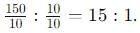
  • 1.5m=1.5 x 100 cm =150 cm
  • 1.5m=1.5x100cm =150cm.
  • Now we have 150 cm to 10 cm. The ratio is 150:10
  • To simplify, divide both by their greatest common divisor, which is 10.
  • So, the ratio is 15 : 1, which corresponds to option (d).

Test: Ratio and Proportion - Question 6

The ratio of 1 hour to 300 seconds is:

Detailed Solution: Question 6

The ratio of 1 hour to 300 seconds is:

  • To compare time, we should convert both times to the same unit. Let's convert 1 hour to seconds (since 1 hour = 3600 seconds).
  • 1 hour = 1 × 3600 seconds = 3600 seconds
  • Now we have 3600 seconds to 300 seconds. The ratio is  3600 : 300.
  • To simplify, divide both by their greatest common divisor, which is 300.
  • So, the ratio is 12 : 1, which corresponds to option (b).

Test: Ratio and Proportion - Question 7

In 4 : 7 : : 16 : 28, 7 and 16 are called

Detailed Solution: Question 7

In 4 : 7 : : 16 : 28, 7 and 16 are called:

  • In a proportion, the first and last terms are called the "extreme terms," and the middle terms are called the "middle terms."
  • Here, 4 and 28 are the extreme terms, and 7 and 16 are the middle terms.
  • So, the answer is (b) middle terms.

Test: Ratio and Proportion - Question 8

The first, second and fourth terms of a proportion are 16, 24 and 54 respectively. Then the third term is:

Detailed Solution: Question 8
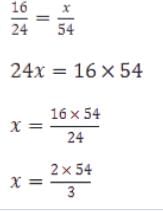
First, second, fourth term are in proportion. The third term will also be in proportion.

First : Second::Third : Fourth

First term =16

Second term =24

Fourth term =54

Third term = x

x = 2 × 18

x = 36

Test: Ratio and Proportion - Question 9

If 12, 21, 72, 126 are in proportion, then:

Detailed Solution: Question 9

If 12, 21, 72, 126 are in proportion, then:

In a proportion, the product of the first and fourth terms is equal to the product of the second and third terms.
So, let's check each option:
(i) 12×21=72×126 → This is not true.
(ii) 12×72=21×126 → This is not true.
(iii) 12×126=21×72 → This is true.
(iv) None of these → We already found a true statement in option (c).

Test: Ratio and Proportion - Question 10

If x, y and z are in proportion, then:

Detailed Solution: Question 10

Three numbers are said to be in continued proportion when the first to second ratio equals the second to third ratio, i.e. x : y = y : z.
In the form of proportion, it can be written as x : y :: y : z

The equality x : y = y : z can be rewritten in product form as x·z = y2.

Therefore the only option that expresses this relation is the one which corresponds to x : y :: y : z,
So Option B is the correct choice.

76 videos|469 docs|47 tests
Information about Test: Ratio and Proportion Page
In this test you can find the Exam questions for Test: Ratio and Proportion solved & explained in the simplest way possible. Besides giving Questions and answers for Test: Ratio and Proportion, EduRev gives you an ample number of Online tests for practice
76 videos|469 docs|47 tests
Download as PDF