NEET PG Exam  >  NEET PG Tests  >  Test: Rheumatic Heart Disease - NEET PG MCQ

Test: Rheumatic Heart Disease - NEET PG MCQ


Test Description

10 Questions MCQ Test - Test: Rheumatic Heart Disease

Test: Rheumatic Heart Disease for NEET PG 2025 is part of NEET PG preparation. The Test: Rheumatic Heart Disease questions and answers have been prepared according to the NEET PG exam syllabus.The Test: Rheumatic Heart Disease MCQs are made for NEET PG 2025 Exam. Find important definitions, questions, notes, meanings, examples, exercises, MCQs and online tests for Test: Rheumatic Heart Disease below.
Solutions of Test: Rheumatic Heart Disease questions in English are available as part of our course for NEET PG & Test: Rheumatic Heart Disease solutions in Hindi for NEET PG course. Download more important topics, notes, lectures and mock test series for NEET PG Exam by signing up for free. Attempt Test: Rheumatic Heart Disease | 10 questions in 10 minutes | Mock test for NEET PG preparation | Free important questions MCQ to study for NEET PG Exam | Download free PDF with solutions
Test: Rheumatic Heart Disease - Question 1

Which of the following drugs is recommended for refractory Sydenham's chorea? (Recent Pattern 2018)

Detailed Solution for Test: Rheumatic Heart Disease - Question 1

Milder cases of Sydenham's chorea are managed by providing a calm environment.
In severe chorea carbamazepine or sodium valproate is preferred to haloperidol. Response takes 1-2 weeks to develop.
However for severe and refractory cases of chorea, corticosteroids are effective and lead to rapid symptom reduction. If all of these fail, IVIG is used.

Test: Rheumatic Heart Disease - Question 2

The mechanism of autoimmunity in rheumatic fever is?  (APPG 2016)

Detailed Solution for Test: Rheumatic Heart Disease - Question 2

The hallmark of the pathogenesis of rheumatic fever is Molecular mimicry where the streptococcal group A carbohydrate epitope, N acetyl glucosamine, and the α-helical coiled-coil streptococcal M protein structurally mimic cardiac myosin in the human disease.

Test: Rheumatic Heart Disease - Question 3

Carey comb murmur is seen in? (Bihar PG 15)

Detailed Solution for Test: Rheumatic Heart Disease - Question 3

A short, mid diastolic murmur is rarely heard during an episode of acute rheumatic fever (Carey-Coombs murmur) and probably is due to flow through an edematous mitral valve. An opening snap is not present in the acute phase, and the murmur dissipates with resolution of the acute attack.

Test: Rheumatic Heart Disease - Question 4

Aschoff's nodules are seen in? (Bihar PG 15)

Detailed Solution for Test: Rheumatic Heart Disease - Question 4
  • During acute RF, Aschoff bodies and are pathognomonic for RF
  • Aschoff bodies consist of a central zone of degenerating, hyper-eosinophilic extracellular matrix infiltrated by lymphocytes (primarily T cells), occasional plasma cells, and plump activated macrophages called Anitschkow cells,
  • The Anitschkow cells have abundant cytoplasm and central nuclei with chromatin arrayed in a slender, wavy ribbon (Caterpillar cells)
  • Valve involvement results in fibrinoid necrosis along the lines of closure forming 1- to 2-mm vegetations (verrucae) that have little effect on cardiac function. These irregular, warty projections probably arise from the precipitation of fibrin at sites of erosion caused by underlying inflammation and collagen degeneration.
Test: Rheumatic Heart Disease - Question 5

In cases of streptococcal pharyngitis how early should the treatment be initiated to effectively prevent rheumatic fever? (JIPMER Nov 2014)

Detailed Solution for Test: Rheumatic Heart Disease - Question 5
  • In case a course of penicillin is commenced within 9 days of sore throat onset, it will prevent almost all cases of ARF.
  • Primary prevention for ARF remains primary prophylaxis (i.e, the timely and complete treatment of group A streptococcal sore throat with antibiotics).
Test: Rheumatic Heart Disease - Question 6

Not common in RHD? (AIIMS Nov. 14)

Detailed Solution for Test: Rheumatic Heart Disease - Question 6

The functional consequence of RHD is valvular stenosis and regurgitation (stenosis tends to predominate). RHD is overwhelmingly the most frequent cause of mitral stenosis accounting for 99% of cases. The mitral valve alone is involved in 70% of cases of RHD, with combined mitral and aortic disease in another 25%; the tricuspid valve is usually less frequently and less severely involved, and the pulmonic valve almost always escapes injury.

Test: Rheumatic Heart Disease - Question 7

A patient presents with syncope, dyspnea & angina, what is the possible diagnosis? (AIIMS Nov. 14)

Detailed Solution for Test: Rheumatic Heart Disease - Question 7

Aortic stenosis presents with

  • Insidious progression of fatigue and dyspnea associated with gradual curtailment of activities.
  • Dyspnea results primarily from elevation of the pulmonary capillary pressure caused by elevations of LV diastolic pressures secondary to reduced left ventricular compliance and impaired relaxation.
  • Angina pectoris usually develops somewhat later and reflects an imbalance between the augmented myocardial oxygen requirements and reduced oxygen availability.
  • Exertional syncope may result from a decline in arterial pressure caused by vasodilation in the exercising muscles and inadequate vasoconstriction in non-exercising muscles in the face of a fixed CO, or from a sudden fall in CO produced by an arrhythmia.
  • Because the CO at rest is usually well maintained until late in the course, marked fatigability, weakness, peripheral cyanosis, cachexia, and other clinical manifestations of a low CO are usually not prominent until this stage is reached. Orthopnea, paroxysmal nocturnal dyspnea, and pulmonary edema, i.e., symptoms of LV failure, also occur only in the advanced stages of the disease.
  • Severe pulmonary hypertension leading to RV failure and systemic venous hypertension, hepatomegaly, AF, and TR are usually late findings in patients with isolated severe AS.
Test: Rheumatic Heart Disease - Question 8

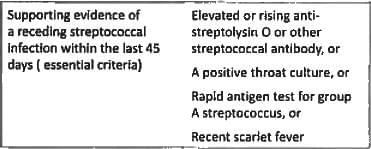
A girl presents with Syndenham's chorea. Which is the best test to prove recent infection? (AlIMS Nov. 14)

Detailed Solution for Test: Rheumatic Heart Disease - Question 8

Test: Rheumatic Heart Disease - Question 9

Sequel of rheumatic heart disease in a 5-year-old child is? (Recent Pattern 2014-15)

Detailed Solution for Test: Rheumatic Heart Disease - Question 9
  • In rheumatic heart disease, the damage to chordate tendinae by inflammatory Aschoff nodules results in development of mitral regurgitation in pediatric presentation.
  • The most common valve involvement > 18 years of age is mitral stenosis
  • Remember that pulmonic valve is not involved in rheumatic etiology.
Test: Rheumatic Heart Disease - Question 10

A patient has got a history of hypersensitivity to penicillin. What is the drug that can be used for rheumatic fever prophylaxis in such a patient. (AIIMS May 2013)

Detailed Solution for Test: Rheumatic Heart Disease - Question 10

Secondary Prophylaxis for Rheumatic Fever
Macrotide or azalide antibiotic (for patients allergic to penicillin and Sulfadiazine)

  • In a patient allergic to penicillin, sulfadiazine is the next consideration for prophylaxis.
    • In a pt weighing 27 kg or less - 0.5 g PO/day
    • In a pt weighing 27 kg or less -1 g PO/day
  • Macrolide (Erythromycin/clarithromycin) is considered in a patient allergic to both Penicillin and sulfadiazine.

Bacterial Endocarditis
The AHA no longer recommends prophylaxis for infective endocarditis in most patients with rheumatic heart disease. The exceptions are:

  • Patients with prosthetic valves or valves repaired with prosthetic material,
  • Patients with previous endocarditis or specific forms of congenital heart disease, and
  • Cardiac transplant recipients who develop cardiac valvulopathy.
Information about Test: Rheumatic Heart Disease Page
In this test you can find the Exam questions for Test: Rheumatic Heart Disease solved & explained in the simplest way possible. Besides giving Questions and answers for Test: Rheumatic Heart Disease, EduRev gives you an ample number of Online tests for practice
Download as PDF