
GATE Civil Engineering (CE) 2027 Test: Transportation Engineering- 1 Free
MCQ Practice Test & Solutions: Test: Transportation Engineering- 1 (10 Questions)
You can prepare effectively for Civil Engineering (CE) GATE Civil Engineering (CE) 2027 Mock Test Series with this dedicated MCQ Practice Test (available with solutions) on the important topic of "Test: Transportation Engineering- 1". These 10 questions have been designed by the experts with the latest curriculum of Civil Engineering (CE) 2026, to help you master the concept.
Test Highlights:
- - Format: Multiple Choice Questions (MCQ)
- - Duration: 30 minutes
- - Number of Questions: 10
Sign up on EduRev for free to attempt this test and track your preparation progress.

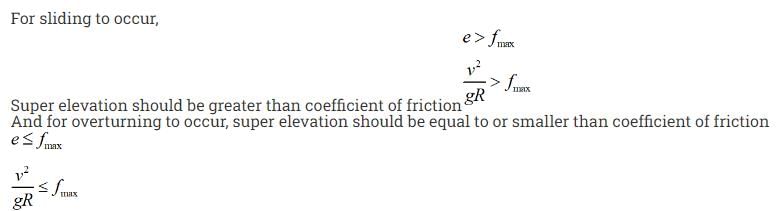
A super-elevation e is provided on a circular horizontal curve such that a vehicle can be stopped on the curve without sliding. Assuming a design speed v and maximum coefficient of side friction fmax, which one of the following criteria should be satisfied?
Detailed Solution: Question 1
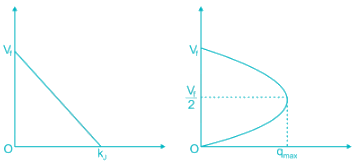
Which of the following statements CANNOT be used to describe free-flow speed (uf) of a traffic stream?
Detailed Solution: Question 2

The safety within a roundabout and the efficiency of a roundabout can be increased respectively by
Detailed Solution: Question 3
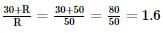
While aligning a hill road with a ruling gradient of 6%, a horizontal curve of radius 50 m is encountered. The grade compensation (in percentage up two equal places) to be provided for this case would be _______
Detailed Solution: Question 4

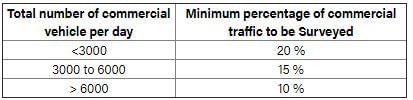
If the total number of commercial vehicles per day ranges from 3000 to 6000, the minimum percentage of commercial traffic to be surveyed for axle load is:
Detailed Solution: Question 5
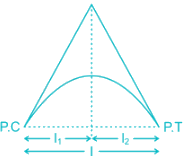
The VPI (vertical point of intersection) is 100 m away (when measured along the horizontal) from the VPC (vertical point of curvature). If the vertical curve is parabolic the length of the curve (in meters and measured along the horizontal) is ________
Detailed Solution: Question 6
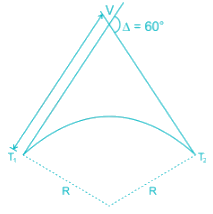
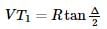
A circular curve of radius R connects two straights with a deflection angle of 60°. The tangent length is
Detailed Solution: Question 7
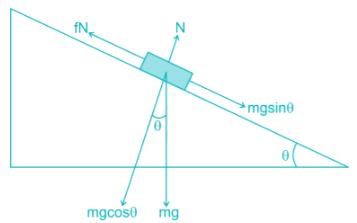
On a circular curve, the rate of super-elevation is e. While negotiating the curve a vehicle comes to a stop. It is seen that the stopped vehicle does not slide inwards (in the radial direction). The coefficient of side friction is f. Which of the following is true:
Detailed Solution: Question 8
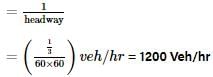
In a one-lane one-way homogeneous traffic stream, the observed average headway is 3.0 s. The flow (expressed in vehicles/hr) in this traffic stream is________
Detailed Solution: Question 9
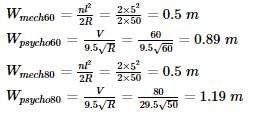
A two-lane, one-way road with a radius of 50 m is predominantly carrying lorries with a wheelbase of 5 m. The speed of lorries is restricted to be between 60 kmph and 80 kmph. The mechanical widening and psychological widening required at 60 kmph are designated as wme,60 and wps,60, respectively. The mechanical widening and psychological widening required at 80 kmph are designated as wme,80 and wps,80, respectively. The correct values of wme,60, wps,60, wme,80, wps,80, respectively are
Detailed Solution: Question 10
33 docs|280 tests |
