
Zero Order & First Reactions - NEET Free MCQ Test with solutions
MCQ Practice Test & Solutions: Test: Zero Order & First Order Reactions (30 Questions)
You can prepare effectively for NEET Topic-wise MCQ Tests for NEET with this dedicated MCQ Practice Test (available with solutions) on the important topic of "Test: Zero Order & First Order Reactions". These 30 questions have been designed by the experts with the latest curriculum of NEET 2026, to help you master the concept.
Test Highlights:
- - Format: Multiple Choice Questions (MCQ)
- - Duration: 45 minutes
- - Number of Questions: 30
Sign up on EduRev for free to attempt this test and track your preparation progress.

Direction (Q. Nos. 1-21) This section contains 21 multiple choice questions. Each question has four choices (a), (b), (c) and (d), out of which ONLY ONE is correct.
Q. For zeroth order reaction,
A → B
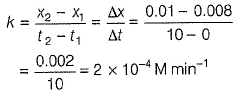
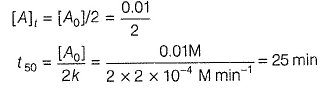
[A]0 = 0.01 M, [A]t = 0.008Matter 10 min.
Thus, half-life is
Detailed Solution: Question 1
A Certain Zeroth Order reaction has k = 0.025 Ms-1 for the disappearance of A. What will be the concentration of A after 15s, if the intial concentration is 0.50 M?
Detailed Solution: Question 2
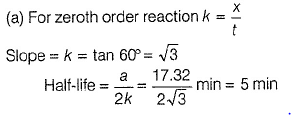
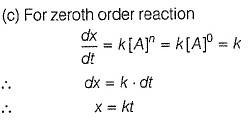 x(product) formed after 15 s
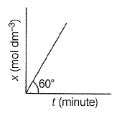
For Zeroth Order Reaction, variation of x with time is shown as
Q. At initial concenration of the reactant as 17.32 min dm-1 , half - life period is
Detailed Solution: Question 3
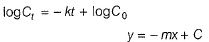
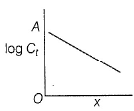
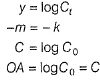
For the first order reaction, rate constant k is given by
kt = logC0 - log Ct
where, C0 is the intial concenration and Ct is the concentration at time t. Graph between log Ct and time t is
Detailed Solution: Question 4
In a first order reaction, the concentration of the reactant decreases from 0.8 M to 0.4 M is 15 min. The time taken for the concentration to change from 0.1 M to 0.025 M is
Detailed Solution: Question 5
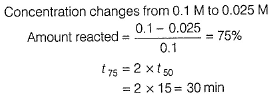
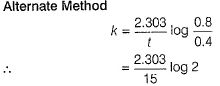
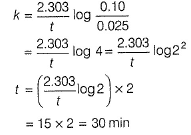
For the First order reaction, concentration of the reactant after two averagelives is reduced to
Detailed Solution: Question 6
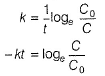
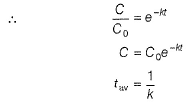

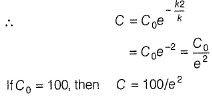
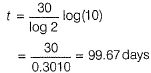
The half-life period of a first order chemical reaction is 6.93 min. The time required for the completion of 99% of the chemical reaction will be (log2 = 0.3010)
[AIEEE 2009]
Detailed Solution: Question 7
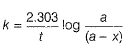

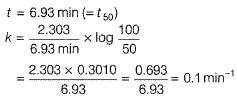

For the first order reaction,
A → Product
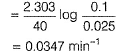
Q. The concentration of A changes from 0.1 M to 0.025 M in 40 min. The rate of the reaction when the concentration of A is 0.01 M is
[AIEEE 2012]
Detailed Solution: Question 8
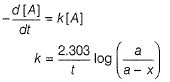

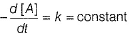
For the reaction,
A → Products, 
Concentration of A at different time intervals are given :
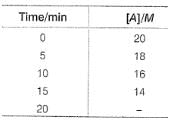
At 20 min, rate will be
Detailed Solution: Question 9

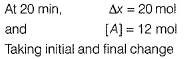
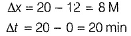

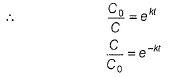
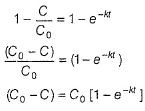
For the first order reaction with, C0 as the initial concentration and C at time t, (C0 - C) =
Detailed Solution: Question 10
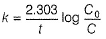
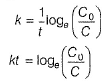
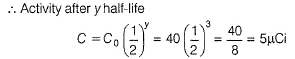
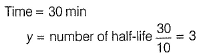
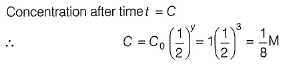
The radioisotope N-13 which has a half-life of 10 min is used to image organs in the body. If the injected sample has an activity of 40 μCi (microcurie), what is the activity after 30 min?
Detailed Solution: Question 11

The following data were obtained during the first order decomposition of
2A(g) → B(g) + C(s)
at constant volume and at a particular temperature :
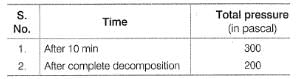
Thus, rate constant is
Detailed Solution: Question 12

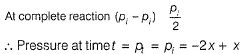




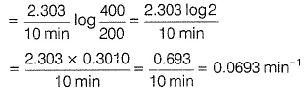
A G .M. Counter is used to study the process of first order of radioactive disintegration. In the absence of radioactive substance A, it counts 3 dps (disintegration per second). When A is placed in G.M Counter it records 23 dps at the start and 13 dps after 10 min. It records x dps after next 10 min. Half-life period of A is y min. Thus, x and y are
Detailed Solution: Question 13
Inversion of sucrose (C12H22O11) is a first order reaction and is studied by measuring angle of rotation at different interval of time

r0 = angle of rotation at the start, rt = angle of rotation at time t
r∞ = angle of rotation at the complete reaction
There is 50% inversion, when
r∞ = angle of rotation at the complete reaction
Detailed Solution: Question 14

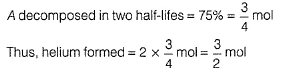
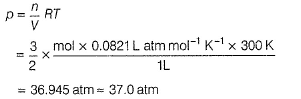
Following radioactive disintegration follows first order kinetics :

Starting with 1 mol of A in a 1L flask at 300 K, pressure set up after two half-lifes is approximately
Detailed Solution: Question 15
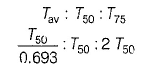
For the first order reaction Tav (average life), T50 (half-life) and T75 (time 75% reaction) are in the ratio of
Detailed Solution: Question 16



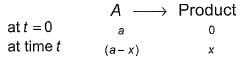
For the first order reaction,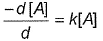
Following equations are given :
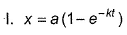
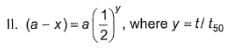
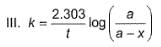
Select the correct equations.
Following equations are given :
Detailed Solution: Question 17

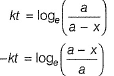
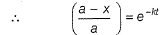

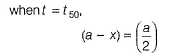

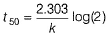

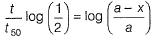

Rate constant of a first order reaction (A → B) is 0.0693 min-1. If initial concentration is 1.0 M, rate after 30 min is
Detailed Solution: Question 18
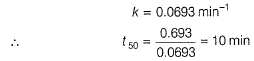

Following reaction is pseudo-unimolecular w.r.t. C6H5N2CI (A)

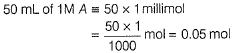
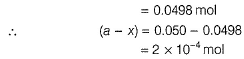
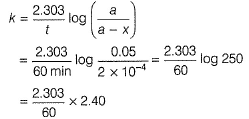
50 mL of 1M benzene diazonium chloride (A) is taken. After 1 h, 1.226 L of N2 gas at 1 atm and 300 K is obtained. Thus, half-life of the reaction is (log 250 = 2.40)
Detailed Solution: Question 19




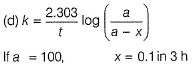
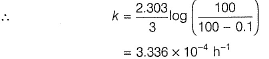
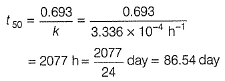
Minimum half-life of an isotope needed so that not more than 0.1 % of the nuclei undergo decay during a 3.0 h laboratory experiment is
Detailed Solution: Question 20
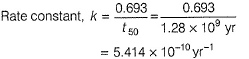
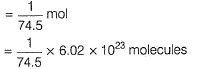
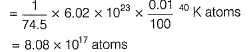
Naturally occurring potassium consists of 0.01% at 40 K which has a half-life of 1.28 x 10⁹ yr. Activity of 1.00 g sample of KCl is
Detailed Solution: Question 21

Direction (Q. Nos. 22-27) This section contains a passage describing theory, experiments, data, etc. Two questions related to the paragraph have been given. Each question has only one correct answer out of the given 4 options (a), (b), (c) and (d).
Passage l
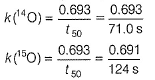
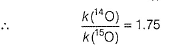
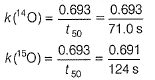
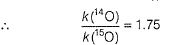
Isotope of oxygen with mass number less than 16 undergoes β+ -emission. Assume an equimolar mixture of 14O and 15O, Also t50 (14O) = 71s, t50 (15O) = 124s.
Q. Ratio of rate constants of 14O to 15O is
Detailed Solution: Question 22


Passage l
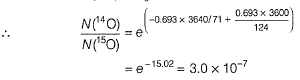
Isotope of oxygen with mass number less than 16 undergoes β+ -emission. Assume an equimolar mixture of 14O and 15O, Also t50 (14O) = 71s, t50 (15O) = 124s.
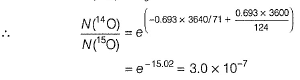
Q. Ratio of 14O to 15O left after 1.00 h is
Detailed Solution: Question 23


Passage II
Consider acid-hydrolysis of ester which is first order reaction.
CH3COOC2H5 + H2O  CH3COOH + C2H5OH
Kinetics is studied by titration of the acid with NaOH at a given time.
V0 = Volume of NaOH at start, Vt = Volume of NaOH at time t, V∞ = Volume of NaOH at the end of the complete hydrolysis.
Q.
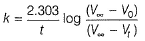
Rate constant k is given by
CH3COOH + C2H5OHV0 = Volume of NaOH at start, Vt = Volume of NaOH at time t, V∞ = Volume of NaOH at the end of the complete hydrolysis.
Rate constant k is given by
Detailed Solution: Question 24









Passage II
Consider acid-hydrolysis of ester which is first order reaction.
CH3COOC2H5 + H2O CH3COOH + C2H5OH
Kinetics is studied by titration of the acid with NaOH at a given time.
V0 = Volume of NaOH at start, Vt = Volume of NaOH at time t, V∞ = Volume of NaOH at the end of the complete hydrolysis.
Q.
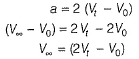
If ester is 50% hydrolysed, then
CH3COOH + C2H5OHV0 = Volume of NaOH at start, Vt = Volume of NaOH at time t, V∞ = Volume of NaOH at the end of the complete hydrolysis.
Detailed Solution: Question 25
Passage III
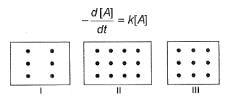
I, II and III are three vessels of equal volumes containing molecules of A as shown and in each A decomposes into products.
Q.
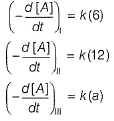
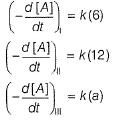
Initial rate of decomposition of A will be in order in these three vessels as
Initial rate of decomposition of A will be in order in these three vessels as
Detailed Solution: Question 26
Passage III
I, II and III are three vessels of equal volumes containing molecules of A as shown and in each A decomposes into products.
Q.
Time of 50% decomposition is in order
Time of 50% decomposition is in order
Detailed Solution: Question 27
Direction (Q. Nos. 28-30) This section contains 3 questions. When worked out will result in one integer from 0 to 9 (both inclusive).This section contains 3 questions, when worked out will result in an integer value from 0 to 9 (both inclusive)
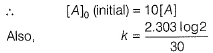
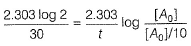
Q. A radioactive element gets spilled over the floor of a room. Its half-life period is 30 days. If the initial activity is ten times the permissible value, it will be safer to enter the room after 10n days. What is the value of n?
Detailed Solution: Question 28



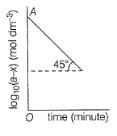
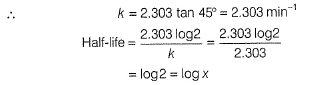
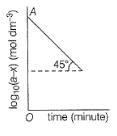
For the first order reaction, variation of log10(a - x)vs time (t) is shown below.
Q.
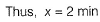
Its half-life period is logx. What is the value of x?
Its half-life period is logx. What is the value of x?
Detailed Solution: Question 29
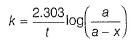
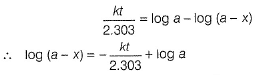

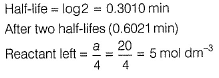
For the first order reaction,
Q.
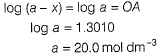
If OA = 1.3010 then reactant left after 0.6021 min i s .......unit.
If OA = 1.3010 then reactant left after 0.6021 min i s .......unit.
Detailed Solution: Question 30
6 docs|803 tests |
