JEE Exam  >  JEE Test  >  Mock Tests Main and Advanced 2026  >  JEE Main Chemistry Test- 1 - JEE MCQ

JEE Main Chemistry Test- 1 Free Online Test 2026


MCQ Practice Test & Solutions: JEE Main Chemistry Test- 1 (25 Questions)

You can prepare effectively for JEE Mock Tests for JEE Main and Advanced 2026 with this dedicated MCQ Practice Test (available with solutions) on the important topic of "JEE Main Chemistry Test- 1". These 25 questions have been designed by the experts with the latest curriculum of JEE 2026, to help you master the concept.

Test Highlights:

  • - Format: Multiple Choice Questions (MCQ)
  • - Duration: 60 minutes
  • - Number of Questions: 25

Sign up on EduRev for free to attempt this test and track your preparation progress.

JEE Main Chemistry Test- 1 - Question 1

 20 g of an ideal gas contains only atoms of S and O occupies 5.6 L at NPT. What is the mol. wt. of gas ?

Detailed Solution: Question 1

Given,
Mass of gas = 20 g
Pressure of gas = 1 atm
Volume of gas = 5.6 L
Temperature of gas = 273 K
Using ideal gas law,

where,
P = pressure of the gas
V = volume of the gas
T = temperature of the gas
n = number of moles of the gas
R = gas constant = 0.0821
Latm/moleK
M = molar mass of gas
w = mass of gas
Now put all the given values in the formula, we get
Therefore, the molar mass of the gas is, 80.0475 g/mole

JEE Main Chemistry Test- 1 - Question 2

5.6 litres of a gas at N.T.P. are found to have a mass of 11 g. The molecular mass of the gas is

Detailed Solution: Question 2

1 mole or molecular mass of the gas has volume 22.4 L
Given that:
11g of gas has volume 5.6 L

So molecular mass = (11/5.6)×22.4 = 44 u

JEE Main Chemistry Test- 1 - Question 3

A crystalline salt Na2SO4.xH2O on heating losses 55.9 per cent of its mass. The formula of crystalline salt is---

Detailed Solution: Question 3

Na2SO4.xH2O has weight =46+32+64+18x=142+18xg
on heating it will become anhydrous so, I.e. water will be evaporated.
55.9% of(142+18x)=18x=>79.378+10.062x=18x
=>7.938x=79.378=>x~10g
so Na2SO4.10H2O and this amount of water is called
water of crystallisation.

JEE Main Chemistry Test- 1 - Question 4

Vapour density of a metal chloride is 66. Its oxide contains 53% metal. The atomic weight of the metal is

Detailed Solution: Question 4

Equivalent of metal = Equivalent of chloride

53/n = 47/8 , E = 9.02 , Atomic mass of metal = n X 9.02

Molecular mass of chloride = 2 X 66 = n X 9.02 + n X 35.5

on solving n = 3

Atomic mass of metal = 9.02 X 3 = 27.06

JEE Main Chemistry Test- 1 - Question 5

When two aqueous solutions react together to give off solid product, this reaction is known as

Detailed Solution: Question 5

Chemical reactions:precipitation. The precipitate forms because the solid (AgCl) is insoluble in water. That is true for all precipitates - the solids are insoluble in aqueous solutions. Precipitation reaction occur all around us.

JEE Main Chemistry Test- 1 - Question 6

At S.T.P. the density of CCl4 vapour in g/L will be nearest to

Detailed Solution: Question 6

Step 1: Molar Mass of CCl₄

  • Carbon (C) = 12 g/mol
  • Chlorine (Cl) = 35.5 g/mol
  • Molar mass of CCl₄ = 12 + (4 × 35.5) = 154 g/mol

Step 2: Volume at STP

  • 1 mole of gas at STP occupies 22.4 liters.

Step 3: Density Calculation

  • Density (D) = Mass/Volume
  • D = 154 g / 22.4 L ≈ 6.87 g/L

Final Answer:
The density of CCl₄ vapor at STP is approximately 6.87 g/L.

JEE Main Chemistry Test- 1 - Question 7

Which of the following transitions of electrons in the hydrogen atom will emit maximum energy?

Detailed Solution: Question 7
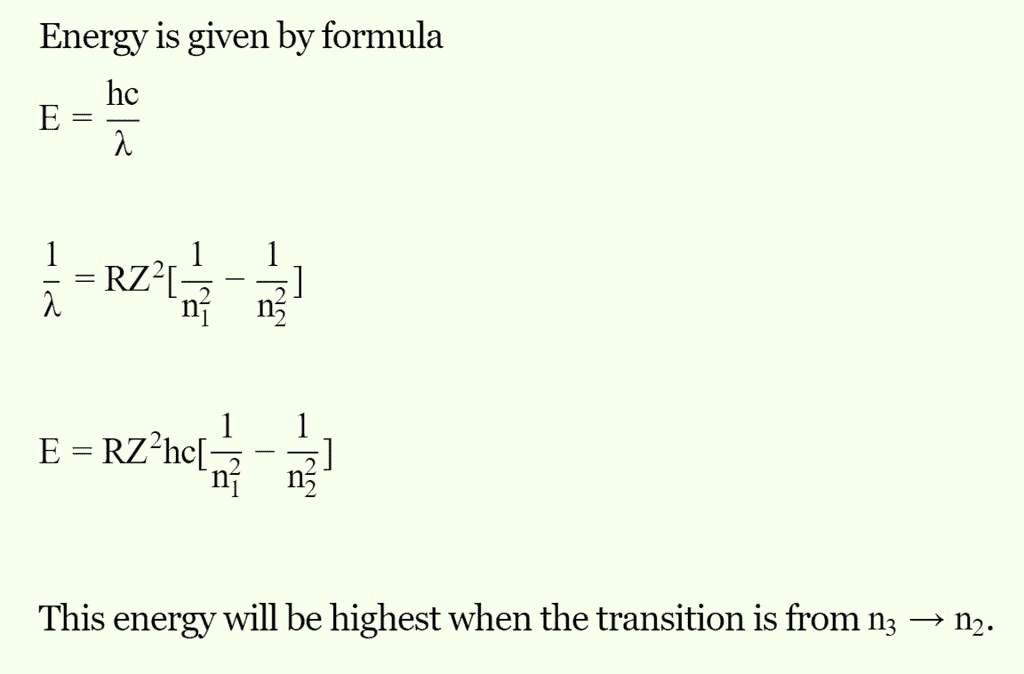
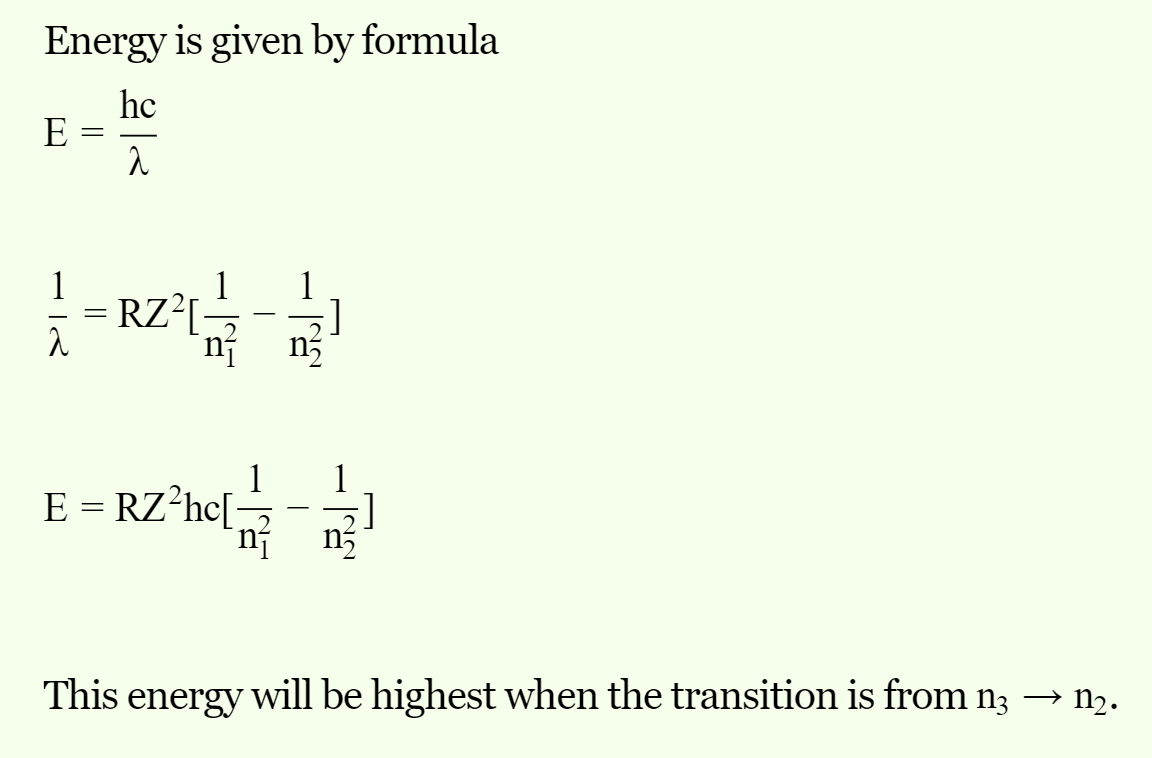
Option C is correct.

The energy emitted in an electronic transition is proportional to E = R h c [1/nf2 - 1/ni2], so the emitted energy depends on the value of 1/nf2 - 1/ni2.

For n5 → n4: 1/42 - 1/52 = 1/16 - 1/25 = 9/400 ≈ 0.02250.

For n4 → n3: 1/32 - 1/42 = 1/9 - 1/16 = 7/144 ≈ 0.04861.

For n3 → n2: 1/22 - 1/32 = 1/4 - 1/9 = 5/36 ≈ 0.13889.

Because 0.13889 is the largest of these differences, the transition in option C emits the maximum energy.

JEE Main Chemistry Test- 1 - Question 8

The uncertainty found from the uncertainty principle  (Δx.Δp = h/4 π) is

Detailed Solution: Question 8

Heisenberg uncertainty principle states that exact momentum and exact position of matter wave can't be determined simultaneously.
∆P.∆X>equal to h/4π

JEE Main Chemistry Test- 1 - Question 9

The number of atoms of hydrogen in 2 moles of NH3

Detailed Solution: Question 9

Therefore 2 moles will have 1.204*1024 molecules of NH3.

There are 3 atoms in each molecule, so 2 moles will have 3*(1.204*1024) atoms

which is 3.61 * 1024 atoms.

JEE Main Chemistry Test- 1 - Question 10

The spectrum of He is expected to be similar to that of

Detailed Solution: Question 10

The spectrum of an atom depends on the number of electrons present in it. Here, helium has two electrons, so the spectrum of Li+ (Z = 3) is similar to that of helium because both He and Li+ have two electrons.

JEE Main Chemistry Test- 1 - Question 11

The electrons present in K-shell of the atom will differ in

Detailed Solution: Question 11

The electrons present in K-shell of the atom will differ in spin quantum number as the electrons will have opposite spins.

JEE Main Chemistry Test- 1 - Question 12

Which of the following statements about quantum numbers is wrong?

Detailed Solution: Question 12

If the value of l=0, then electron lies in s-subshell which has spherical shape. So electron distribution is spherical.

Shape of orbital is given by azimuthal quantum number as it describes the subshell.

Magnetic quantum number determines the shift of atomic orbital due to external magnetic field i.e., zeeman effect.

Spin quantum number describes the spin of electron in particular orbital. Orientations of electron cloud is specified of a magnetic quantum number.

So B option is incorrect.

JEE Main Chemistry Test- 1 - Question 13

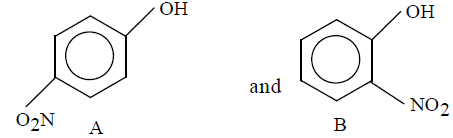
Out of the two compounds shown below, the vapour pressing of B at a particular temperature is expected to be
Detailed Solution: Question 13

Because of intramolecular hydrogen bonding in (B), i.e., ortho nitrophenol, the vapour pressure of ortho nitrophenol is expected to be higher than paranitrophenol.

Therefore, the correct option is A.

JEE Main Chemistry Test- 1 - Question 14

In which of the following molecules, the central atom does not use sP3-hybrid orbitals in its bonding ?

Detailed Solution: Question 14

In the given options, BeF3−​, Be forms three sigma bonds with three flourines.

So, hybridisation of Be becomes sp2. 

Hence, the correct answer is option A.

JEE Main Chemistry Test- 1 - Question 15

The correct increasing bond angle among  and 

Detailed Solution: Question 15

BF3​is trigonal planar which makes the angle as 120 degree.PF3​ is trigonal bipyramidal making the angle slightly less than 109 degrees ClF3​ is T-shaped making the least angle.

JEE Main Chemistry Test- 1 - Question 16

Calculated bond order in the superoxide () ion is 

Detailed Solution: Question 16

O2^- (superoxide) = 13 valence e⁻. = σs(2 e⁻) σs*(2e⁻) σp(2e⁻) πp(4e⁻) πp*(3e⁻) σp*(0) . bond order = ½[ σs(2e⁻) σp(2e⁻) πp(4 e⁻) - σs*(2e⁻) πp*(3e⁻) ]. = ½[8-5] = 1.5

JEE Main Chemistry Test- 1 - Question 17

The ionic species having largest size is

Detailed Solution: Question 17

Answer: Option C - Li+(aq)

The effective size of an ion in aqueous solution is its hydrated radius, which includes the ion plus the layer of bound water molecules around it.

Ions with smaller bare radii have higher charge density and therefore attract and orient more water molecules strongly; this leads to a larger hydrated radius compared to larger, less strongly hydrated ions.

Because Li+ has the smallest bare ionic radius (highest charge density) among the given cations, Li+(aq) is most strongly hydrated and so has the largest effective size compared with Na+(aq) and Rb+(aq).

Li+(g) is the unhydrated (gas-phase) ion and is therefore much smaller than any hydrated species.

Thus the largest species among the options is Li+(aq).

JEE Main Chemistry Test- 1 - Question 18

From which of the following species it is easiest to remove one electron ?

Detailed Solution: Question 18

Ionization energy is the energy required to remove an electron from a species. Due to the electron-electron repulsion present in negatively charged ions, it is easier to remove an electron from O- compared to a neutral atom or a positively charged ion. Na+ has a stable noble gas configuration (1s2 2s2 2p6), making it more difficult to remove an electron. Therefore, the correct answer is O- (g).

JEE Main Chemistry Test- 1 - Question 19

With respect to chlorine, hydrogen will be

Detailed Solution: Question 19

With respect to Chlorine, hydrogen will be electropositive.

Reason:

Chlorine being a strong electronegative element tends to force hydrogen to lose electron and hydrogen acquire electropositive character so that chlorine can complete its octet. 

JEE Main Chemistry Test- 1 - Question 20

Which element has the greatest tendency to lose electrons ?

Detailed Solution: Question 20

Fe has high electronegativity. it is a metal and it has proper to lose electron

*Answer can only contain numeric values
JEE Main Chemistry Test- 1 - Question 21

0.01 mole of iodoform (CHI3) reacts with Ag to produce a gas whose volume at NTP in ml is :-
2CHI3 + 6Ag —→ 6AgI(s) + C2H2(g)


Detailed Solution: Question 21

mol of C2H2 = 1/2 × mol of CHI3
= 1/2 × 0.01 = 0.005
volume at N.T.P. = 0.005 × 22400 = 112 ml

*Answer can only contain numeric values
JEE Main Chemistry Test- 1 - Question 22

Sum of σ and π bonds are present in CH3COOH?


Detailed Solution: Question 22

Single bond is σ bond and double bond contains 1σ and 1 π bond. Therefore, it contains 7 σ and 1 π bond. Hence, total is 8

*Answer can only contain numeric values
JEE Main Chemistry Test- 1 - Question 23

How many maximum electrons can be accomodate in 7th shell of element X?


Detailed Solution: Question 23
Maximum number of electron in a shell
= 2n2
= 2(7)2
= 98

*Answer can only contain numeric values
JEE Main Chemistry Test- 1 - Question 24


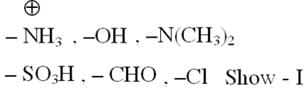
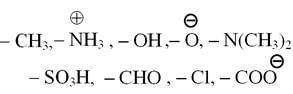
How many groups show – I effect?


Detailed Solution: Question 24

*Answer can only contain numeric values
JEE Main Chemistry Test- 1 - Question 25

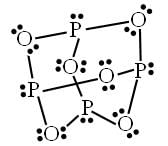
Number of lone pair present in P4O6.


Detailed Solution: Question 25

360 docs|100 tests
Information about JEE Main Chemistry Test- 1 Page
In this test you can find the Exam questions for JEE Main Chemistry Test- 1 solved & explained in the simplest way possible. Besides giving Questions and answers for JEE Main Chemistry Test- 1, EduRev gives you an ample number of Online tests for practice
Download as PDF