CBSE Class 12  >  Class 12 Test  >  Coordination Compounds - Class 12 MCQ

Coordination Compounds - Free MCQ Test with solutions for Class 12


MCQ Practice Test & Solutions: Coordination Compounds (41 Questions)

You can prepare effectively for Class 12 with this dedicated MCQ Practice Test (available with solutions) on the important topic of "Coordination Compounds ". These 41 questions have been designed by the experts with the latest curriculum of Class 12 2026, to help you master the concept.

Test Highlights:

  • - Format: Multiple Choice Questions (MCQ)
  • - Duration: 45 minutes
  • - Number of Questions: 41

Sign up on EduRev for free to attempt this test and track your preparation progress.

Coordination Compounds - Question 1

The EAN of platinum in potassium hexachloroplatinate (IV) is:        

Detailed Solution: Question 1

Effective atomic no. (EAN) = 78-4+2x6=86. 

Coordination Compounds - Question 2

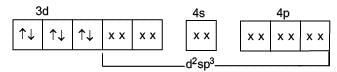
The hybridization of Fe in K4[Fe(CN)6] complex is:    

Detailed Solution: Question 2

Electronic configuration of Fe2+ in K4Fe(CN)6 is:

x x Electron pair donated by CN

Coordination Compounds - Question 3

The colour of [Ti(H2O)6]3+ is due to:    

Detailed Solution: Question 3

the d-d-excitation is responsible for colour of T i(H2O)3+6 which has one unpaired electron.

Coordination Compounds - Question 4

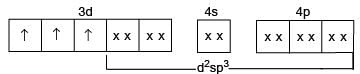
[Cr(NH3)6]3+ ion is:    

Detailed Solution: Question 4

[Cr(NH3)6]3+ has three unpaired electrons. Electronic configuration of Cr3+ in Cr(NH3)6 is:

Coordination Compounds - Question 5

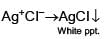
Which will give a white precipitate with AgNO3 in aqueous solution?    

Detailed Solution: Question 5

Coordination Compounds - Question 6

EDTA is a ........ligand.    

Detailed Solution: Question 6

Coordination Compounds - Question 7

The number of ions formed on dissolving one molecule of FeSO4.(NH4)2SO4.6H2O in water is:    

Detailed Solution: Question 7

It is a double salt:

Coordination Compounds - Question 8

Aqua regia reacts with Pt to yield:    

Detailed Solution: Question 8

It is a fact

Coordination Compounds - Question 9

In [Cr(NH3)4CI2]CI the ligands are:    

Detailed Solution: Question 9

Atoms or group donating electron pair to metal are ligands.

Coordination Compounds - Question 10

Which possesses tetrahedral shape (sp3 - hybridization of central atom?    

Detailed Solution: Question 10

All involves sp3 - hybridization.

Coordination Compounds - Question 11

Which of the following is p complex?    

Detailed Solution: Question 11

In π-complex, organic ligand use their π system to bond with metal, e.g., ferrocene.

Coordination Compounds - Question 12

Which complex has square planar shape & dsp2- hybridization?    

Detailed Solution: Question 12

All involve dsp2-hybrdization

Coordination Compounds - Question 13

Formula of ferrocene is:    

Detailed Solution: Question 13

Ferroc ene is cyclopentadienide iron complex.

Coordination Compounds - Question 14

The number of precipitable halide ions in [Pt(NH3)CI2Br]CI is:    

Detailed Solution: Question 14

Coordination Compounds - Question 15

Which statement about coordination number of metal ion is true?    

Detailed Solution: Question 15

The characteristics of coordination number.

Coordination Compounds - Question 16

The correct name of the compound [Cu(NH3)4](NO3)2, according to IUPAC system is:    

Detailed Solution: Question 16

Follow IUPAC rules.

Coordination Compounds - Question 17

The formula of a carbonyl complex of (CO)n CO(CO)n, in  which there is a single covalent Co-Co bond is?    

Detailed Solution: Question 17

Co shows zero oxidation state in its carbonyl  & follow EAN rule

Coordination Compounds - Question 18

Of the following complexes, the one with the largest value of the crystal field splitting is:    

Detailed Solution: Question 18

CN- ligand has strong ligand field so, value of CFSE is higher

Coordination Compounds - Question 19

The IUPAC name of [CoCI(NO2)(en)2]CI is:    

Detailed Solution: Question 19

Follow IUPAC rules.

Coordination Compounds - Question 20

In which complex is the transition metal in zero oxidation state?    

Detailed Solution: Question 20

Ni in Ni(CO)4 has zero oxidation stae.

Coordination Compounds - Question 21

Which is low spin complex?    

Detailed Solution: Question 21

Both CN- and NO2- are strong field ligands.

Coordination Compounds - Question 22

From the stability constant (hypothetical values) given below, predict which is the strongest ligand?

Detailed Solution: Question 22

Higher is the stability constant of ligand, lesser is its dissoc iation, more is its stability.

Coordination Compounds - Question 23

Which of the following complex species do not involve d2sp3-hybridization?    

Detailed Solution: Question 23

[Cr(NH3 )6 ][Co(CN)6 ] is isomer to [Co(NH3 )6 ][Cr(CN)6 ] , i.e., ligands are changed in complex anion and complex cation.

Coordination Compounds - Question 24

Which of the following compounds would exhibit coordination isomerism?    

Detailed Solution: Question 24

S-atom is donor in SCN and N-atom is donor in NCS. The linkage isomerism arises when ligand has two possibilities to attach on central atom.

Coordination Compounds - Question 25

[(C6H5)2Pd(SCN)2] and [(C6H5)2Pd(NCS)2] are:    

Detailed Solution: Question 25

Coordination Compounds - Question 26

[Cr(H2O6]CI3 (at. no. of Cr=24) has a magnetic moment of 3.83 BM. The correct distribution of 3d-electrons in the chromium of the complex:
 

Detailed Solution: Question 26

Follow IUPAC rules.

Coordination Compounds - Question 27

The hypothetical complex chloro diaquatriammine cobalt(III) chloride can be represented as:    

Detailed Solution: Question 27

Chlorodiaquatriamminecobalt(Ill) chloride can be represented as [CoCl(NH3)3(H2O)2]Cl2.

Coordination Compounds - Question 28

In the silver plating of Cu, K[Ag(CN)2] is used instead of AgNO3. The reason is:    

Detailed Solution: Question 28

Copper being more electropositive readily precipitate silver from their salt (Ag+) solution.

In K[Ag(CN)2] solution a complex anion [Ag(CN)2] is formed so Ag+ ions are less available in the solution and Cu cannot displace Ag from this complex ion.

Coordination Compounds - Question 29

The complex used as an anticancer agent is:    

Detailed Solution: Question 29

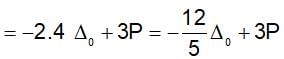
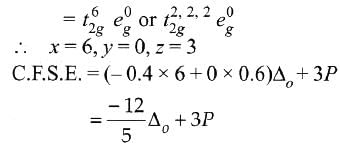
d6-cation with low spin ha selectronic congiguration t62ge0g

Total energy= (-0.4D0per e- x6)
(-0.4D0 per e- x6)

+(e- paring energy of 3 pairs)

Coordination Compounds - Question 30

Low spin complex of d6-cation in an octahedral field will have the following energy:

Detailed Solution: Question 30

where x = number of electrons occupying t2g orbital

y = number of electrons occupying eorbital

z = number of pairs of electrons

For low spin d6 complex electronic configuration

View more questions
Information about Coordination Compounds Page
In this test you can find the Exam questions for Coordination Compounds solved & explained in the simplest way possible. Besides giving Questions and answers for Coordination Compounds , EduRev gives you an ample number of Online tests for practice
Download as PDF