JEE Exam  >  JEE Test  >  Chapter-wise Tests Main & Advanced  >  Test: Introduction To Matrices - JEE MCQ

Introduction To Matrices - JEE Chapter Free MCQ Test with solutions


MCQ Practice Test & Solutions: Test: Introduction To Matrices (10 Questions)

You can prepare effectively for JEE Chapter-wise Tests for JEE Main & Advanced with this dedicated MCQ Practice Test (available with solutions) on the important topic of "Test: Introduction To Matrices". These 10 questions have been designed by the experts with the latest curriculum of JEE 2026, to help you master the concept.

Test Highlights:

  • - Format: Multiple Choice Questions (MCQ)
  • - Duration: 10 minutes
  • - Number of Questions: 10

Sign up on EduRev for free to attempt this test and track your preparation progress.

Test: Introduction To Matrices - Question 1

Which of the following is a matrix of the order 2×2 where the equation of the elements is given by aij=i+j.

Detailed Solution: Question 1

Test: Introduction To Matrices - Question 2

If the order of the matrix is m×n, then how many elements will there be in the matrix?

Detailed Solution: Question 2

The number of elements for a matrix with the order m×n is equal to mn, where m is the number of rows and n is the number of columns in the matrix.

Test: Introduction To Matrices - Question 3


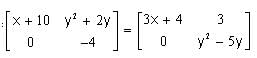
Then the value of x is ____

Detailed Solution: Question 3


= x+10 = 3x+4
= x = 3

Test: Introduction To Matrices - Question 4

The number of all possible matrices of order 2 × 2 with each entry 0 or 1 is:

Detailed Solution: Question 4

The number of possible entries of 2 × 2 matrix is 4 Every entry has two choice, 0 or 1.

Thus, the total no. of choices is,

2 × 2 × 2 × 2 = 24

= 16

Test: Introduction To Matrices - Question 5

Let A and B be two non zero square matrics and AB and BA both are defined. It means

Detailed Solution: Question 5

Given:

 A and B be two non zero square matrics

Calculations:

Matrix AB is defined means Columns is equal to the Rows of B 

and BA is defined means Columns of B is equal to the Rows of A

Hence, Both matrices (A) and (B) have same order is Correct.

Test: Introduction To Matrices - Question 6

is example of:

Detailed Solution: Question 6

A matrix having non-zero elements only in the diagonal running from the upper left to the lower right.

The given matrix is a diagonal matrix. 

Test: Introduction To Matrices - Question 7

What is the element in the 2nd row and 1st column of a 2 x 2 Matrix A = [ aij], such that a = (i + 3) (j – 1)​?

Detailed Solution: Question 7

Rows are represented by i
Columns are represented by j
... a = (i+3)(j-1)
i = 2 , j = 1    (given)
a21 = (2+3)(1-1) = 0
so, a21 = 0

Test: Introduction To Matrices - Question 8

If A is a matrix of order 3 × 5 and B is a matrix of order 5 × 3, then the order of AB and BA will respectively b

    Detailed Solution: Question 8

    Calculation:

    Given: A is a matrix of order 3 × 5 and B is a matrix of order 5 × 3

    Number of rows in A = 3

    Number of column in A = 5

    Number of rows in B = 5

    Number of column in B = 3

    The order of AB = number of row is A × number of columns in B
    = 3 × 3
    And, 
    The order of BA = number of row is B × number of columns in A
    = 5 × 5
    Hence, option (3) is correct.

    Test: Introduction To Matrices - Question 9

    Consider the following information regarding the number of men and women workers in three factories I. II and III

    What does the entry in the third row and second column represent if the information is represented as a 3 x 2 matrix?​

    Detailed Solution: Question 9

    The information is represented in the form of a 3 X 2 matrix as follows:

    The entry in the third row and second column represents the number of women workers in factory III.

    Test: Introduction To Matrices - Question 10

    If A and B are two matrices such that AB=A and BA=B, then which one of the following is correct?

    Detailed Solution: Question 10

    Let A and B be two matrices such that AB =A and BA=B Now, consider AB=A Take Transpose on both side (AB)T=AT
    ⇒AT=BT⋅AT ...(1)
    Now, BA=B
    Take, Transpose on both side (BA)T=BT
    ⇒ BT=AT⋅BT…(2)
    Now, from equation (1) and (2). we have AT=(AT.BT)AT
    AT=AT(BTAT)
    =AT(AB)T(∵(AB)T=BT=BTAT)
    =AT⋅AT
    Thus, AT=(AT)2

    446 docs|929 tests
    Information about Test: Introduction To Matrices Page
    In this test you can find the Exam questions for Test: Introduction To Matrices solved & explained in the simplest way possible. Besides giving Questions and answers for Test: Introduction To Matrices, EduRev gives you an ample number of Online tests for practice
    Download as PDF