JEE Exam  >  JEE Test  >  Mathematics (Maths) Main & Advanced  >  Test: Matrices- 1 - JEE MCQ

Matrices- 1 - JEE Maths Free MCQ Test with solutions


MCQ Practice Test & Solutions: Test: Matrices- 1 (25 Questions)

You can prepare effectively for JEE Mathematics (Maths) for JEE Main & Advanced with this dedicated MCQ Practice Test (available with solutions) on the important topic of "Test: Matrices- 1". These 25 questions have been designed by the experts with the latest curriculum of JEE 2026, to help you master the concept.

Test Highlights:

  • - Format: Multiple Choice Questions (MCQ)
  • - Duration: 25 minutes
  • - Number of Questions: 25

Sign up on EduRev for free to attempt this test and track your preparation progress.

Test: Matrices- 1 - Question 1

The number of all possible matrices of order 3×3 with each entry 0 if 1 is

Detailed Solution: Question 1

23x3 = 29 = 512.

The number of elements in a 3 X 3 matrix is the product 3 X 3=9.

Each element can either be a 0 or a 1.

Given this, the total possible matrices that can be selected is 29=512

Test: Matrices- 1 - Question 2

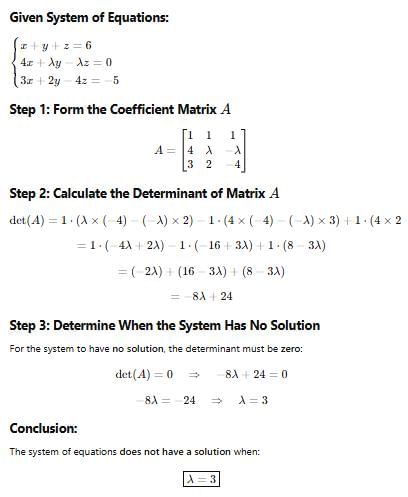
For what value of λ the following system of equations does not have a solution ? x + y + z = 6, 4x + λy - λz = 0, 3 x + 2y – 4 z = - 5

Detailed Solution: Question 2
Test: Matrices- 1 - Question 3

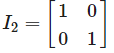
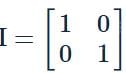
I2 is the matrix

Detailed Solution: Question 3

In linear algebra, the identity matrix, or sometimes ambiguously called a unit matrix, of size n is the n × n square matrix with ones on the main diagonal and zeros elsewhere. It is denoted by In, or simply by I if the size is immaterial or can be trivially determined by the context

Test: Matrices- 1 - Question 4

Let A be any m×n matrix, then A2 can be found only when

Detailed Solution: Question 4

The product of any matrix with itself can be found only when it is a square matrix.i.e. m = n.

Test: Matrices- 1 - Question 5

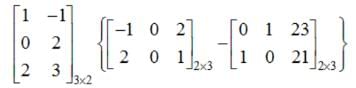
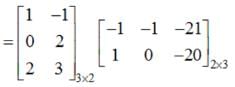
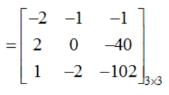
The order of the single matrix obtained from is

Detailed Solution: Question 5

Test: Matrices- 1 - Question 6

If A and B are square matrices of the same order, then(A+B)2 = A2+2AB+B2 implies

Detailed Solution: Question 6

If A and B are square matrices of same order , then , product of the matrices is not commutative.Therefore , the given result is true only when AB = BA.

Test: Matrices- 1 - Question 7

The value of λ, for which system of equations. x + y + z = 1, x + 2y + 2z = 3, x + 2y + λz = 4, have no solution is

Detailed Solution: Question 7
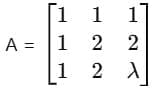
Coefficient matrix

For no solution, |A| = 0 and the augmented matrix rank > rank(A).

Set |A| = 0 → λ – 2 = 0 → λ = 2

Check inconsistency:
If λ = 2, equations 2 and 3 become:

x + 2y + 2z = 3
x + 2y + 2z = 4 → contradiction

Hence no solution when λ = 2.

Test: Matrices- 1 - Question 8

If A is a matrix of order 3 × 4 , then each row of A has

Detailed Solution: Question 8


, therefore matrix A has 4 elements in each row

Test: Matrices- 1 - Question 9

If A and B are any two matrices, then

Detailed Solution: Question 9

Let matrix A is of order m x n , and matrix B is of order p x q . then , the product AB is defined only when n = p. that’s why, If A and B are any two matrices, then AB may or may not be defined.

Test: Matrices- 1 - Question 10

If, we are given a square matrix A then, Adj.(KA) = ….

Detailed Solution: Question 10

Adj.(KA) = Kn−1 Adj.A , where K is a scalar and A is a n x n matrix.

Test: Matrices- 1 - Question 11

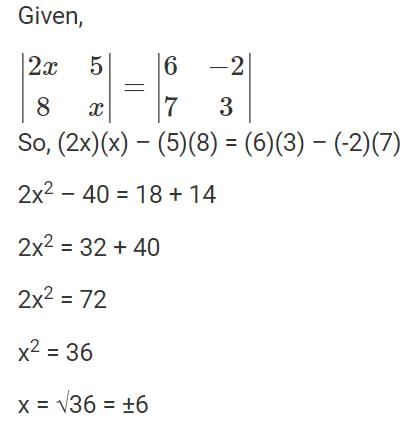
Detailed Solution: Question 11

Option C is correct: x = ±6.

Determinant on the left: (2x)(x) - 5 × 8 = 2x2 - 40.

Determinant on the right: 6 × 3 - (-2) × 7 = 18 + 14 = 32.

Equate the determinants: 2x2 - 40 = 32.

Add 40 to both sides: 2x2 = 72.

Divide by 2: x2 = 36.

Taking square roots: x = ±6. Therefore the correct option is C.

Test: Matrices- 1 - Question 12

If P is a matrix of order 2 × 3 and Q is a matrix of order 3 × 2, then PQ is of order

Detailed Solution: Question 12

Here, matrix P is of order 2 × 3 and matrix Q is of order 2 × 2 ,
then , the product PQ is defined only when : no. of columns in P = no. of rows in Q.
And the order of resulting matrix is given by : rows in P x columns in Q. = 2 x 2

Test: Matrices- 1 - Question 13

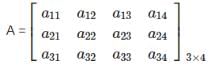
A square matrix A = [aij]n×n is called a lower triangular matrix if aij = 0 for

Detailed Solution: Question 13
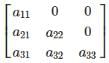
A lower triangular matrix is given by : 
 ,

here , aij = 0 if i is less than j and

aij ≠ 0 if i is greater than j.

Test: Matrices- 1 - Question 14

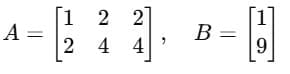
The equations x + 2y + 2z = 1 and 2x + 4 y + 4z = 9 have

Detailed Solution: Question 14

Write the system as AX = B, where

Check consistency using rank:

Since

the system is inconsistent.

Therefore, no solution.

Test: Matrices- 1 - Question 15

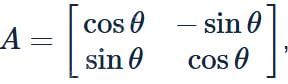
If then AT+ A = I2, if

Detailed Solution: Question 15

Option C is correct.

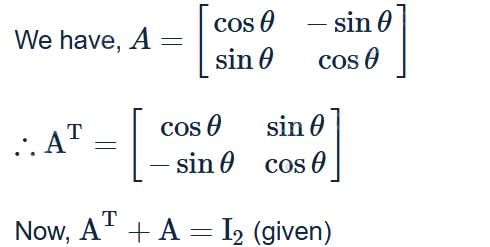
Let A = [cosθ - sinθ; sinθ cosθ].

Then AT = [cosθ sinθ; -sinθ cosθ].

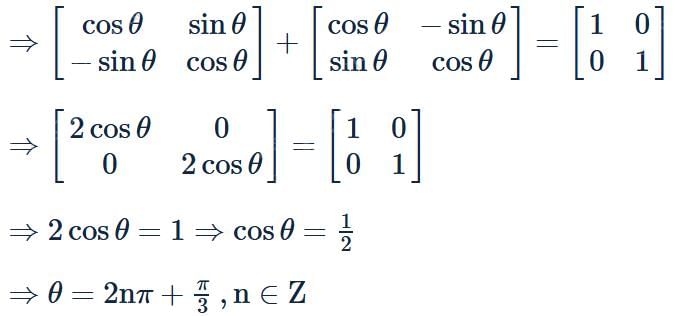
So AT + A = [2 cosθ 0; 0 2 cosθ] = 2 cosθ I2.

Given AT + A = I2, we get 2 cosθ I2 = I2, hence 2 cosθ = 1 and cosθ = 1/2.

All solutions of cosθ = 1/2 are θ = 2nπ ± π/3, n ∈ Z. Therefore option C is the correct choice.


Test: Matrices- 1 - Question 16

The number of all the possible matrices of order 2 × 2 with each entry 0, 1 or 2 is

Detailed Solution: Question 16

To determine the number of possible 2×2 matrices where each entry can be 0, 1, or 2, we calculate the total number of combinations for each of the four independent entries.

  • Each entry has 3 choices.
  • There are 4 independent entries in a 2×2 matrix.
  • The total number of combinations is calculated as 34.
  • Therefore, the total number of possible matrices is 81.

Test: Matrices- 1 - Question 17

If Ak = 0, and (I − A)p = I + A + A2 + … + Ak − 1, then p is

Detailed Solution: Question 17

Since A= 0, the matrix A is nilpotent.
For a nilpotent matrix, the matrix geometric series holds:

Given in the question:

So, 

Comparing powers, we get:

p = -1

Test: Matrices- 1 - Question 18

A square matrix  A = [aij]n×n is called an upper triangular if aij = 0 for

Detailed Solution: Question 18
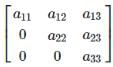
Upper Triangular matrix is given by  :
.
 Here, aij=0 , if i is greater than j.and aij ≠ 0, if I is less than j.

Test: Matrices- 1 - Question 19

If A and B are two matrices such that AB = A and BA = B, then which one of the following is correct?

Detailed Solution: Question 19

Let A and B be two matrices such that AB = A and BA = B Now, consider AB = A Take Transpose on both side (AB)T = A
⇒ AT = BT ⋅ AT ...(1)
Now, BA = B 
Take, Transpose on both side (BA)T = B
⇒ BT = AT⋅BT…(2)
Now, from equation (1) and (2). we have AT = (AT . BT)A
AT=AT(BTAT)
= AT(AB)T(∵(AB)T = BT = BTAT)
= AT ⋅ A
Thus, AT = (AT)2

Test: Matrices- 1 - Question 20

If A is any square matrix, then

Detailed Solution: Question 20

For any square matrix A, both (A + AT) is symmetric and (A - AT) is skew-symmetric. Therefore, options A and B are true.

  • (A + AT) is symmetric.
  • (A - AT) is skew-symmetric.

Test: Matrices- 1 - Question 21

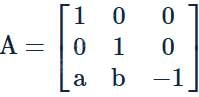
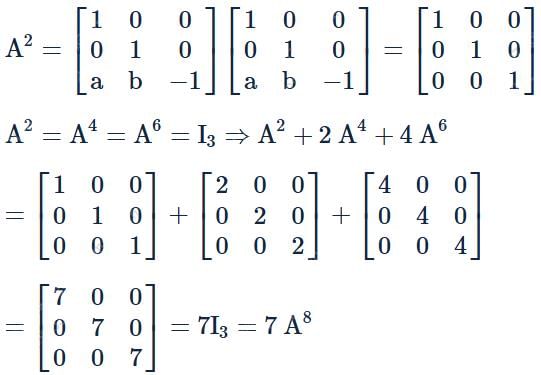
If and I is the unit matrix of order 3, then A2 + 2 A4 + 4 A6 is equal to

Detailed Solution: Question 21

Test: Matrices- 1 - Question 22

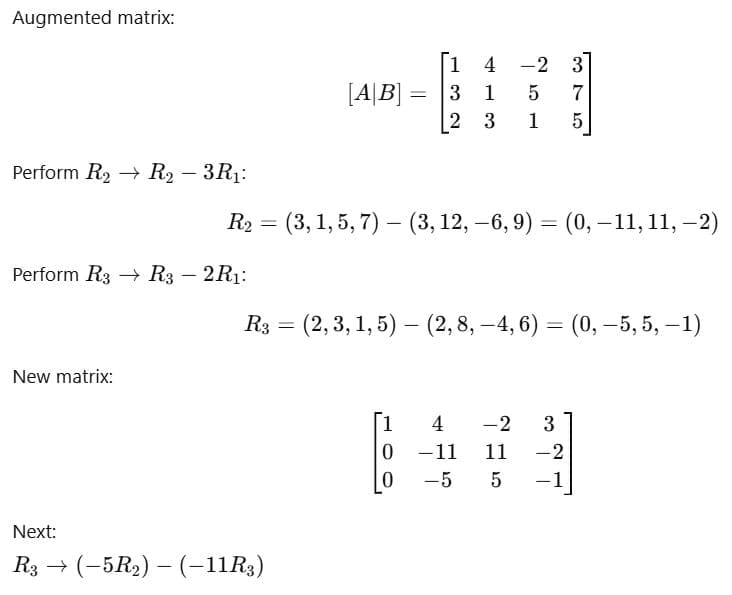
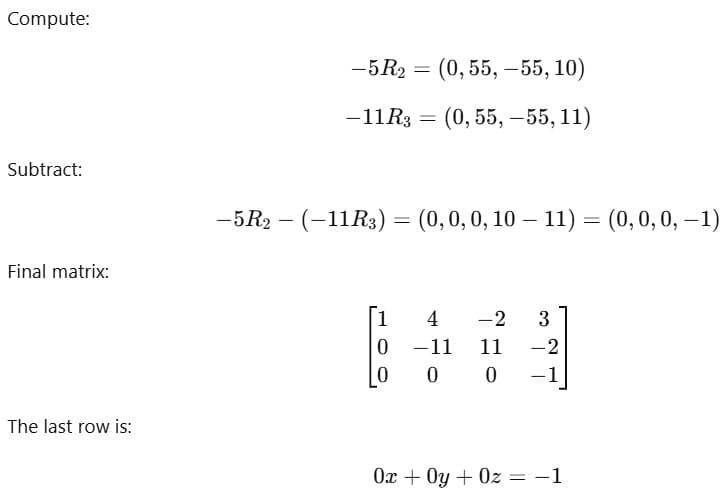
The equations, x + 4 y – 2 z = 3, 3 x + y + 5 z = 7, 2 x + 3y +z = 5 have

Detailed Solution: Question 22
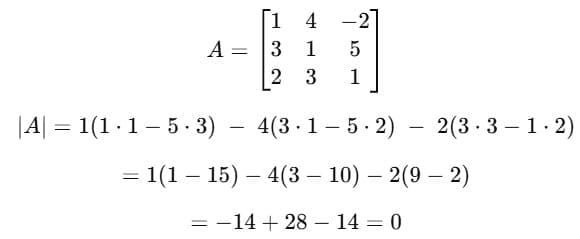
To check the nature of the solutions, compute the determinant of the coefficient matrix:

Since |A| = 0, the system is either inconsistent or has infinitely many solutions.

Now check consistency:

Which is false → contradiction.

So the system is inconsistent.

Test: Matrices- 1 - Question 23

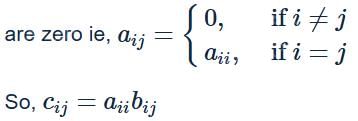
If A = [aij]n×n be a diagonal matrix with diagonal element all different and B = [bij]n×n be some another matrix. Let AB = [cij]n×n then cij is equal to

Detailed Solution: Question 23
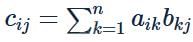
(In general) and in a diagonal matrix non-diagonal elements
Test: Matrices- 1 - Question 24

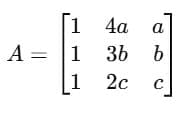
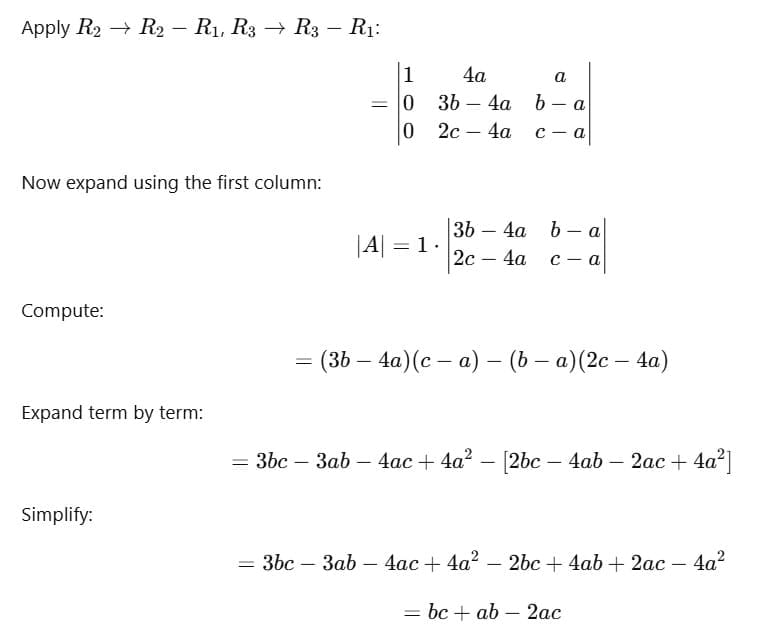
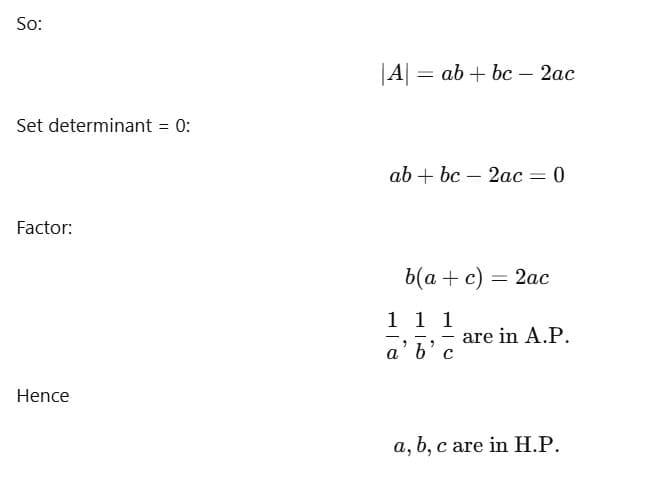
If the system of equationsx + 4 ay + az = 0, x + 3by + bz = 0 andx + 2 cy +cz = 0 have a non-zero solution,then a, b, c are in

Detailed Solution: Question 24
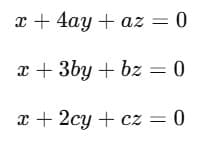
Given System:

Coefficient matrix:

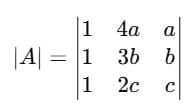
For a non-zero solution,

∣A∣ = 0

Now, we will find the determinant:

So, option (a) is the correct answer.

Test: Matrices- 1 - Question 25

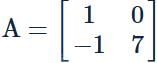
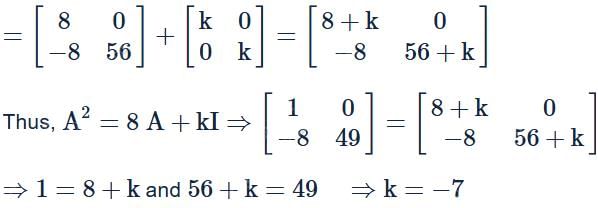
If and then the value of k so that A2 = 8 A + kI is

Detailed Solution: Question 25

We have,

and

173 videos|510 docs|154 tests
Information about Test: Matrices- 1 Page
In this test you can find the Exam questions for Test: Matrices- 1 solved & explained in the simplest way possible. Besides giving Questions and answers for Test: Matrices- 1, EduRev gives you an ample number of Online tests for practice
Download as PDF