NEET Exam  >  NEET Test  >  Biology Class 12  >  Test: Population: Attributes & Growth - NEET MCQ

Population: Attributes & Growth - Free MCQ Practice Test with solutions,


MCQ Practice Test & Solutions: Test: Population: Attributes & Growth (10 Questions)

You can prepare effectively for NEET Biology Class 12 with this dedicated MCQ Practice Test (available with solutions) on the important topic of "Test: Population: Attributes & Growth". These 10 questions have been designed by the experts with the latest curriculum of NEET 2026, to help you master the concept.

Test Highlights:

  • - Format: Multiple Choice Questions (MCQ)
  • - Duration: 10 minutes
  • - Number of Questions: 10

Sign up on EduRev for free to attempt this test and track your preparation progress.

Test: Population: Attributes & Growth - Question 1

Which of the following would necessarily decrease the density of a population in a given habitat?

Detailed Solution: Question 1

Mortality and emigration would necessarily decrease the density of a population in a given habitat.

Topic in NCERT: POPULATION DYNAMICS

Line in NCERT: "two (mortality and emigration) to a decrease."

Test: Population: Attributes & Growth - Question 2

Human population follows the

Detailed Solution: Question 2

A is correct. Human population growth is best described as J-shaped (exponential) because the global human population shows a rapid and accelerating increase rather than a clear long-term leveling-off.

The J-shaped or exponential curve reflects continuous multiplication where the growth rate remains roughly proportional to current population, producing a steep upward trajectory.

An S-shaped (logistic) curve implies that growth slows and the population stabilises at a fixed carrying capacity due to limiting resources; this global stabilisation has not yet been observed as a persistent, worldwide pattern.

The term Z-shaped is not a standard global population-growth model for humans; it would imply sharp oscillations or abrupt changes, which are not representative of the long-term global human population trend.

Therefore, J-shaped (exponential) growth (option A) best fits the observed global human population trend.

Test: Population: Attributes & Growth - Question 3

The formula for exponential population growth is

Detailed Solution: Question 3

Formula = the rate of change in population size) = (the contribution of each individual to population growth) x (the number of individuals in the population
dt/dN = rN,
where:
dN = change in number
dt = change in time
r = the per head maximum potiential growth rate
N = number of individuals in a population.
Topic in NCERT: Population Growth Models
Line in NCERT: "dN/dt = rN"

Test: Population: Attributes & Growth - Question 4

When the number of immigration and births is more than emigration and deaths, the growth curve of the population will show

Detailed Solution: Question 4

Exponential model is the one in which rate of change in anything is directly proportional to the number of the thing present. Exponential phase shows the exponential growth. Thus the size or the number increases at a constant growing rate.

Topic in NCERT: Population Density

Line in NCERT: "population density will increase if the number of births plus the number of immigrants (B + I) is more than the number of deaths plus the number of emigrants (D + E)."

Test: Population: Attributes & Growth - Question 5

 Population growth curve is sigmoid if the growth pattern is

Detailed Solution: Question 5

S-shaped growth curve (sigmoid growth curve) A pattern of growth in which, in a new environment, the population density of an organism increases slowly initially, in a positive acceleration phase; then increases rapidly approaching an exponential growth rate as in the J-shaped curve; but then declines in a negative acceleration phase until at zero growth rate the population stabilizes.

Topic in NCERT: Logistic growth

Line in NCERT: "A population growing in a habitat with limited resources show initially a lag phase, followed by phases of acceleration and deceleration and finally an asymptote, when the population density reaches the carrying capacity. plot of N in relation to time (t) results in a sigmoid curve."

Test: Population: Attributes & Growth - Question 6

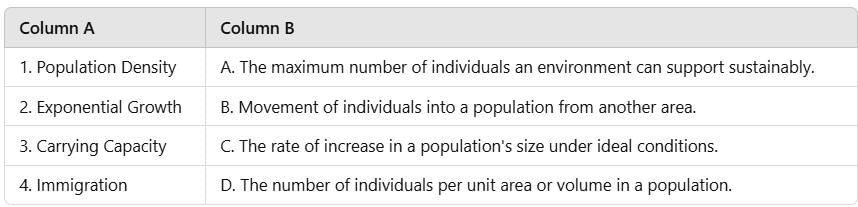
Match the items in Column A with the correct descriptions in Column B.
Detailed Solution: Question 6

Solution:

1 - D: Population Density → The number of individuals per unit area or volume in a population.
2 - C: Exponential Growth → The rate of increase in a population's size under ideal conditions.
3 - A: Carrying Capacity → The maximum number of individuals an environment can support sustainably.
4 - B: Immigration → Movement of individuals into a population from another area.

Test: Population: Attributes & Growth - Question 7

 If in a population, natality is balanced by mortality, then there will be

Detailed Solution: Question 7

The density of a population in a given habitat during a given period changes due to changes in four basic processes, two of which (natality and immigration) contribute to an increase in population density and two (mortality and emigration) to a decrease. In a zero population growth density natality is balanced by mortality. 
Topic in NCERT: Population Density

Line in NCERT: "Under normal conditions, births and deaths are the most important factors influencing population density."

Test: Population: Attributes & Growth - Question 8

The graph shows two types of population growth curve. A is exponential and B is logistic.
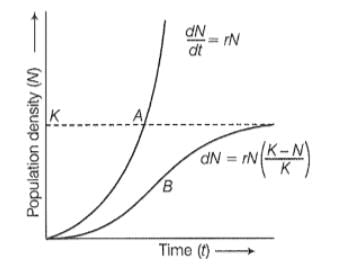
Which one of the following growth model considered as more realistic one?

Detailed Solution: Question 8

Solution:

The logistic growth curve is considered more realistic because it accounts for the limitations imposed by the environment, such as limited resources and carrying capacity. In contrast, the exponential growth curve assumes unlimited resources, which rarely occurs in nature. Therefore, Option B is the correct answer as it reflects more realistic conditions for population growth.

Topic in NCERT: Logistic Growth Model

Line in NCERT: "the logistic growth model is considered a more realistic one."

Test: Population: Attributes & Growth - Question 9

Consider the following statements about population growth and dynamics:
1. Exponential growth occurs only when resources are limited.
2. Logistic growth models show a sigmoid curve and account for carrying capacity.
3. Natality, mortality, immigration, and emigration are the four main factors that influence population size.
4. The intrinsic rate of natural increase (r) is constant and unaffected by environmental conditions.
Which of the following options is correct?

Detailed Solution: Question 9

Statement 1 is incorrect because exponential growth occurs only under conditions of unlimited resources, not limited resources.
Statement 2 is correct as logistic growth models describe population growth with limited resources, leading to a sigmoid curve.
Statement 3 is correct since natality, mortality, immigration, and emigration are the four key factors that influence population dynamics.
Statement 4 is incorrect because the intrinsic rate of natural increase (r) can vary depending on environmental factors like resource availability and competition.

Topic in NCERT: Population Growth Dynamics

Line in NCERT: "when resources are unlimited, the growth is usually exponential but when resources become progressively limiting, the growth pattern turns logistic." "The intrinsic rate of natural increase (r) is a measure of the inherent potential of a population to grow." "Natality, mortality, immigration, and emigration are the four main factors that influence population size."

Test: Population: Attributes & Growth - Question 10

What does the carrying capacity (K) of a habitat refer to?

Detailed Solution: Question 10

Carrying capacity (K) refers to the maximum number of individuals a habitat can support given the available resources. Beyond this limit, the population will stop growing or may even decline due to resource depletion.

Topic in NCERT: Carrying Capacity

Line in NCERT: "In nature, a given habitat has enough resources to support a maximum possible number, beyond which no further growth is possible. Let us call this limit as nature's carrying capacity (K) for that species in that habitat."

69 videos|305 docs|161 tests
Information about Test: Population: Attributes & Growth Page
In this test you can find the Exam questions for Test: Population: Attributes & Growth solved & explained in the simplest way possible. Besides giving Questions and answers for Test: Population: Attributes & Growth, EduRev gives you an ample number of Online tests for practice
69 videos|305 docs|161 tests
Download as PDF