NEET Exam  >  NEET Test  >  Biology Class 12  >  Test: Population Interactions - NEET MCQ

Population Interactions - Free MCQ Practice Test with solutions, NEET Biology


MCQ Practice Test & Solutions: Test: Population Interactions (12 Questions)

You can prepare effectively for NEET Biology Class 12 with this dedicated MCQ Practice Test (available with solutions) on the important topic of "Test: Population Interactions". These 12 questions have been designed by the experts with the latest curriculum of NEET 2026, to help you master the concept.

Test Highlights:

  • - Format: Multiple Choice Questions (MCQ)
  • - Duration: 12 minutes
  • - Number of Questions: 12

Sign up on EduRev for free to attempt this test and track your preparation progress.

Test: Population Interactions - Question 1

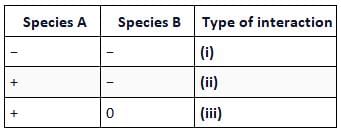
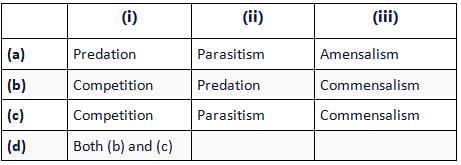
Refer to the given table. If '+' sign has been assigned for beneficial interaction, sign for detrimental interaction and '0' for neutral interaction, identify the type of interaction (i), (ii) and (iii) and select the correct option.
Detailed Solution: Question 1

In competition, both species are harmed. In predation and parasitism, one species derives benefit and the other one is harmed. Commensalism is an interaction in which one species is benefitted and other one remains unaffected.

Topic in NCERT: Population Interactions

Line in NCERT: "Even in minimal communities, many interactive linkages exist, although all may not be readily apparent. Interspecific interactions arise from the interaction of populations of two different species. They could be beneficial, detrimental or neutral (neither harm nor benefit) to one of the species or both."

Test: Population Interactions - Question 2

Read the following statements and select the correct option.
Statement 1: Brood parasitism in birds is an example of parasitism in which the parasitic bird lays its eggs in the nest of its host and the host incubates them.
Statement 2: During the course of evolution, the eggs of the parasite bird have evolved to resemble the host's eggs in size and colour to reduce the chances of the host bird detecting the foreign eggs and removing them from the nest.

Detailed Solution: Question 2

The correct option is:

2. Both statements 1 and 2 are correct and statement 2 is the correct explanation of statement 1

Explanation:

- Statement 1 is correct: Brood parasitism in birds involves a parasitic bird laying its eggs in the nest of a host bird, and the host bird then incubates these eggs.

- Statement 2 is correct: During the course of evolution, the eggs of parasitic birds have evolved to resemble the host's eggs in size and color. This adaptation reduces the chances of the host bird detecting the foreign eggs and removing them from the nest.

Therefore, statement 2 provides the correct explanation for statement 1.

Topic in NCERT: Parasitism

Line in NCERT: "Brood parasitism in birds is a fascinating example of parasitism in which the parasitic bird lays its eggs in the nest of its host and lets the host incubate them. During the course of evolution, the eggs of the parasitic bird have evolved to resemble the host's egg in size and colour to reduce the chances of the host detecting the foreign eggs and ejecting them from the nest."

Test: Population Interactions - Question 3

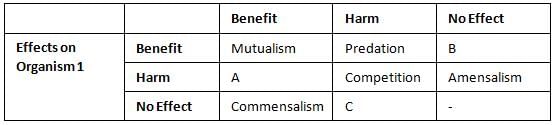
Refer to the given table that summarises the interactions between two organisms (organisms 1 and organism 2). Identify the types of interaction (A,B and C) and select the correct answer.
(i) A can be either predation or parasitism 
(ii) B can be either commensalism 
(iii) C can be amensalism. 
(iv) A can be amensalism, 

Detailed Solution: Question 3

A can be either predation or parasitism since one species is harmed and the other is benefitted. B is commensalism since one species is benefitted and other has no effect on it. C can be amensalism since one species is harmed and the other has no effect on it.

Topic in NCERT: Interspecific interactions

Line in NCERT: "Both the species benefit in mutualism and both lose in competition in their interactions with each other. In both parasitism and predation only one species benefits (parasite and predator, respectively) and the interaction is detrimental to the other species (host and prey, respectively). The interaction where one species is benefitted and the other is neither benefitted nor harmed is called commensalism. In amensalism on the other hand one species is harmed whereas the other is unaffected."

Test: Population Interactions - Question 4

What is 'resource partitioning' and how does it help species co-exist?

Detailed Solution: Question 4

Resource partitioning is a strategy where species share the same resources but divide them in a way that reduces competition, allowing them to coexist. This can be through spatial or temporal division of resources.It allows species to access the same resource at different times or in different ways.

Topic in NCERT: Competition and Co-existence

Line in NCERT: "One such mechanism is ‘resource partitioning'. If two species compete for the same resource, they could avoid competition by choosing, for instance, different times for feeding or different foraging patterns."

Test: Population Interactions - Question 5

When one population is harmed and the other remains unaffected, the relationship is called

Detailed Solution: Question 5

In ammensalism one component (population) is harmed and the other remains unaffected. The alga Microcystis release hydroxyl amine that kills the surrounding fauna but the alga itself remain unaffected. Parasitism is generally considered to deal with any small organism that live on or in another organism regardless of whether its effect is negative, positive or neutral. In predation one population adversaly affects the other by direct attack but nevertheless depends on other. In exploitation one species harms the other by making its direct or indirect use for support, shelter or food.

Topic in NCERT: Amensalism

Line in NCERT: "In amensalism on the other hand one species is harmed whereas the other is unaffected."

Test: Population Interactions - Question 6

Which of the following statements about predation is correct?

Detailed Solution: Question 6

Predators help control prey populations, often preventing prey from reaching excessively high densities. This is a natural ecological balance.

Topic in NCERT: Predation and its Ecological Role

Line in NCERT: "Some predators help in controlling their prey populations."

Test: Population Interactions - Question 7

Mycorrhiza represents 

Detailed Solution: Question 7

A nutrient depletion zone can develop when there is rapid soil solution uptake, low nutrient concentration, low diffusion rate, or low soil moisture. These conditions are very common; therefore, most plants rely on fungi to facilitate the uptake of minerals from the soil. Mycorrhizae, known as root fungi, form symbiotic associations with plant roots. In these associations, the fungi are actually integrated into the physical structure of the root. The fungi colonize the living root tissue during active plant growth.

Topic in NCERT: Mutualism

Line in NCERT: "Similarly, the mycorrhizae are associations between fungi and the roots of higher plants."

Test: Population Interactions - Question 8

Small fish get stuck near the bottom of a shark and derive their nutrition from it? This kind of association is called

Detailed Solution: Question 8

Correct option: D

Commensalism is an association in which one species benefits while the other is neither harmed nor helped.

Parasitism is an association in which one organism (the parasite) obtains nutrients from the host and causes harm to the host.

If the organism obtains nutrition by feeding on the host's tissues or body fluids, the relationship is parasitism; if it takes food scraps, transport, or shelter without injuring the host, the relationship is commensalism.

A classical example is the remora (sucker fish) attaching to larger fishes: the remora gains food and transport while the host is generally not harmed. Hence the association is classified as commensalism.

Final answer: Option D

Test: Population Interactions - Question 9

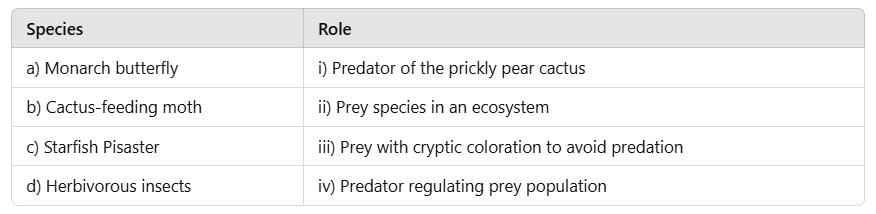
Match the following species with their role in ecological interactions:
Detailed Solution: Question 9

Monarch butterflies (a) have cryptic coloration to avoid being preyed upon, making them (iii) prey with cryptic coloration.
Cactus-feeding moths (b) are predators of the prickly pear cactus, making them (i) predator.
Starfish Pisaster (c) is a predator that regulates prey populations, so it's (iv) a predator.
Herbivorous insects (d) are prey species in an ecosystem, making them (ii) prey.

Test: Population Interactions - Question 10

Which of the following adaptations are examples of plant defenses against herbivores?

Detailed Solution: Question 10

  • Thorns on Acacia trees are a direct defense mechanism in plants to deter herbivores from feeding on their leaves or branches.
  • High reproductive rate of a parasitic plant is not a defense mechanism; it's an adaptation for survival and spread, unrelated to protecting against herbivory.
  • Camouflage in insects like the Monarch butterfly is an adaptation for insects, not plants, so it does not qualify as a plant defense.

Topic in NCERT: Defenses Against Herbivory

Line in NCERT: "Plants therefore have evolved an astonishing variety of morphological and chemical defences against herbivores. Thorns (Acacia, Cactus) are the most common morphological means of defence. Many plants produce and store chemicals that make the herbivore sick when they are eaten, inhibit feeding or digestion, disrupt its reproduction or even kill it."

Test: Population Interactions - Question 11

Which of the following are examples of parasitism?

Detailed Solution: Question 11

 the human liver fluke’s life cycle (D) is an  example of parasitism, where one species benefits at the expense of another. The other options describe mutualistic or commensal relationships.

Topic in NCERT: Life Cycles of Parasites

Line in NCERT: "The human liver fluke (a trematode parasite) depends on two intermediate hosts (a snail and a fish) to complete its life cycle."

Test: Population Interactions - Question 12

How does a carnivore population increase?

Detailed Solution: Question 12

A carnivore population increases due to an increase in the population of herbivores. In this, an organism i.e. carnivore (predator) is benefited by killing and eating another organism i.e. herbivore (prey).

69 videos|305 docs|161 tests
Information about Test: Population Interactions Page
In this test you can find the Exam questions for Test: Population Interactions solved & explained in the simplest way possible. Besides giving Questions and answers for Test: Population Interactions, EduRev gives you an ample number of Online tests for practice
69 videos|305 docs|161 tests
Download as PDF