
Properties of LTI Systems - Free MCQ Practice Test with solutions, GATE
MCQ Practice Test & Solutions: Test: Properties of LTI Systems (20 Questions)
You can prepare effectively for Electrical Engineering (EE) Signals and Systems with this dedicated MCQ Practice Test (available with solutions) on the important topic of "Test: Properties of LTI Systems". These 20 questions have been designed by the experts with the latest curriculum of Electrical Engineering (EE) 2026, to help you master the concept.
Test Highlights:
- - Format: Multiple Choice Questions (MCQ)
- - Duration: 15 minutes
- - Number of Questions: 20
Sign up on EduRev for free to attempt this test and track your preparation progress.

Detailed Solution: Question 1
Does the system h(t) = exp([-1-2j]t) correspond to a stable system?
Detailed Solution: Question 2

Detailed Solution: Question 3
For an LTI discrete system to be stable, the square sum of the impulse response should be
Detailed Solution: Question 4
Detailed Solution: Question 5
Does the system h(t) = exp(-7t) correspond to a stable system?
Detailed Solution: Question 6
What is the following expression equal to: h*(d+bd), d(t) is the delta function
Detailed Solution: Question 7
Detailed Solution: Question 8
The system transfer function and the input if exchanged will still give the same response.
Detailed Solution: Question 9
In a discrete Linear Shift Invariant system the input sequence length is L, the impulse response sequence length is M, the output sequence length N is
Detailed Solution: Question 10
Detailed Solution: Question 11
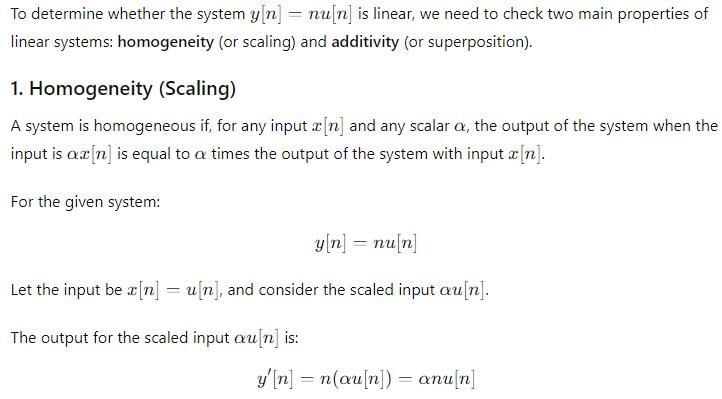
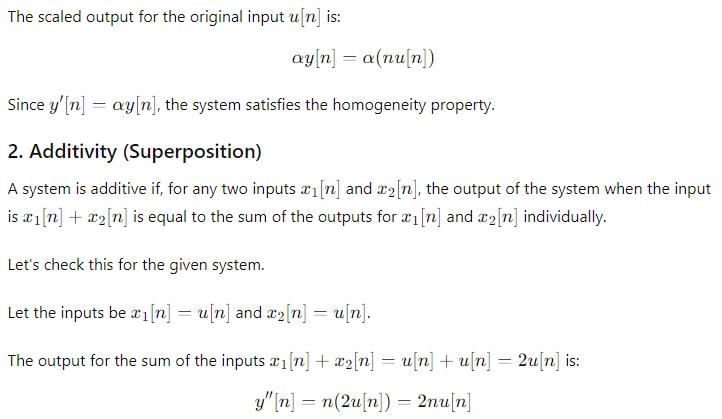
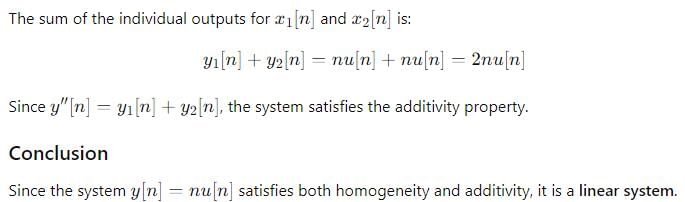
A continuous-time system that is initially at rest is described by

where x(t) is the input voltage and y(t) is the output voltage. The impulse response of the system is
where x(t) is the input voltage and y(t) is the output voltage. The impulse response of the system is
Detailed Solution: Question 12

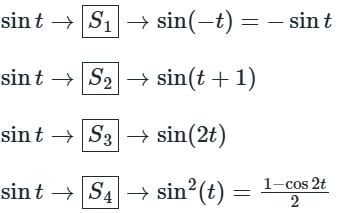
The outputs of four systems (S1, S2, S3, and S4) corresponding to the input signal sin(t), for all time t, are shown in the figure.
Based on the given information, which of the four systems is/are definitely NOT LTI (linear and time-invariant)?
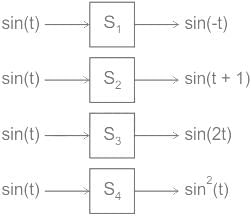
Based on the given information, which of the four systems is/are definitely NOT LTI (linear and time-invariant)?
Detailed Solution: Question 13
Which one of the following statements is NOT TRUE for a continuous time causal and stable LTI system?
Detailed Solution: Question 14
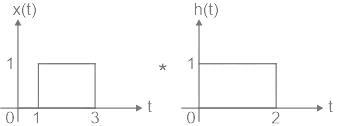
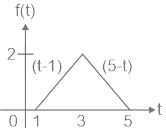
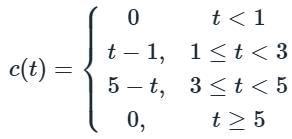
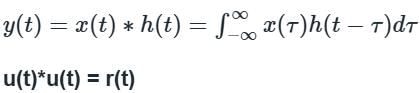
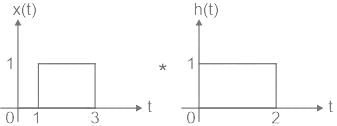
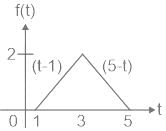
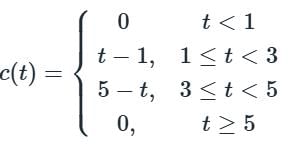
What is the convolution integral c(t) for a system with input x(t) and impulse response h(t), where x(t) = u(t - 1) - u(t - 3) and h(t) = u(t) - u(t - 2) ?
Detailed Solution: Question 15

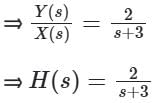
Consider a single input single output discrete-time system with x[n] as input and y[n] as output. Where the two are related as

Which one of the following statements is true about the system?
Which one of the following statements is true about the system?
Detailed Solution: Question 16

The signal y(t) = T{x(t)} = sin(2πt)⋆x(t) + u(t - 2) is _______.
Detailed Solution: Question 17
Which one of the following statements is NOT TRUE for a continuous time causal and stable LTI system
Detailed Solution: Question 18
Which of the following statements about the time-invariant and time-varying control systems is INCORRECT?
Detailed Solution: Question 19
What is the convolution integral c(t) for a system with input x(t) and impulse response h(t), where x(t) = u(t - 1) - u(t - 3) and h(t) = u(t) - u(t - 2)?
Detailed Solution: Question 20
41 videos|72 docs|33 tests |
