Super TET Exam  >  Super TET Test  >  Science  >  Test: Ultrasound And Human Ear - Super TET MCQ

Ultrasound And Human Ear - Free MCQ Practice Test with solutions, Super


MCQ Practice Test & Solutions: Test: Ultrasound And Human Ear (10 Questions)

You can prepare effectively for Super TET Science for Super TET with this dedicated MCQ Practice Test (available with solutions) on the important topic of "Test: Ultrasound And Human Ear". These 10 questions have been designed by the experts with the latest curriculum of Super TET 2026, to help you master the concept.

Test Highlights:

  • - Format: Multiple Choice Questions (MCQ)
  • - Duration: 10 minutes
  • - Number of Questions: 10

Sign up on EduRev for free to attempt this test and track your preparation progress.

Test: Ultrasound And Human Ear - Question 1

Which waves are employed in SONAR?

Detailed Solution: Question 1

Another popular use for ultrasonics is in ships, both for navigation and for locating objects underwater. Sound travels faster through water than through air, which is very helpful because light hardly travels through water at all. Most people know that whales can use low-frequency sound to communicate across entire oceans. Submarinesuse a similar trick with a type of navigation called sonar (sound navigation and ranging), which is a bit like an underwater equivalent of radar.

Test: Ultrasound And Human Ear - Question 2

A person clapped his hands near a cliff and heard the echo after 5 sec. What is the distance of the cliff from the person, if the speed of the sound V is taken as 346 ms-1 ?

Detailed Solution: Question 2

Speed of sound in air, v = 342 ms^-1

Time taken for hearing the echo, t = 3 s 

Distance  travelled by the sound = vt 

= 342 * 3 

= 1026 m

In 3 s, sound has to travel twice the distance between the the cliff and the person. 

Hence the distance between the cliff and the person is given by, d=  1730 m/2 = 865 m

Test: Ultrasound And Human Ear - Question 3

The vibrations or the pressure variations inside the inner ear are converted into electrical signals by the:

Detailed Solution: Question 3

The middle ear transmits the amplified pressure variations received from the sound wave to the inner ear. In the inner ear, the pressure variations are turnedinto electrical signals by the cochlea. These electrical signals are sent to the brain via the auditory nerve, and the brain interprets them as sound.

Test: Ultrasound And Human Ear - Question 4

Which part of the ear amplifies the vibrations of eardrum?

Detailed Solution: Question 4

The pressure from sound waves makes the eardrum vibrate. The vibrations are transmitted further into the ear via three bones in the middle ear: the hammer(malleus), the anvil (incus) and the stirrup (stapes).

Test: Ultrasound And Human Ear - Question 5

Sound of the frequency below 20 Hz is known as

Detailed Solution: Question 5

Human beings can normally hear sounds with a frequency between about 20 Hzand 20,000 Hz. Sounds with frequencies below 20 hertz are called infrasound.Infrasound is too low-pitched for humans to hear. Sounds with frequencies above 20,000 hertz are called ultrasound.

Test: Ultrasound And Human Ear - Question 6

The technique used by bats to find their way or to locate food is

Detailed Solution: Question 6

 The technique used by bats to find their way or to locate food is echo-location

Test: Ultrasound And Human Ear - Question 7

Ultrasound is not used to:

Detailed Solution: Question 7

When bats detect ultrasonic waves which after touching the prey comes back to bats ear which tell them how far their prey is and how it looks like. Similarly people detect ultrasonic waves to know the distance. the waves touch the building and comes back which tells us how far it is.

Test: Ultrasound And Human Ear - Question 8

Young children below 5 years can hear up to a frequency of:

Detailed Solution: Question 8

Young children below 5 years can hear frequencies up to about 20,000 Hz (20 kHz).

As people grow older, the upper limit of hearing usually decreases.

Test: Ultrasound And Human Ear - Question 9

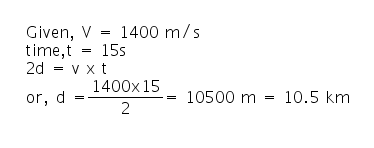
The velocity of ultrasonic sound in water is 1400 m. The depth of the ocean as detected by SONAR, if the time taken to receive the reflected wave is 15s, is

Detailed Solution: Question 9
Test: Ultrasound And Human Ear - Question 10

A ship on the surface of water sends a signal and receives it back after 4 seconds from a submarine inside the water. Calculate the distance of the submarine from the ship (The speed of sound in water is 1450 m/s).

Detailed Solution: Question 10

2 D = velocity X time
D = (velocity X time) / 2 = 1450 X 4 / 2 = 2900 m = 2.9 km

59 videos|119 docs|73 tests
Information about Test: Ultrasound And Human Ear Page
In this test you can find the Exam questions for Test: Ultrasound And Human Ear solved & explained in the simplest way possible. Besides giving Questions and answers for Test: Ultrasound And Human Ear, EduRev gives you an ample number of Online tests for practice
59 videos|119 docs|73 tests
Download as PDF