Class 8 Exam  >  Class 8 Tests  >  Mathematics (Maths) Class 8  >  Test: Mensuration- 1 - Class 8 MCQ

Test: Mensuration- 1 - Class 8 MCQ


Test Description

20 Questions MCQ Test Mathematics (Maths) Class 8 - Test: Mensuration- 1

Test: Mensuration- 1 for Class 8 2026 is part of Mathematics (Maths) Class 8 preparation. The Test: Mensuration- 1 questions and answers have been prepared according to the Class 8 exam syllabus.The Test: Mensuration- 1 MCQs are made for Class 8 2026 Exam. Find important definitions, questions, notes, meanings, examples, exercises, MCQs and online tests for Test: Mensuration- 1 below.
Solutions of Test: Mensuration- 1 questions in English are available as part of our Mathematics (Maths) Class 8 for Class 8 & Test: Mensuration- 1 solutions in Hindi for Mathematics (Maths) Class 8 course. Download more important topics, notes, lectures and mock test series for Class 8 Exam by signing up for free. Attempt Test: Mensuration- 1 | 20 questions in 25 minutes | Mock test for Class 8 preparation | Free important questions MCQ to study Mathematics (Maths) Class 8 for Class 8 Exam | Download free PDF with solutions
Test: Mensuration- 1 - Question 1

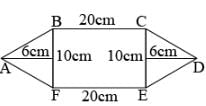
Find the area of adjoining figure is

Detailed Solution for Test: Mensuration- 1 - Question 1

The given figure is made up of three simple shapes:

  • One rectangle (BCEF) in the middle
  • Two triangles, one on each side of the rectangle

Step 1: Area of the rectangle (BCEF)
Length = 20 cm
Breadth = 10 cm
Area of rectangle = 20 × 10 = 200 cm2

Step 2: Area of the two triangles (ΔABF and ΔDCE)
Both triangles are similar having same base and height, So their respective areas will also be same.
Base = 10 cm
Height = 6 cm
Area of one triangle = 1/2 ​× 10 × 6 = 30 cm2
Area of two triangles = 30 + 30 = 60 cm2

Step 3: Total area of the figure
Area = Area of Rectangle + Area of two triangles
Area = 200 + 60 = 260 cm2

Therefore, the area of the adjoining figure is 260 cm2

Test: Mensuration- 1 - Question 2

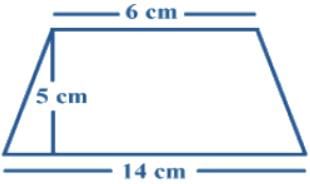
The length of parallel sides of trapezium is 14 cm and 6 cm and its height is 5 cm. Its area will be
Detailed Solution for Test: Mensuration- 1 - Question 2

Given that, the length of one side of the trapezium b1 = 6cm and another is b2 =14cm.
The height of the trapezium h = 5cm.
Drawing the figure from the given data.

Test: Mensuration- 1 - Question 3

The area of trapezium in the adjoining figure is  

Detailed Solution for Test: Mensuration- 1 - Question 3

Area of Trapezium  = 1/2 (sum of Parallel sides ) * height
let a and b are the parallel sides:
a= 4cm
b= 6 cm
h= 3cm
according to formula -> 1/2(4+6)*(3)
=>1/2(10)(3)
=>30/2
=>15 cm2

Test: Mensuration- 1 - Question 4

The curved surface area of a cylinder is equal to the total surface area of a cube whose each edge is 7 cm. If the height of the cylinder is 10 cm, what is its radius?
(π=22/7)

Detailed Solution for Test: Mensuration- 1 - Question 4

Cube Total Surface Area = 6a2 = 6×72 = 6×49 = 294 cm2

Given
Curved Surface Area of cylinder = 294

CSA = 2πrh
2 × 22/7 × r × 10 = 294

44r/7 ×10 = 294
(440r)/7 = 294
440r = 2058
r = 4.68 ≈ 5 cm

So, option (b) is the correct answer.

Test: Mensuration- 1 - Question 5

If a cuboidal box has height, length and width as 20 cm, 15 cm and 10 cm respectively. Then its total surface area is:

Detailed Solution for Test: Mensuration- 1 - Question 5

To find the total surface area (TSA) of a cuboid, we use the formula:
TSA=2(lb+bh+hl)

Given:

  • l = 15 cm
  • b = 10 cm
  • h = 20 cm

Total surface area = 2(lb + bh + hl)
= 2(15 × 10 + 10 × 20 + 20 × 15)
= 2(150 + 200 + 300) = 2 × 650 = 1300 cm2
Correct answer: 1300 cm2

Test: Mensuration- 1 - Question 6

A square park and a circular park have the same area. If the side of the square is 14 m, the radius of the circular park is approximately:

Detailed Solution for Test: Mensuration- 1 - Question 6

The correct answer is Option B - 7 m

Area of the square = 142 = 196 m2.

Area of the circle = πr2.

Equating the areas gives πr2 = 196.

So r = √(196/π) = 14/√π.

Using π ≈ 3.1416, we get r ≈ 7.90 m.= 8 m

Among the given choices, the nearest value is 8 m, so the correct option is Option B.

Test: Mensuration- 1 - Question 7

The height of a cuboid whose volume is 275 cm3 and base area is 25 cm2 is:

Detailed Solution for Test: Mensuration- 1 - Question 7

In Cuboid,
Base Area = Length × Breadth
Volume = Length × Breadth × height
So, we can write as:
Volume of a cuboid = Base area × Height
Height = Volume / Base area
H = 275/25 = 11 cm

Test: Mensuration- 1 - Question 8

A rectangular field is twice as long as it is wide. If its area is 2420 m2, what is its perimeter?

Detailed Solution for Test: Mensuration- 1 - Question 8

The correct answer is Option C - 209 m

Let the width be w and the length be 2w.

The area is given by length × width = 2w × w = 2w2, and this equals 2420; so 2w2 = 2420.

Thus w2 = 1210, so w = √1210 (take the positive root for a length).

The perimeter is 2(l + w) = 2(2w + w) = 6w, so P = 6√1210.

Numerically, √1210 ≈ 34.785, hence P ≈ 6 × 34.785 = 208.71 m ≈ 209 m

Test: Mensuration- 1 - Question 9

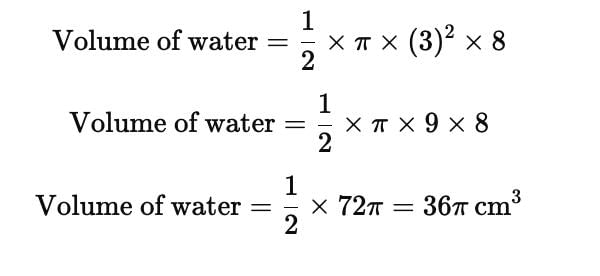
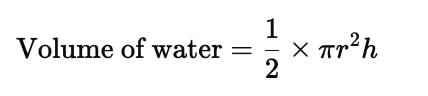
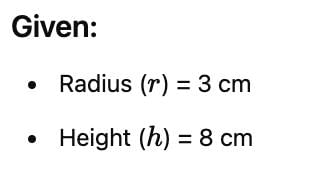
A glass in the form of a right circular cylinder is half full of water. Its base radius is 3 cm and height is 8 cm. The volume of water is
Detailed Solution for Test: Mensuration- 1 - Question 9


Test: Mensuration- 1 - Question 10

A water tank is in the shape of a cuboid of dimensions 6 m × 5 m × 4 m. The capacity of the tank is

Detailed Solution for Test: Mensuration- 1 - Question 10

Volume = 6×5×4 = 120 m3
1 m3 = 1000 L
So capacity = 120000 L

Test: Mensuration- 1 - Question 11

The height of a cylinder whose radius is 7 cm and the total surface area is 968 cm2 is:

Detailed Solution for Test: Mensuration- 1 - Question 11

Test: Mensuration- 1 - Question 12

The diagonals of a rhombus are 10 cm and 8 cm. Its area is

Detailed Solution for Test: Mensuration- 1 - Question 12

The correct answer is Option A - 40 cm2

Area = ½ × d1 × d2

Substituting d1 = 10 cm and d2 = 8 cm.

Area = ½ × 10 × 8 = ½ × 80 = 40 cm2

Test: Mensuration- 1 - Question 13
The base radius and height of a right circular cylinder are 5 cm and 10 cm. Its total surface area is
Detailed Solution for Test: Mensuration- 1 - Question 13

The total surface area of a right circular cylinder is calculated using the formula:

Total Surface Area = 2πr (r + h)

Given:

  • r = 5 cm
  • h = 10 cm

Substituting these values into the formula gives:

Total Surface Area = 2π × 5 × (5 + 10)

Total Surface Area = 10π × 15

Total Surface Area = 150π cm2

Test: Mensuration- 1 - Question 14

The total surface area of a cube of side 7 cm is

Detailed Solution for Test: Mensuration- 1 - Question 14

The correct answer is Option C - 294 cm2

Use the formula 6a2 for the total surface area of a cube, where a is the side length.

Here a = 7 cm.

So a2 = 49 cm2.

Now compute 6 × 49 = 294.

Therefore the total surface area is 294 cm2, which corresponds to Option C.

Test: Mensuration- 1 - Question 15

The formula for finding total surface area of cuboid is  

Detailed Solution for Test: Mensuration- 1 - Question 15

What is the lateral surface area of a cuboid of length l ...
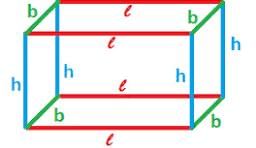
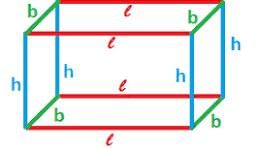
Lets break the figure -
It has 6 surfaces.
Area of bottom surface = L * B
Area of Top Surface = L * B
Area of Right side surface = B * H
Area of Left Side surface  = B * H
Area of front Surface = H * L
Area of Back surface = H * L 
Total surface area of Cuboid = sum of all the surfaces.
=> (Bottom surface area + Top surface area + Right side surface area + Left side surface area + front side surface area
back side surface area)
=> (LB + LB + BH + BH + HL + HL)
=> (2LB + 2BH + 2HL)
=> 2(LB + BH + HL)
hence option B is correct.

Test: Mensuration- 1 - Question 16

The formula for lateral surface area of cuboid is  

Detailed Solution for Test: Mensuration- 1 - Question 16

What is the lateral surface area of a cuboid of length l ...
Lateral surface area -> Total Surface area of cuboid - surface area of Top and Bottom Surfaces.
=> 2LB + 2BH + 2HL - LB - LB
=> 2BH + 2HL
=> 2H(L + B)
hence option A is correct 

Test: Mensuration- 1 - Question 17

The height of cuboid  whose volume is 200 cm3 and base  area is 20 cm2 is

Detailed Solution for Test: Mensuration- 1 - Question 17

Base area = length * breadth = 20 sq.cm
Now,
Volume of cuboid = length * breadth * height
Volume = 20 * height
200 = 20 * height
Height = 200 / 20 = 10 cm.

Test: Mensuration- 1 - Question 18

If each edge of a cube is doubled, its surface are will increase

Detailed Solution for Test: Mensuration- 1 - Question 18

Lets  take the original side of cube be S, and final side be 2S.
Orginal surface area will be => 6 * S * S
Final surface area will be => 6 * 2S * 2S
=> 4 * (6 * S * S)
=> 4 times orginal surface area.
Hence the option C is correct.

Test: Mensuration- 1 - Question 19

The formula for finding total surface area of cylinder is 

Detailed Solution for Test: Mensuration- 1 - Question 19

The total surface area (TSA) of a cylinder includes the areas of the two circular bases and the lateral surface area. The formula is derived as follows:

  • Area of the two circular bases: 2 × πr2
  • Lateral surface area: 2πrh
  • Total Surface Area: 2πr2 + 2πrh = 2πr(r + h)

Thus, the correct answer is option B.

Test: Mensuration- 1 - Question 20

If the base of rhombus of 7 cm and its altitude is 4 cm, its area will be    

Detailed Solution for Test: Mensuration- 1 - Question 20

Base =  7 cm
Height  = 4 cm
Area of  Rhombus = Base × Height
= 7 × 4
= 28 cm2

112 videos|658 docs|49 tests
Information about Test: Mensuration- 1 Page
In this test you can find the Exam questions for Test: Mensuration- 1 solved & explained in the simplest way possible. Besides giving Questions and answers for Test: Mensuration- 1, EduRev gives you an ample number of Online tests for practice
112 videos|658 docs|49 tests
Download as PDF