Humanities/Arts Exam  >  Humanities/Arts Test  >  History Class 12  >  Test: Bricks, Beads & Bones- 1 - Humanities/Arts MCQ

Test: Bricks, Beads & Bones- 1 - Humanities/Arts MCQ


Test Description

10 Questions MCQ Test History Class 12 - Test: Bricks, Beads & Bones- 1

Test: Bricks, Beads & Bones- 1 for Humanities/Arts 2026 is part of History Class 12 preparation. The Test: Bricks, Beads & Bones- 1 questions and answers have been prepared according to the Humanities/Arts exam syllabus.The Test: Bricks, Beads & Bones- 1 MCQs are made for Humanities/Arts 2026 Exam. Find important definitions, questions, notes, meanings, examples, exercises, MCQs and online tests for Test: Bricks, Beads & Bones- 1 below.
Solutions of Test: Bricks, Beads & Bones- 1 questions in English are available as part of our History Class 12 for Humanities/Arts & Test: Bricks, Beads & Bones- 1 solutions in Hindi for History Class 12 course. Download more important topics, notes, lectures and mock test series for Humanities/Arts Exam by signing up for free. Attempt Test: Bricks, Beads & Bones- 1 | 10 questions in 10 minutes | Mock test for Humanities/Arts preparation | Free important questions MCQ to study History Class 12 for Humanities/Arts Exam | Download free PDF with solutions
Test: Bricks, Beads & Bones- 1 - Question 1

Assertion (A): The Harappan civilization's burial practices reveal significant social differences among its members.

Reason (R): Artifacts such as jewelry and pottery found in graves indicate a belief in their utility in the afterlife.

Detailed Solution for Test: Bricks, Beads & Bones- 1 - Question 1

- Assertion (A) is true as archaeological evidence suggests that variations in burial practices, such as the presence of brick-lined pits and grave goods, indicate differing social statuses within the Harappan civilization.

- Reason (R) is also true because the inclusion of items like jewelry and pottery in graves does imply a belief in their usefulness in the afterlife.

- The reason provided supports the assertion by explaining how the graves reflect social differences through the artifacts included. Thus, the reason is indeed the correct explanation of the assertion.

Test: Bricks, Beads & Bones- 1 - Question 2

The Director General of the ASI who brought a military precision to the practice of archaeology was?

Detailed Solution for Test: Bricks, Beads & Bones- 1 - Question 2

Option D is correct - R.E.M. Wheeler.

R.E.M. Wheeler introduced a systematic grid system (often called the Wheeler box-grid method) and insisted on careful recording of contexts and finds.

He emphasised stratigraphic excavation, so that layers and their relationships were preserved and studied rather than being removed mechanically; this approach increased accuracy and control in fieldwork.

His earlier service in the Royal Artillery and his insistence on organisation and discipline in excavations led contemporaries to describe his methods as having military precision.

During his tenure as Director-General of the ASI in the mid-20th century, he applied these methods widely, helping to establish more rigorous, scientific field procedures.

Correct option: D

Test: Bricks, Beads & Bones- 1 - Question 3

Which of the following is true about Mohenjodaro's drainage system?
i. Streets were laid out in a grid pattern with drains.
ii. Drainage systems were constructed after the houses were built.
iii. Each house had drains connected to street drains.
iv. Mohenjodaro lacked a well-designed drainage system.

Detailed Solution for Test: Bricks, Beads & Bones- 1 - Question 3

Mohenjodaro had a well-planned drainage system with streets laid out in a grid pattern. Each house had its own drain connected to the street drains, ensuring a hygienic and organized urban environment.

Test: Bricks, Beads & Bones- 1 - Question 4

In 1875, a report on Harappan seal was published, which was written by

Detailed Solution for Test: Bricks, Beads & Bones- 1 - Question 4

Alexander Cunningham wrote a report on a Harappan seal, which he published in the form of a drawing, in 1875.

Test: Bricks, Beads & Bones- 1 - Question 5

Assertion (A): The Harappan civilization is noted for its advanced urban planning and architecture during the Mature Harappan period.

Reason (R): The archaeological evidence indicates that Harappan settlements featured large buildings and sophisticated drainage systems.

Detailed Solution for Test: Bricks, Beads & Bones- 1 - Question 5
Assertion: The assertion is true as the Harappan civilization is indeed recognized for its advanced urban planning, particularly during the Mature Harappan period.
Reason: The reason is also true, as extensive archaeological findings support the presence of large buildings and complex drainage systems in Harappan cities, indicating advanced urban infrastructure.
Explanation: The reason provides a correct explanation for the assertion since the urban planning and architectural achievements of the Harappan civilization are supported by the evidence of large structures and sophisticated infrastructure. Thus, both the Assertion and Reason are true, and the Reason correctly explains the Assertion.
Test: Bricks, Beads & Bones- 1 - Question 6

Arrange the following phases of the Harappan civilization in the correct chronological order:

  1. Mature Harappan
  2. Late Harappan
  3. Early Harappan
Detailed Solution for Test: Bricks, Beads & Bones- 1 - Question 6
Early Harappan (6000 BCE - 2600 BCE): This is the formative phase of the civilization.
Mature Harappan (2600 BCE - 1900 BCE): This is the period of urban prosperity and growth.
Late Harappan (1900 BCE - 1300 BCE): This phase marks the decline of the Harappan civilization.
Test: Bricks, Beads & Bones- 1 - Question 7

What was the purpose of the Great Bath in Mohenjodaro's Citadel?
i. It was used as a special ritual bath.
ii. It served as a water reservoir for agriculture.
iii. It was a place for public gatherings and celebrations.
iv. The Great Bath had eight connected bathrooms.
Detailed Solution for Test: Bricks, Beads & Bones- 1 - Question 7

Correct option: C - i and iii.

i is correct because the tank was specially constructed with watertight lining, steps and a surrounding paved area, features that support its interpretation as a place for ritual bathing.

iii is correct because the design with surrounding spaces and a gallery indicates communal use; scholars read this as evidence for public ceremonies or communal bathing connected with ritual activity.

ii is incorrect since the structure is sealed and there is no archaeological evidence of outlets or channels that would have distributed water for agriculture.

Sources note that several small rooms adjoined the tank (often counted as eight); these likely served as changing or washing rooms. This is a structural detail about the complex, not a statement of the Bath's purpose, so it does not change the correct purpose-based choices.

Hence the correct combination of purpose-related statements is i and iii (option C).

Test: Bricks, Beads & Bones- 1 - Question 8

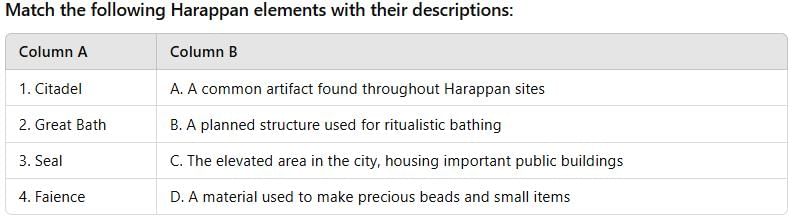
Detailed Solution for Test: Bricks, Beads & Bones- 1 - Question 8
Citadel (C): The Citadel was an elevated area in Harappan cities used for important buildings.
Great Bath (B): The Great Bath was used for ritualistic bathing, located within the Citadel.
Seal (A): Seals were common artifacts, often featuring undeciphered scripts and animal motifs.
Faience (D): Faience was a material used to craft beads and other small valuable items.
Test: Bricks, Beads & Bones- 1 - Question 9

Given below are two statements about the Harappan civilization:

  • Statement I: The Harappan civilization's decline is solely attributed to the drying up of rivers.
  • Statement II: The Harappan script has been fully deciphered, providing detailed insights into their political structure.

Choose the correct answer from the options below:

Detailed Solution for Test: Bricks, Beads & Bones- 1 - Question 9

Correct option: B

Statement I is false. Archaeological and environmental evidence indicates that the decline was caused by multiple factors such as climate change, river-system shifts (including drying or changes of river courses), a reduction in long-distance trade, and socio-economic changes. It is not accurate to attribute the decline solely to drying rivers.

Statement II is false. The Harappan script remains undeciphered. The surviving inscriptions are typically very short and no bilingual texts exist that would allow a secure decipherment, so we do not have direct epigraphic evidence to reconstruct detailed political structures.

Conclusion: Both statements are false; therefore option B is correct.

Test: Bricks, Beads & Bones- 1 - Question 10

Which of the following best describes the layout of Mohenjodaro?

Detailed Solution for Test: Bricks, Beads & Bones- 1 - Question 10

Mohenjodaro was designed as a well-planned urban center featuring a grid layout, with streets and roads that facilitated efficient movement and drainage. The city was divided into two main sections: the Citadel and the Lower Town, which showcased advanced urban planning that included standardized brick sizes and organized building platforms. This meticulous design reflects the sophistication of the Harappan civilization.

30 videos|321 docs|25 tests
Information about Test: Bricks, Beads & Bones- 1 Page
In this test you can find the Exam questions for Test: Bricks, Beads & Bones- 1 solved & explained in the simplest way possible. Besides giving Questions and answers for Test: Bricks, Beads & Bones- 1, EduRev gives you an ample number of Online tests for practice
30 videos|321 docs|25 tests
Download as PDF



