NEET Exam  >  NEET Test  >  Physics Class 11  >  Test: Universal Law of Gravitation - NEET MCQ

Test: Universal Law of Gravitation - NEET MCQ


Test Description

15 Questions MCQ Test Physics Class 11 - Test: Universal Law of Gravitation

Test: Universal Law of Gravitation for NEET 2026 is part of Physics Class 11 preparation. The Test: Universal Law of Gravitation questions and answers have been prepared according to the NEET exam syllabus.The Test: Universal Law of Gravitation MCQs are made for NEET 2026 Exam. Find important definitions, questions, notes, meanings, examples, exercises, MCQs and online tests for Test: Universal Law of Gravitation below.
Solutions of Test: Universal Law of Gravitation questions in English are available as part of our Physics Class 11 for NEET & Test: Universal Law of Gravitation solutions in Hindi for Physics Class 11 course. Download more important topics, notes, lectures and mock test series for NEET Exam by signing up for free. Attempt Test: Universal Law of Gravitation | 15 questions in 60 minutes | Mock test for NEET preparation | Free important questions MCQ to study Physics Class 11 for NEET Exam | Download free PDF with solutions
Test: Universal Law of Gravitation - Question 1

According to Newton's Universal Law of Gravitation, the gravitational force between two point masses is:

Detailed Solution for Test: Universal Law of Gravitation - Question 1

The correct answer is Option C - Directly proportional to the product of their masses and inversely proportional to the square of the distance between them

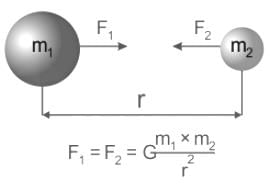
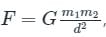
The magnitude of the gravitational force between two point masses m₁ and m₂ separated by a distance r is given by F = G m₁ m₂ / r2.

Here G is the gravitational constant with approximate value 6.67 × 10⁻¹¹ N m2 kg-2.

From the formula, the force is directly proportional to the product of the masses, so F ∝ m₁ m₂; for example, doubling one mass doubles the force.

The force is inversely proportional to the square of the distance, so F ∝ 1 / r2; for example, doubling r reduces the force to one quarter.

In vector form the force is attractive along the line joining the masses: ⃗F = -G m₁ m₂ / r2, the negative sign indicating attraction toward the other mass.

These proportionalities and the formula confirm that Option C correctly states the dependence of gravitational force on the masses and separation.

Topic in NCERT: Universal law of gravitation

Line in NCERT: "every body in the universe attracts every other body with a force which is directly proportional to the product of their masses and inversely proportional to the square of the distance between them."

Test: Universal Law of Gravitation - Question 2

The value of universal gravitational constant G in SI units is approximately:

Detailed Solution for Test: Universal Law of Gravitation - Question 2

The correct answer is Option A - 6.67 × 10⁻¹¹ N m² kg⁻²

F = G m1 m2 / r2 is the mathematical form of the universal law of gravitation, where G is the constant of proportionality.

Rearranging gives G = F r2 / (m1 m2), so the SI units of G follow from the units of force, distance and mass.

Thus [G] = N · m2 · kg-2, which matches the unit shown in the correct option.

The experimentally determined numerical value in SI units is approximately 6.67 × 10⁻¹¹, so the full SI expression is 6.67 × 10⁻¹¹ N m2 kg-2.

Topic in NCERT: The gravitational constant

Line in NCERT: "the currently accepted value is g = 6.67 × 10^-11 n m²/kg²."

Test: Universal Law of Gravitation - Question 3

Two bodies of masses 100 kg and 10000 kg are at a distance of 1 m apart. The gravitational force between them is approximately
(G = 6.67 × 10⁻¹¹ N m² kg⁻²):

Detailed Solution for Test: Universal Law of Gravitation - Question 3

The correct answer is Option D - 6.67 × 10⁻⁵ N

F = G \t m1 \t m2 / r2

Given G = 6.67 × 10⁻¹¹ N m2 kg-2, m1 = 100 kg, m2 = 10000 kg, r = 1 m.

m1 · m2 = 100 × 10000 = 1000000

Substituting, F = 6.67 × 10-11 × 1000000 / 12 = 6.67 × 10⁻⁵ N

Hence the magnitude of the gravitational force is 6.67 × 10⁻⁵ N, which matches the stated option.

Topic in NCERT: Universal law of gravitation

Line in NCERT: "newton's law of universal gravitation states that the gravitational force of attraction between any two particles of masses m₁ and m₂ separated by a distance r has the magnitude f = g(m₁m₂/r²)."

Test: Universal Law of Gravitation - Question 4
If the distance between two masses is doubled, the gravitational force between them becomes:
Detailed Solution for Test: Universal Law of Gravitation - Question 4

The correct answer is Option C - One-fourth of the original value

According to Newton's law of universal gravitation, the magnitude of the force between two point masses is given by

F = G m1 m2 / r2

For a new separation r' = 2r, the gravitational force becomes

F' = G m1 m2 / (r')2

F' = G m1 m2 / (2r)2 = G m1 m2 / (4 r2)

Since F = G m1 m2 / r2, it follows that F' = F / 4.

Therefore the gravitational force becomes one-fourth of the original value, confirming Option C.

Topic in NCERT: Universal law of gravitation

Line in NCERT: "every body in the universe attracts every other body with a force which is directly proportional to the product of their masses and inversely proportional to the square of the distance between them."

Test: Universal Law of Gravitation - Question 5
Which of the following statements regarding gravitational force are correct?
A. Gravitational force is always attractive
B. Gravitational force depends on the medium
C. Gravitational force is a central force
D. Gravitational force obeys inverse square law
E. Gravitational force is the strongest force
Detailed Solution for Test: Universal Law of Gravitation - Question 5

The correct answer is Option A - A, C and D only

Statement A is true because gravitational force between two masses is always attractive; two masses always attract each other under classical gravity.

Statement B is false because gravitational interaction depends on the masses involved and their separation, not on the material medium; gravity acts through vacuum as well as through matter.

Statement C is true since a central force is one that acts along the line joining two bodies and depends only on their separation; gravitational force meets both conditions.

Statement D is true because the magnitude of gravitational force follows an inverse-square law.

F = G m1 m2 / r2

Statement E is false; gravity is the weakest of the fundamental interactions, much weaker than the electromagnetic and strong nuclear forces.

Topic in NCERT: Gravitation

Line in NCERT: "the gravitational force is attractive, i.e., the force f is along - r."

Test: Universal Law of Gravitation - Question 6
The dimensional formula of universal gravitational constant G is:
Detailed Solution for Test: Universal Law of Gravitation - Question 6

The correct answer is Option C - M⁻¹ L³ T⁻²

Using the law of gravitation between two point masses, F = G m1 m2 / r2.

The dimensional symbol of force is [F] = M L T-2.

The dimensional symbols of mass and distance are [m] = M and [r] = L, respectively.

Rearranging the relation to find G gives [G] = [F][r]2 / [m]2.

Substituting dimensions: [G] = (M L T-2)(L2)/(M2).

Simplifying yields [G] = M-1 L3 T-2, which matches Option C.

Topic in NCERT: Dimensions unit

Line in NCERT: "dimensions unit [m l³ t⁻²]"

Test: Universal Law of Gravitation - Question 7

Match List-I with List-II:

List-I
(A) Gravitational force
(B) Gravitational constant G
(C) Gravitational field
(D) Gravitational potential

List-II
(I) Universal constant
(II) Obeys inverse square law
(III) Vector quantity
(IV) Scalar quantity

Detailed Solution for Test: Universal Law of Gravitation - Question 7

The correct answer is Option B - (A)-(II), (B)-(I), (C)-(III), (D)-(IV)

F = G m1 m2 / r2

A(II): The magnitude of the quantity represented by A varies as 1/r2, so it obeys the inverse square law; its direction is along the line joining the bodies.

B(I): The symbol G is a universal constant; its measured value is 6.67×10⁻¹¹ N m2 kg-2, and it appears in the law shown above.

C(III): The quantity represented by C is a vector; it is defined as force per unit mass and has both magnitude and direction. g = F / m

D(IV): The quantity represented by D is a scalar; it has magnitude only and, for a point mass, is given by the expression below. V = - G M / r

Test: Universal Law of Gravitation - Question 8
Two point masses m₁ and m₂ are separated by a distance r.
If both masses are doubled and the distance is halved, the gravitational force becomes:
Detailed Solution for Test: Universal Law of Gravitation - Question 8

The correct answer is Option C - 16 times the original force

According to Newton's law of gravitation, the force is given by F = G m1 m2 / r2, where G is the gravitational constant.

Both masses are doubled, so they become 2 m1 and 2 m2, and the distance is halved to r/2.

The new force is F' = G (2 m1)(2 m2) / (r/2)2.

Simplifying, the numerator gives 4 m1 m2 and the denominator is r2/4, so F' = G (4 m1 m2) / (r2/4).

Thus F' = 4 × 4 × (G m1 m2 / r2) = 16 F, i.e., the force becomes 16 times the original value.

Topic in NCERT: Universal law of gravitation

Line in NCERT: "every body in the universe attracts every other body with a force which is directly proportional to the product of their masses and inversely proportional to the square of the distance between them."

Test: Universal Law of Gravitation - Question 9
Consider the following statements:
Statement I: Gravitational force between two bodies is independent of the medium.
Statement II: Gravitational force acts along the line joining the centres of the two bodies.
Detailed Solution for Test: Universal Law of Gravitation - Question 9

The correct answer is Option B - Both statements are correct but Statement II does not explain Statement I

Statement I is true because, in classical gravity, the force depends only on the masses involved and their separation; the intervening material does not change the gravitational interaction between the masses.

F = G m1 m2 / r2

In the formula above, G is the gravitational constant, and m1, m2 and r are the two masses and the distance between them; none of these quantities is altered by placing a medium between the masses, and classical gravity has no shielding, so the force is independent of the medium.

Statement II is also true because the gravitational force between two point masses is directed along the line of the relative position vector; for extended bodies with spherical symmetry, the shell theorem shows the net force is as if the entire mass were concentrated at the centre, so the direction is along the line joining their centres.

Statement II gives the direction of the force but does not address the dependence (or independence) on the intervening medium; independence follows from the dependence on masses, distance and G, not from the force's direction.

Statement II does not explain Statement I. Therefore Option B is correct.

Topic in NCERT: Gravitational forces and shielding

Line in NCERT: "gravitational shielding is not possible."

Test: Universal Law of Gravitation - Question 10
Three equal masses each of mass m are placed at the corners of an equilateral triangle of side a.
The gravitational force on any one mass due to the other two is:
Detailed Solution for Test: Universal Law of Gravitation - Question 10

The correct answer is Option C - √3 × G × m² / a²

Each of the other two masses exerts a gravitational force of magnitude Gm2/a2 on the chosen mass.

The two forces are symmetrically placed with an angle of 60° between them.

For two equal forces F with angle θ between them, the resultant magnitude is R = 2F cos(θ/2).

Here F = Gm2/a2 and θ = 60°, so cos(θ/2) = cos30° = √3/2.

R = 2 × (Gm2/a2) × (√3/2)

R = √3 × Gm2/a2

Thus the magnitude of the resultant gravitational force equals √3 × G × m² / a², which corresponds to Option C.

Topic in NCERT: Gravitation

Line in NCERT: "example 7.2 three equal masses of mkg each are fixed at the vertices of an equilateral triangle abc."

Test: Universal Law of Gravitation - Question 11
The gravitational force between two bodies is F.
If one mass is increased by 50 percent and the distance is reduced to 75 percent of the original value, the new force will be:
Detailed Solution for Test: Universal Law of Gravitation - Question 11

The correct answer is Option D - 8F / 3

Using Newton's law of gravitation, the force is given by F = G m1 m2 / r2.

One mass is increased by 50%, so it becomes 1.5 m1 (= 3/2 m1), and the separation is reduced to 75% of original, so r' = 0.75 r (= 3/4 r).

The new force is F' = G (1.5 m1) m2 / (0.75 r)2.

Taking the ratio with the original force, F'/F = (3/2) / (3/4)2.

Evaluating, (3/2) / (9/16) = (3/2) × (16/9) = 8/3, so F' = (8/3) F.

Therefore the new force equals 8F / 3, which matches Option D.

Test: Universal Law of Gravitation - Question 12
Which of the following properties are associated with gravitational force?
A. It is the weakest fundamental force
B. It is a conservative force
C. It is a short-range force
D. It follows the principle of superposition
E. It can be shielded
Detailed Solution for Test: Universal Law of Gravitation - Question 12

The correct answer is Option A - A, B and D only

Weakest fundamental force: Gravitational interaction is far weaker than the other fundamental forces (strong, electromagnetic, weak); this is why it is described as the weakest fundamental force.

Conservative force: The work done by gravity between two points is independent of the path taken, so the gravitational force is conservative. For any closed path, the net work by gravity is zero.

Short-range - not true: gravity acts over arbitrary distances and is a long-range force, decreasing with distance but never becoming exactly zero.

F = G m1 m2 / r2

This inverse-square dependence shows that gravitational influence extends indefinitely, though it weakens with increasing r.

Principle of superposition: Gravitational forces from multiple masses add vectorially; the net gravitational force is the vector sum of individual forces, so the principle of superposition holds.

Can be shielded - not true: there is no known material or method that blocks or shields gravity; gravitational effects cannot be screened in the way electromagnetic fields can, so gravity is effectively unshieldable.

Topic in NCERT: Gravitational forces and shielding

Line in NCERT: "gravitational shielding is not possible."

Test: Universal Law of Gravitation - Question 13
Two spherical bodies of masses M and 5M and radii R and 2R are released in free space with initial separation between their centres equal to 12R.
The distance covered by the smaller body before collision is:
Detailed Solution for Test: Universal Law of Gravitation - Question 13

The correct answer is Option C - 10R

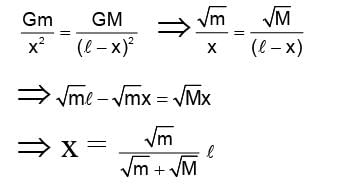
Because there is no external force, the position of the centre of mass is fixed; hence the displacements of the two masses about their initial positions satisfy m1Δx1 = m2Δx2.

The reduction in separation between the centres from initial to contact is 12R - 3R = 9R, so the magnitudes of the displacements satisfy Δx1 + Δx2 = 9R.

With m1 = M and m2 = 5M, the centre-of-mass relation gives Δx1 = 5Δx2. Substituting into the sum, 5Δx2 + Δx2 = 9R, so 6Δx2 = 9R and Δx2 = 1.5R.

Therefore Δx1 = 5×1.5R = 7.5R, so the smaller body travels 7.5R before collision.

Since 7.5R is not among the listed options, none of the given choices is correct.

Test: Universal Law of Gravitation - Question 14
Consider the following statements about Newton's Law of Gravitation:
Statement I: The law is applicable only to point masses or spherically symmetric bodies.
Statement II: For extended bodies, the gravitational force can be calculated by integrating over all mass elements.
Detailed Solution for Test: Universal Law of Gravitation - Question 14

The correct answer is Option B - Statement I is incorrect but Statement II is correct

The law of universal gravitation gives the force between two point masses as F = G m1 m2 / r2, directed along the line joining them, where G is the gravitational constant.

Statement I is incorrect because the law itself is universal and applies to every pair of mass elements; the simple closed form F = G m1 m2 / r2 is valid directly only for point masses or when an extended body is spherically symmetric and the force on an external point can be treated as if the entire mass were concentrated at the centre.

Statement II is correct because, for an extended body, the total gravitational force is obtained by the principle of superposition by summing (integrating) contributions of all mass elements. For a point mass m interacting with a continuous mass distribution with density ρ(r'), a differential force is dF = G m·dm / r2 (with vector direction along the line joining the elements), and the net force is found by integrating over the body's volume.

In vector form, for a point at position r acted on by a continuous distribution ρ(r'), the force can be written as F = G m ∫ ρ(r') (r' - r) / |r' - r|3 dV', which implements the required integration over all mass elements.

Therefore, the correct assessment is that the first statement is false while the second statement is true, so Option B is correct.

Topic in NCERT: Gravitation

Line in NCERT: "before we can apply eq. (7.5) to objects under consideration, we have to be careful since the law refers to point masses whereas we deal with extended objects which have finite size."

Test: Universal Law of Gravitation - Question 15
A body of mass m is placed at a distance r from the centre of the Earth.
If the distance is increased to 2r, the ratio of gravitational force in the first case to that in the second case is:
Detailed Solution for Test: Universal Law of Gravitation - Question 15

The correct answer is Option D - 4 : 1

According to Newton's law of gravitation, the gravitational force between two point masses is given by F = G M m / r2.

Let the force at the first distance be F1 = G M m / r2.

At twice the distance the force is F2 = G M m / (2r)2 = G M m / 4 r2.

Therefore, the ratio F1 : F2 = (G M m / r2) : (G M m / 4 r2) which simplifies to 4 : 1.

Topic in NCERT: Gravitation

Line in NCERT: "the force due to this smaller sphere is just as if the entire mass of the smaller sphere is concentrated at the centre."

97 videos|376 docs|102 tests
Information about Test: Universal Law of Gravitation Page
In this test you can find the Exam questions for Test: Universal Law of Gravitation solved & explained in the simplest way possible. Besides giving Questions and answers for Test: Universal Law of Gravitation, EduRev gives you an ample number of Online tests for practice
97 videos|376 docs|102 tests
Download as PDF