All Exams   >   Grade 3 Exam

Prepare for Grade 3 Exam
with EduRev

All you need for Grade 3 Exam Exam preparation covering complete
Grade 3 syllabus
442 K+K+
Grade 3 Students on EduRev
4.6/5/5
12k+ ratings on Google Play
20 Million+Million+
Docs & Videos viewed
155 Million+Million+
MCQs attempted in Tests
Everything you need for your Exam at one place
EduRev features
2500+ Notes
With relevant content to help you prepare for exams in the best way
EduRev features
600+ Tests
Practice every topic with over 15M+ questions in 75K+ tests
EduRev features
850+ Videos
With 100K+ videos & 250K+ notes clear all your concepts
EduRev features
80+ Courses
With 1000+ courses you can prepare for every exam!
EduRev features
10k+ Doubts
The best teachers and fellow students to help you out
Why students choose EduRev for their Grade 3 Exam4.6 (150K+ ratings)
Why students choose EduRev for their Grade 3 Exam
4.6 (150K+ ratings)

Complete Overview of Grade 3 Subjects and Online Courses

Grade 3 is a truly important milestone in a child's academic journey. Students aged 8 to 9 years begin transitioning from "learning to read" to "reading to learn," making this the right time to build strong foundations across all subjects. The Class 3 syllabus covers a wide range of areas - English, Mathematics, Science, History, Geography, and even exciting newer subjects like coding and yoga.
For Indian parents and students looking for structured Grade 3 online courses, EduRev offers a comprehensive collection tailored specifically for this age group. Here's a quick snapshot of the core subjects available:

Subject AreaCourses Available on EduRev
EnglishEnglish Language, Grammar, Spelling Bee, Reading Comprehension, Cursive Writing
MathematicsMathematics, Mental Maths, Vedic Maths, Abacus
Science & Social StudiesScience, History, Geography
Skill DevelopmentHTML, Yoga, Fun Learning Games, Stories & Rhymes
These best courses for Grade 3 students are designed to make learning engaging while ensuring conceptual clarity at every step.

How to Build Strong English Language and Grammar Skills in Class 3

English is undoubtedly the backbone of academic learning at this stage. The English Language for Grade 3 course on EduRev covers reading, writing, listening, and communication skills in an age-appropriate manner.

For grammar specifically, Grade 3 students need to get comfortable with parts of speech - nouns, verbs, adjectives, and pronouns - along with punctuation, tenses, and sentence construction. The English Grammar Class 3 course and the English Grammar for Junior Classes course together provide thorough practice through worksheets and exercises.

Key Grammar Topics for Grade 3

  • Identifying and using nouns, verbs, and adjectives correctly
  • Understanding simple, compound, and complex sentences
  • Punctuation: full stops, commas, question marks, and exclamation marks
  • Basic tenses: present, past, and future
  • Building vocabulary using dictionary words

Students can also explore English Grammar Basic for foundational revision, and use Dictionary Words resources to independently understand word meanings, pronunciations, and usage.

Best Mental Maths and Vedic Mathematics Techniques for Grade 3 Students

Mathematics at Grade 3 goes well beyond simple addition and subtraction. Building calculation speed and number sense is critical, and that's where Mental Maths and Vedic Mathematics come in. The Mental Maths course trains students to perform arithmetic operations entirely in their heads - a skill that boosts both confidence and speed.

Vedic Mathematics, derived from ancient Indian scriptures called the Vedas and popularized by Jagadguru Swami Sri Bharati Krishna Tirthaji Maharaja, offers simple sutras (techniques) that make multiplication, division, and other operations much faster. The Vedic Mathematics for Junior Classes course introduces these tricks in a child-friendly way. The Mathematics for Grade 3 course complements this with curriculum-aligned content.

Why These Techniques Matter

  • Mental maths tricks for Class 3 reduce dependency on calculators early on
  • Vedic maths builds a strong love for numbers through pattern recognition
  • Regular mental maths practice for Class 3 improves exam performance significantly

What Is Abacus Learning and Why Is It Important for Grade 3 Kids?

The Abacus is one of the oldest calculating tools in history, originating thousands of years ago and widely used across Asia. In modern school education, abacus learning for beginners is recognised as a powerful way to develop arithmetic ability, concentration, and memory in young children. Research also suggests abacus training positively impacts spatial reasoning in kids.

The Abacus course on EduRev is specifically designed for abacus maths for Class 3 learners - breaking down the learning process step by step. Students who complete abacus training often show noticeably improved mental calculation speed, making it one of the best abacus courses for Grade 3.

Mastering Reading Comprehension and Spelling Bee Preparation for Class 3

Two skills that significantly strengthen overall English proficiency are reading comprehension and spelling. Reading comprehension for Grade 3 helps children identify the main idea, supporting details, and sequence of events while building vocabulary in context. The Reading Comprehension for Junior Classes course offers structured exercises and passages ideal for this age group.

The Spelling Bee for Class 3 is both a school activity and a competitive event that sharpens phonemic awareness, vocabulary, and public speaking confidence. Consistent practice with the Spelling Bee course on EduRev helps students prepare with graded word lists and practice drills.

Quick Tips for Spelling Bee Preparation

  • Practise spelling Bee words for Grade 3 in groups of 10 each day
  • Use the words in sentences to understand their meaning and context
  • Review pronunciation alongside spelling for better retention

Science, History, and Geography for Grade 3: Key Topics Every Student Should Know

The Social Studies and Science subjects at Grade 3 lay the groundwork for understanding the world - both the natural and the human-made. Let's break down what each covers:

SubjectKey TopicsEduRev Course
SciencePlants, animals, matter, weather, human bodyScience for Grade 3
HistoryCommunity, timelines, local history, notable figuresHistory for Grade 3
GeographyMaps, landforms, water bodies, continents, climateGeography for Grade 3

Class 3 History topics help children develop a sense of chronology and community belonging, while Class 3 Geography topics introduce map-reading and an understanding of Earth's physical features. Together with Science, these subjects build a well-rounded learner.

How to Improve Cursive Writing Skills for Grade 3 Students

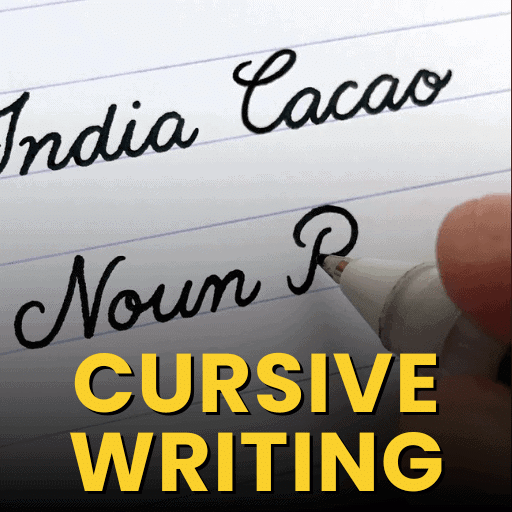
Cursive writing is more than just an aesthetic skill - educational research confirms it supports fine motor development, cognitive processing, and even reading fluency. The Cursive Writing for English course is a great starting point, while the Cursive Writing for English & Hindi course is especially valuable for bilingual learners, helping them develop coordination across both languages simultaneously.

How to Learn Cursive Writing for Kids - Step by Step

  1. Start with individual letter formation before connecting letters
  2. Practise on ruled sheets for consistent letter sizing
  3. Focus on maintaining uniform slant and spacing
  4. Gradually move to writing full words and then short sentences

Fun Learning Activities, Games, Stories, and Rhymes for Grade 3 Kids

Not all learning has to happen through textbooks! For 8-year-olds, fun learning games for Grade 3 kids and interactive activities are among the most effective ways to improve engagement and retention. The Fun Learning with Games course on EduRev makes this possible with educational games designed for Grade 3 concepts.

Stories and rhymes play an equally important role. Global literacy organisations affirm that storytelling and reading aloud are among the most effective early literacy strategies. The Fun Stories and Rhymes course builds vocabulary, phonological awareness, and a genuine love for reading in young learners.

Introduction to HTML and Yoga for Young Learners in Grade 3

Two exciting additions to the Grade 3 learning journey are HTML coding and yoga - preparing children both digitally and physically for the future.

HTML for kids introduces the building blocks of the internet. HTML (HyperText Markup Language) is the standard language for creating web content, maintained by the World Wide Web Consortium (W3C). The HTML for Junior Classes course makes coding accessible to young learners, nurturing computational thinking and digital creativity - skills increasingly essential in today's world.

Yoga, an ancient Indian practice combining asanas, pranayama, and mindfulness, has been recognised globally - with June 21 celebrated as International Day of Yoga. India's NEP 2020 also acknowledges yoga as part of holistic school education. The Yoga: A Healthy Way of Living course helps Grade 3 students improve flexibility, focus, and emotional well-being in a structured, fun manner.

Top Tips for Parents to Support Their Child's Grade 3 Learning Journey

Parents play a pivotal role in helping their child succeed at Grade 3. Here are some practical, actionable tips to support your child's Class 3 learning guide at home:

  • Build a routine: Set aside dedicated time daily for each subject, including fun activities and physical movement.
  • Encourage reading: Use reading comprehension exercises for junior classes to build both skill and habit.
  • Make maths enjoyable: Explore mental maths and abacus activities together to reduce maths anxiety.
  • Support writing practice: Even 10 minutes of cursive writing daily makes a noticeable difference over time.
  • Use EduRev courses: From Science to Abacus and Yoga, EduRev's Grade 3 courses provide structured, curriculum-aligned learning under one roof.
  • Celebrate small wins: Positive reinforcement at this age goes a long way in building a child's confidence and love for learning.

With the right blend of core academics, skill-based learning, and creative activities, Grade 3 can be an incredibly enriching year for every child. Explore all available Grade 3 subjects and courses on EduRev to give your child a strong, well-rounded start.

Grade 3 FAQs

1. What are the main subjects I need to study for Grade 3?
Ans. Grade 3 curriculum typically includes English language arts, mathematics fundamentals, science concepts, and social studies. Students learn basic reading comprehension, arithmetic operations like addition and subtraction, life sciences including plants and animals, and geography basics. The core subjects form the foundation for advanced learning in subsequent years.
2. How can I improve my English reading skills in Grade 3?
Ans. Consistent daily reading practice strengthens comprehension abilities significantly. Students should read age-appropriate storybooks, short stories, and simple texts aloud to improve fluency and pronunciation. Discussing stories with teachers or parents, learning new vocabulary words in context, and answering questions about reading passages develops critical thinking. Regular practice with comprehension exercises builds confidence gradually.
3. What tricks help with Grade 3 maths problems faster?
Ans. Mental maths strategies like breaking numbers into smaller parts and using number bonds accelerate problem-solving. Students benefit from memorising basic multiplication facts and practising skip counting for quick calculations. Visualising problems using fingers or drawing diagrams helps understand concepts better. Consistent daily practise of arithmetic operations transforms speed and accuracy over time.
4. How do I remember all the science facts for Grade 3 exams?
Ans. Creating visual memory aids like colourful flashcards, mind maps, and labelled diagrams strengthens retention significantly. Students learn better by grouping related facts-such as animal habitats together or plant parts as one topic. Acting out processes, watching educational videos, and discussing science concepts aloud with peers reinforces understanding. Spaced revision sessions beat last-minute cramming for lasting memory.
5. What's the best way to study Grade 3 social studies at home?
Ans. Breaking social studies into geography, history, and civics sections makes learning manageable and structured. Students retain information better through maps, timelines, and interactive activities rather than pure memorisation. Reading short stories about historical figures, locating places on maps, and discussing current community events connects abstract concepts to real life. Regular practice tests assess understanding effectively.
6. How should I prepare my child for Grade 3 assessment tests?
Ans. Consistent daily revision of key concepts for ten to fifteen minutes builds strong foundations for Grade 3 assessment preparation. Parents should encourage solving sample question papers, reviewing previous test papers, and practising under timed conditions. Using educational resources like detailed notes, MCQ tests, and visual worksheets from EduRev helps identify weak areas. Regular feedback and positive reinforcement boost confidence before assessments.
7. What should Grade 3 students know about time and money?
Ans. Grade 3 students learn to tell time to the nearest five minutes using analogue clocks and understand the value of currency notes and coins. They practise simple money transactions, making change, and solving basic word problems involving addition of amounts. Understanding concepts like days, weeks, months, and seasons develops temporal awareness. Practical activities with real coins and clock faces reinforce these life skills effectively.
8. How do I help my Grade 3 child with writing assignments?
Ans. Writing improves through regular guided practice with sentence formation, simple paragraph writing, and creative storytelling exercises. Parents should encourage children to write short journals, recount daily events, and answer comprehension questions in complete sentences. Providing constructive feedback on spelling, grammar, and sentence structure without overwhelming students maintains motivation. Celebrating effort rather than perfection fosters positive writing attitudes.
9. What topics come under Grade 3 science curriculum?
Ans. Grade 3 science explores life processes, basic human body systems, plant and animal diversity, weather patterns, and simple physical properties of matter. Students learn about the five senses, food chains, habitats, seasons, and everyday phenomena like light and sound. Practical observation activities and hands-on experiments develop scientific thinking. Understanding living organisms and their environments builds foundational ecological awareness.
10. How can Grade 3 students improve concentration during studies?
Ans. Creating a quiet, distraction-free study space with minimal screen time significantly enhances focus duration for young learners. Breaking study sessions into shorter blocks-twenty to thirty minutes-with brief movement breaks prevents mental fatigue and restlessness. Using flashcards, worksheets, and interactive learning materials keeps engagement high. Establishing consistent study routines at fixed times trains the brain for better attention and retention.
One subscription to unlock all
Grade 3 Courses
View Pricing Plans Starting @ $1 per month
All you need for your Grade 3 exam, get it in your pocket now
Trusted by 442 K+ students
CONNECT WITH US ON
EduRev stands for Education Revolution.
Made with Love ❤️
Copyright © 2026 EduRev Inc