|
 Liberalisation, Privatisation and Globalisation - An Appraisal 48 Flashcards |

Start
|

|
What were the main economic challenges India faced after achieving independence? |

Card: 1 / 48 |
|
|
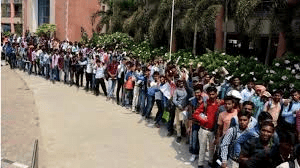
India struggled with unemployment, poverty, population growth, and a reliance on taxation and public sector profits to fund its policies.
|
Card: 2 / 48 |
|
|
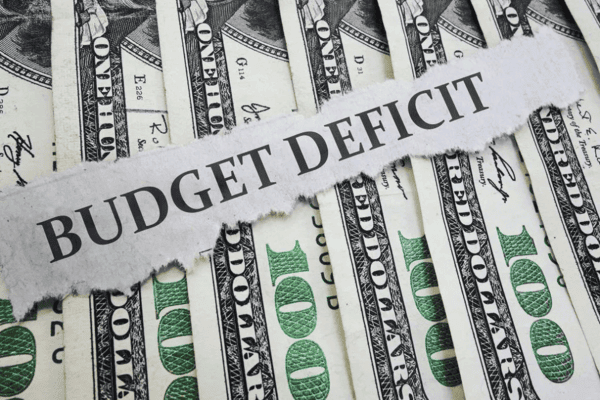
Fill in the blank: The 1991 economic crisis in India was largely due to excessive government ___ and insufficient ___ from exports. |
Card: 3 / 48 |
|
|
Spending; revenue
|
Card: 4 / 48 |

|
|
True or False: The government borrowed heavily in the 1980s because it had a surplus in its budget. |
Card: 5 / 48 |
|
|
False; the government borrowed heavily because its expenditure exceeded income.
|
Card: 6 / 48 |
|
|
What significant policy did India adopt in response to the 1991 economic crisis? |
Card: 7 / 48 |
|
|
India adopted the New Economic Policy (NEP), which focused on liberalization, privatization, and globalization. 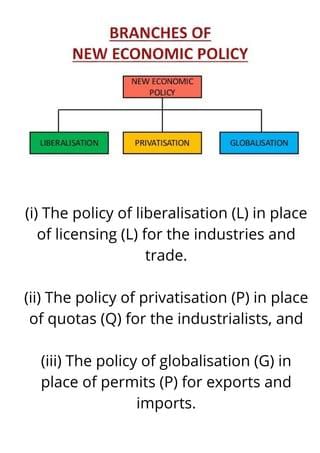 |
Card: 8 / 48 |
|
|
Riddle: I am a strategy to improve economic performance by cutting back on government control and boosting competition. What am I? |
Card: 9 / 48 |
|
|
Liberalization
|
Card: 10 / 48 |

|
|
What role did the International Monetary Fund (IMF) play in India's 1991 economic crisis? |
Card: 11 / 48 |
|
|
The IMF provided a $7 billion loan to India in exchange for implementing economic reforms, including liberalization and reducing government intervention.
|
Card: 12 / 48 |
|
|
Fill in the blank: The government's excessive spending on the ___ sector and defense without immediate returns strained India's financial resources. |
Card: 13 / 48 |
|
|
Social |
Card: 14 / 48 |
|
|
Short Answer: Describe the outcome of the New Economic Policy (NEP) introduced in 1991. |
Card: 15 / 48 |
|
|
The NEP aimed to create a competitive environment by liberalizing the economy, which included reducing trade restrictions and enhancing economic efficiency. |
Card: 16 / 48 |
|
|
What was the primary goal of liberalisation introduced in India? |
Card: 17 / 48 |
|
|
To eliminate restrictive rules and laws that hindered economic growth and development. |
Card: 18 / 48 |
|
|
Fill in the blank: The comprehensive reforms of 1991 marked a significant shift in India's approach to ___ and ___ in the industrial sector. |
Card: 19 / 48 |
|
|
Liberalisation; deregulation |
Card: 20 / 48 |
|
|
True or False: Before 1991, entrepreneurs in India could freely start or close their businesses without any government permission. |
Card: 21 / 48 |
|
|
False; entrepreneurs needed government permission to start, close, or determine production levels for firms. |
Card: 22 / 48 |
|
|
What were the key regulatory mechanisms in the industrial sector before liberalisation? |
Card: 23 / 48 |
|
|
Industrial licensing, sector restrictions, small-scale production limits, and price and distribution controls. |
Card: 24 / 48 |
|
|
 Unlock all Flashcards with EduRev Infinity Plan Starting from @ ₹99 only
|
|
|
|
Riddle: I was abolished for nearly all products except a few, including alcohol and pharmaceuticals. What am I? |
Card: 25 / 48 |
|
|
Industrial licensing. 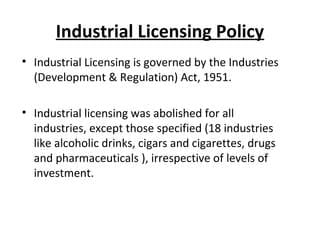 |
Card: 26 / 48 |
|
|
What is one of the key changes that occurred in the small-scale industries after the reforms? |
Card: 27 / 48 |
|
|
Many goods previously restricted to small-scale industries were dereserved. |
Card: 28 / 48 |
|
|
Fill in the blank: The market was allowed to determine ___ in most industries, which reduced government control. |
Card: 29 / 48 |
|
|
Prices |
Card: 30 / 48 |
|
|
What institutions were primarily regulated by the Reserve Bank of India in the financial sector? |
Card: 31 / 48 |
|
|
Banks, investment banks, stock exchanges, and the foreign exchange market. |
Card: 32 / 48 |
|
|
Multiple Choice: Which of the following industries remained reserved for the public sector after the liberalisation reforms? A) Alcohol B) Atomic energy generation C) Pharmaceuticals D) Electronics |
Card: 33 / 48 |
|
|
B) Atomic energy generation. |
Card: 34 / 48 |
|
|
True or False: Financial sector reforms included increasing government control over pricing in the market. |
Card: 35 / 48 |
|
|
False; the reforms aimed to reduce government control over pricing. |
Card: 36 / 48 |
|
|
What was a primary objective of the financial sector reforms in India? |
Card: 37 / 48 |
|
|
To shift the RBI's role from a regulator to a facilitator, allowing the financial sector more autonomy in decision-making. |
Card: 38 / 48 |
|
|
The introduction of the Goods and Services Tax (GST) in 2016 aimed to generate ___ and reduce ___ in the Indian economy. |
Card: 39 / 48 |
|
|
Additional revenue; tax evasion |
Card: 40 / 48 |
|
|
True or False: The foreign exchange market in India was fully liberalized before 1991. |
Card: 41 / 48 |
|
|
False. The foreign exchange market underwent significant changes in 1991. 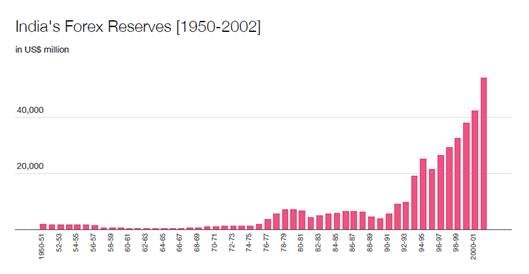 |
Card: 42 / 48 |
|
|
Fill in the blank: The reforms in indirect taxes aimed at establishing a common national market for ___ and ___. |
Card: 43 / 48 |
|
|
Goods; commodities |
Card: 44 / 48 |
|
|
What were the main changes in trade and investment policy reforms introduced in India? |
Card: 45 / 48 |
|
|
Dismantling quantitative restrictions on imports, reducing tariff rates, and eliminating licensing procedures for most imports. |
Card: 46 / 48 |
|
|
Riddle: I am a tax imposed on incomes and profits, gradually reduced to curb evasion. What am I? |
Card: 47 / 48 |
|
|
Direct tax |
Card: 48 / 48 |
|
|
Completed! Keep practicing to master all of them. |

Restart
|