


Class 12 Exam > Class 12 Questions > Find the electric field inside the sphere whi... Start Learning for Free
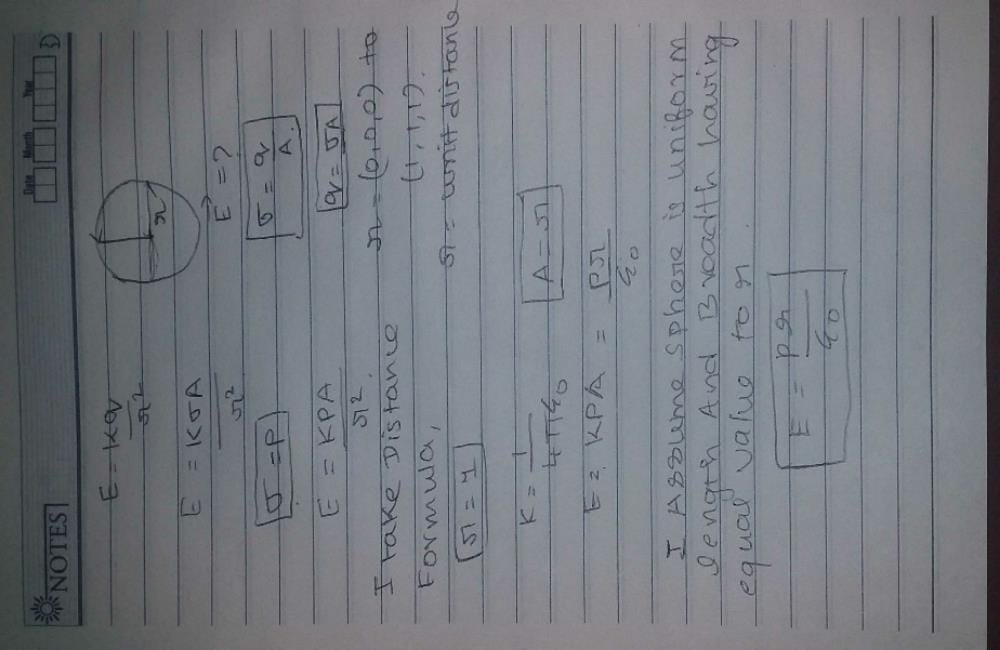
Find the electric field inside the sphere which carries a charge density proportional to the distance from the origin
ρ = kr
ρ = kr
- a)ρ/ε0
- b)ρr/ε0
- c)ρr2/ε0
- d)none of the above
Correct answer is option 'B'. Can you explain this answer?

Most Upvoted Answer
Find the electric field inside the sphere which carries a charge densi...
We can start by using Gauss's Law to find the electric field. Gauss's Law states that the flux of the electric field through any closed surface is proportional to the charge enclosed by the surface. Mathematically, it can be written as:
∮E⋅dA = Qenc/ε0
where E is the electric field, dA is an infinitesimal area element on the surface, Qenc is the charge enclosed by the surface, and ε0 is the permittivity of free space.
In this case, we can choose a spherical Gaussian surface centered at the origin, with radius r. The charge enclosed by this surface is:
Qenc = ∫ρdV
where ρ is the charge density and dV is an infinitesimal volume element. Since the charge density is proportional to the distance from the origin, we can write:
ρ = k r
where k is a constant of proportionality. The integral becomes:
Qenc = ∫ρdV = k ∫r^2sinθdrdθdφ
where the limits of integration are 0 to r for r, 0 to π for θ, and 0 to 2π for φ. Evaluating the integral gives:
Qenc = (4/3)πk r^3
Now we can apply Gauss's Law to find the electric field. The flux of the electric field through the Gaussian surface is:
∮E⋅dA = E(4πr^2)
where we have used the fact that the surface area of a sphere is 4πr^2. Therefore, Gauss's Law gives us:
E(4πr^2) = (4/3)πk r^3/ε0
Solving for E, we get:
E = k r/3ε0
Therefore, the electric field inside the sphere is proportional to the distance from the origin, with a constant of proportionality k/3ε0.
∮E⋅dA = Qenc/ε0
where E is the electric field, dA is an infinitesimal area element on the surface, Qenc is the charge enclosed by the surface, and ε0 is the permittivity of free space.
In this case, we can choose a spherical Gaussian surface centered at the origin, with radius r. The charge enclosed by this surface is:
Qenc = ∫ρdV
where ρ is the charge density and dV is an infinitesimal volume element. Since the charge density is proportional to the distance from the origin, we can write:
ρ = k r
where k is a constant of proportionality. The integral becomes:
Qenc = ∫ρdV = k ∫r^2sinθdrdθdφ
where the limits of integration are 0 to r for r, 0 to π for θ, and 0 to 2π for φ. Evaluating the integral gives:
Qenc = (4/3)πk r^3
Now we can apply Gauss's Law to find the electric field. The flux of the electric field through the Gaussian surface is:
∮E⋅dA = E(4πr^2)
where we have used the fact that the surface area of a sphere is 4πr^2. Therefore, Gauss's Law gives us:
E(4πr^2) = (4/3)πk r^3/ε0
Solving for E, we get:
E = k r/3ε0
Therefore, the electric field inside the sphere is proportional to the distance from the origin, with a constant of proportionality k/3ε0.
Free Test
FREE
| Start Free Test |
Community Answer
Find the electric field inside the sphere which carries a charge densi...
 | Explore Courses for Class 12 exam |  |
Top Courses for Class 12View all





Top Courses for Class 12
Question Description
Find the electric field inside the sphere which carries a charge density proportional to the distance from the originρ = kra)ρ/ε0b)ρr/ε0c)ρr2/ε0d)none of the aboveCorrect answer is option 'B'. Can you explain this answer? for Class 12 2026 is part of Class 12 preparation. The Question and answers have been prepared according to the Class 12 exam syllabus. Information about Find the electric field inside the sphere which carries a charge density proportional to the distance from the originρ = kra)ρ/ε0b)ρr/ε0c)ρr2/ε0d)none of the aboveCorrect answer is option 'B'. Can you explain this answer? covers all topics & solutions for Class 12 2026 Exam. Find important definitions, questions, meanings, examples, exercises and tests below for Find the electric field inside the sphere which carries a charge density proportional to the distance from the originρ = kra)ρ/ε0b)ρr/ε0c)ρr2/ε0d)none of the aboveCorrect answer is option 'B'. Can you explain this answer?.
Find the electric field inside the sphere which carries a charge density proportional to the distance from the originρ = kra)ρ/ε0b)ρr/ε0c)ρr2/ε0d)none of the aboveCorrect answer is option 'B'. Can you explain this answer? for Class 12 2026 is part of Class 12 preparation. The Question and answers have been prepared according to the Class 12 exam syllabus. Information about Find the electric field inside the sphere which carries a charge density proportional to the distance from the originρ = kra)ρ/ε0b)ρr/ε0c)ρr2/ε0d)none of the aboveCorrect answer is option 'B'. Can you explain this answer? covers all topics & solutions for Class 12 2026 Exam. Find important definitions, questions, meanings, examples, exercises and tests below for Find the electric field inside the sphere which carries a charge density proportional to the distance from the originρ = kra)ρ/ε0b)ρr/ε0c)ρr2/ε0d)none of the aboveCorrect answer is option 'B'. Can you explain this answer?.
Solutions for Find the electric field inside the sphere which carries a charge density proportional to the distance from the originρ = kra)ρ/ε0b)ρr/ε0c)ρr2/ε0d)none of the aboveCorrect answer is option 'B'. Can you explain this answer? in English & in Hindi are available as part of our courses for Class 12. Download more important topics, notes, lectures and mock test series for Class 12 Exam by signing up for free.
Here you can find the meaning of Find the electric field inside the sphere which carries a charge density proportional to the distance from the originρ = kra)ρ/ε0b)ρr/ε0c)ρr2/ε0d)none of the aboveCorrect answer is option 'B'. Can you explain this answer? defined & explained in the simplest way possible. Besides giving the explanation of Find the electric field inside the sphere which carries a charge density proportional to the distance from the originρ = kra)ρ/ε0b)ρr/ε0c)ρr2/ε0d)none of the aboveCorrect answer is option 'B'. Can you explain this answer?, a detailed solution for Find the electric field inside the sphere which carries a charge density proportional to the distance from the originρ = kra)ρ/ε0b)ρr/ε0c)ρr2/ε0d)none of the aboveCorrect answer is option 'B'. Can you explain this answer? has been provided alongside types of Find the electric field inside the sphere which carries a charge density proportional to the distance from the originρ = kra)ρ/ε0b)ρr/ε0c)ρr2/ε0d)none of the aboveCorrect answer is option 'B'. Can you explain this answer? theory, EduRev gives you an ample number of questions to practice Find the electric field inside the sphere which carries a charge density proportional to the distance from the originρ = kra)ρ/ε0b)ρr/ε0c)ρr2/ε0d)none of the aboveCorrect answer is option 'B'. Can you explain this answer? tests, examples and also practice Class 12 tests.
| Explore Courses for Class 12 exam | |
Top Courses for Class 12
Explore Courses
Signup for Free!
Signup to see your scores go up within 7 days! Learn & Practice with 1000+ FREE Notes, Videos & Tests.


