


Class 8 Exam > Class 8 Questions > Loudness of sound depends upon itsa)Wavelengt... Start Learning for Free
Loudness of sound depends upon its
- a)Wavelength
- b)Amplitude
- c)Frequency
- d)Time-period
Correct answer is option 'B'. Can you explain this answer?

Verified Answer
Loudness of sound depends upon itsa)Wavelengthb)Amplitudec)Frequencyd)...
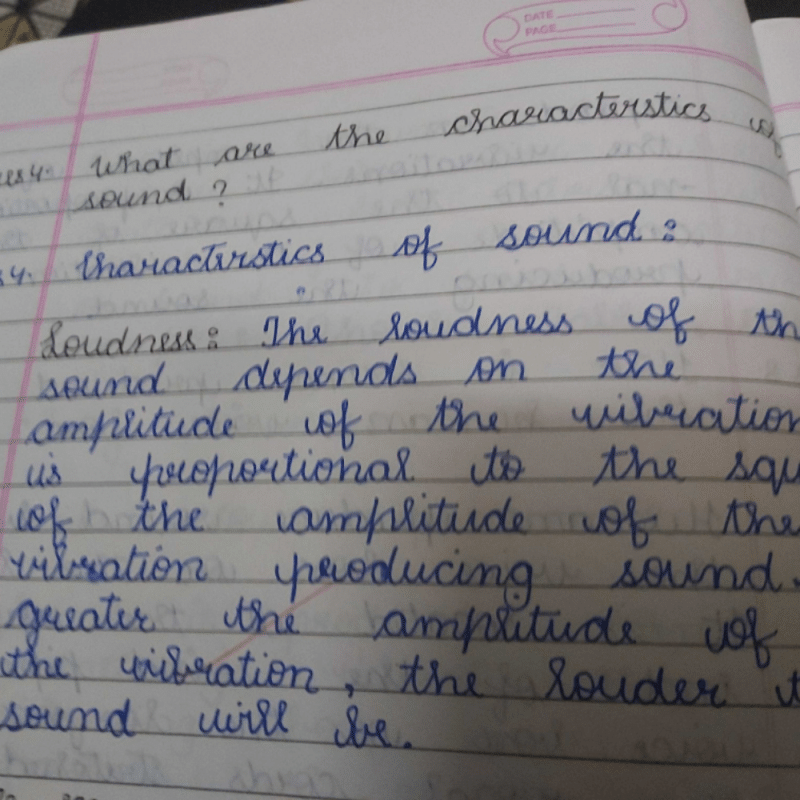
The maximum displacement from mean position is called its amplitude. The loudness of sound depends upon its amplitude.
Most Upvoted Answer
Loudness of sound depends upon itsa)Wavelengthb)Amplitudec)Frequencyd)...
Free Test
FREE
| Start Free Test |
Community Answer
Loudness of sound depends upon itsa)Wavelengthb)Amplitudec)Frequencyd)...
Loudness of Sound
Loudness is a perceptual quality of sound that describes how strong or weak a sound is perceived by the human ear. The main factor that affects the loudness of sound is its amplitude.
Key Factors Affecting Loudness
- Amplitude:
- The amplitude of a sound wave refers to the height of the wave.
- Greater amplitude means more energy, resulting in a louder sound.
- For example, a loud drumbeat has a high amplitude compared to a soft whisper.
- Wavelength:
- Wavelength is the distance between successive peaks of a sound wave.
- While it affects pitch, it does not directly influence loudness.
- Frequency:
- Frequency determines the pitch of the sound, not its loudness.
- Higher frequency sounds (like a whistle) can be perceived as louder than lower frequency sounds (like a bass) at the same amplitude, but frequency itself does not define loudness.
- Time-period:
- Time-period is the duration of one complete wave cycle.
- It is related to frequency but does not impact the loudness of the sound.
Conclusion
In summary, the loudness of sound is primarily determined by the amplitude of the sound wave. Higher amplitudes produce louder sounds, making option 'B' the correct answer. Understanding this concept is crucial in fields like music, acoustics, and audio engineering.
Loudness is a perceptual quality of sound that describes how strong or weak a sound is perceived by the human ear. The main factor that affects the loudness of sound is its amplitude.
Key Factors Affecting Loudness
- Amplitude:
- The amplitude of a sound wave refers to the height of the wave.
- Greater amplitude means more energy, resulting in a louder sound.
- For example, a loud drumbeat has a high amplitude compared to a soft whisper.
- Wavelength:
- Wavelength is the distance between successive peaks of a sound wave.
- While it affects pitch, it does not directly influence loudness.
- Frequency:
- Frequency determines the pitch of the sound, not its loudness.
- Higher frequency sounds (like a whistle) can be perceived as louder than lower frequency sounds (like a bass) at the same amplitude, but frequency itself does not define loudness.
- Time-period:
- Time-period is the duration of one complete wave cycle.
- It is related to frequency but does not impact the loudness of the sound.
Conclusion
In summary, the loudness of sound is primarily determined by the amplitude of the sound wave. Higher amplitudes produce louder sounds, making option 'B' the correct answer. Understanding this concept is crucial in fields like music, acoustics, and audio engineering.

 | Explore Courses for Class 8 exam |  |
Top Courses for Class 8View all





Top Courses for Class 8
Question Description
Loudness of sound depends upon itsa)Wavelengthb)Amplitudec)Frequencyd)Time-periodCorrect answer is option 'B'. Can you explain this answer? for Class 8 2026 is part of Class 8 preparation. The Question and answers have been prepared according to the Class 8 exam syllabus. Information about Loudness of sound depends upon itsa)Wavelengthb)Amplitudec)Frequencyd)Time-periodCorrect answer is option 'B'. Can you explain this answer? covers all topics & solutions for Class 8 2026 Exam. Find important definitions, questions, meanings, examples, exercises and tests below for Loudness of sound depends upon itsa)Wavelengthb)Amplitudec)Frequencyd)Time-periodCorrect answer is option 'B'. Can you explain this answer?.
Loudness of sound depends upon itsa)Wavelengthb)Amplitudec)Frequencyd)Time-periodCorrect answer is option 'B'. Can you explain this answer? for Class 8 2026 is part of Class 8 preparation. The Question and answers have been prepared according to the Class 8 exam syllabus. Information about Loudness of sound depends upon itsa)Wavelengthb)Amplitudec)Frequencyd)Time-periodCorrect answer is option 'B'. Can you explain this answer? covers all topics & solutions for Class 8 2026 Exam. Find important definitions, questions, meanings, examples, exercises and tests below for Loudness of sound depends upon itsa)Wavelengthb)Amplitudec)Frequencyd)Time-periodCorrect answer is option 'B'. Can you explain this answer?.
Solutions for Loudness of sound depends upon itsa)Wavelengthb)Amplitudec)Frequencyd)Time-periodCorrect answer is option 'B'. Can you explain this answer? in English & in Hindi are available as part of our courses for Class 8. Download more important topics, notes, lectures and mock test series for Class 8 Exam by signing up for free.
Here you can find the meaning of Loudness of sound depends upon itsa)Wavelengthb)Amplitudec)Frequencyd)Time-periodCorrect answer is option 'B'. Can you explain this answer? defined & explained in the simplest way possible. Besides giving the explanation of Loudness of sound depends upon itsa)Wavelengthb)Amplitudec)Frequencyd)Time-periodCorrect answer is option 'B'. Can you explain this answer?, a detailed solution for Loudness of sound depends upon itsa)Wavelengthb)Amplitudec)Frequencyd)Time-periodCorrect answer is option 'B'. Can you explain this answer? has been provided alongside types of Loudness of sound depends upon itsa)Wavelengthb)Amplitudec)Frequencyd)Time-periodCorrect answer is option 'B'. Can you explain this answer? theory, EduRev gives you an ample number of questions to practice Loudness of sound depends upon itsa)Wavelengthb)Amplitudec)Frequencyd)Time-periodCorrect answer is option 'B'. Can you explain this answer? tests, examples and also practice Class 8 tests.
| Explore Courses for Class 8 exam | |
Top Courses for Class 8
Explore Courses
Signup for Free!
Signup to see your scores go up within 7 days! Learn & Practice with 1000+ FREE Notes, Videos & Tests.


