


NEET Exam > NEET Questions > An explosion blows a rock into three parts. T... Start Learning for Free
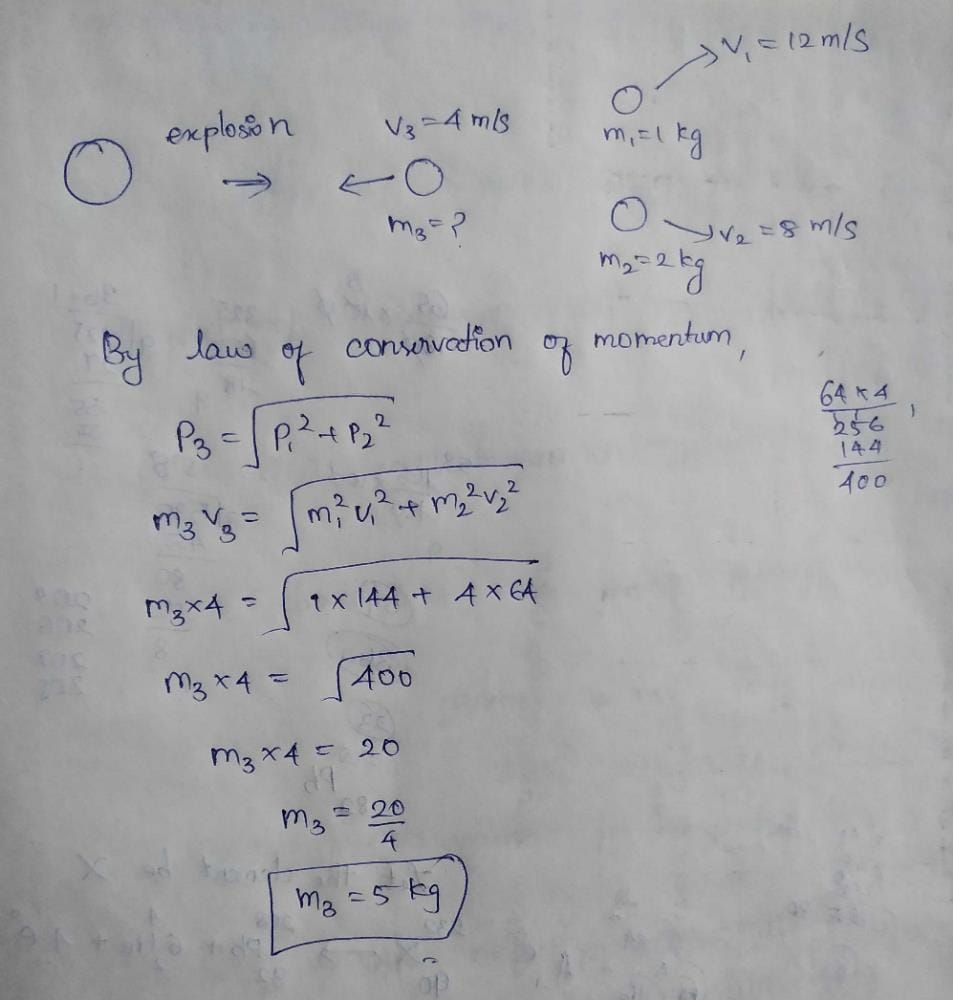
An explosion blows a rock into three parts. Two parts go off at right angles to each other. These two are, 1 kg first part moving with a velocity of 12 ms–1 and 2 kg second part moving with a velocity of 8 ms–1. If the third part flies off with a velocity of 4 ms–1, its mass would be: [2009]
- a)7 kg
- b)17 kg
- c)3 kg
- d)5 kg
Correct answer is option 'D'. Can you explain this answer?

Most Upvoted Answer
An explosion blows a rock into three parts. Two parts go off at right ...
$^{-1}$ and 2 kg second part moving with a velocity of 8 ms$^{-1}$. What is the mass and velocity of the third part?
To solve this problem, we need to use the law of conservation of momentum. According to this law, the total momentum of a system of objects remains constant if there are no external forces acting on the system. In other words, the sum of the momenta of all the objects before the explosion is equal to the sum of the momenta of all the objects after the explosion.
Before the explosion, the rock had zero velocity, so its momentum was zero. After the explosion, the two parts that went off at right angles to each other have the following momenta:
First part: momentum = mass x velocity = 1 kg x 12 ms$^{-1}$ = 12 kg ms$^{-1}$
Second part: momentum = mass x velocity = 2 kg x 8 ms$^{-1}$ = 16 kg ms$^{-1}$
The total momentum of these two parts is:
Total momentum = 12 kg ms$^{-1}$ + 16 kg ms$^{-1}$ = 28 kg ms$^{-1}$
According to the law of conservation of momentum, the momentum of the third part must be equal and opposite to the total momentum of the first two parts. Let's call the mass of the third part "m" and its velocity "v". Then we have:
Momentum of third part = -28 kg ms$^{-1}$
Momentum = mass x velocity
Therefore:
-mv = -28 kg ms$^{-1}$
Solving for "m", we get:
m = 28/v
Now we can use the law of conservation of energy to find the velocity of the third part. According to this law, the total kinetic energy of a system of objects remains constant if there are no external forces acting on the system. In other words, the sum of the kinetic energies of all the objects before the explosion is equal to the sum of the kinetic energies of all the objects after the explosion.
Before the explosion, the rock had zero kinetic energy, so its total kinetic energy was zero. After the explosion, the two parts that went off at right angles to each other have the following kinetic energies:
First part: KE = 0.5 x mass x velocity$^2$ = 0.5 x 1 kg x (12 ms$^{-1}$)$^2$ = 72 J
Second part: KE = 0.5 x mass x velocity$^2$ = 0.5 x 2 kg x (8 ms$^{-1}$)$^2$ = 64 J
The total kinetic energy of these two parts is:
Total KE = 72 J + 64 J = 136 J
According to the law of conservation of energy, the kinetic energy of the third part must be equal to the difference between the total kinetic energy of the first two parts and the initial kinetic energy of the rock. The initial kinetic energy of the rock was zero, so we have:
KE of third part = Total KE - 0 = 136 J
Using the formula for kinetic energy, we can write:
0.5mv$^2$ = 136 J
Solving for "v", we get:
v = $\sqrt{\frac{272}{m}}$
Substituting
To solve this problem, we need to use the law of conservation of momentum. According to this law, the total momentum of a system of objects remains constant if there are no external forces acting on the system. In other words, the sum of the momenta of all the objects before the explosion is equal to the sum of the momenta of all the objects after the explosion.
Before the explosion, the rock had zero velocity, so its momentum was zero. After the explosion, the two parts that went off at right angles to each other have the following momenta:
First part: momentum = mass x velocity = 1 kg x 12 ms$^{-1}$ = 12 kg ms$^{-1}$
Second part: momentum = mass x velocity = 2 kg x 8 ms$^{-1}$ = 16 kg ms$^{-1}$
The total momentum of these two parts is:
Total momentum = 12 kg ms$^{-1}$ + 16 kg ms$^{-1}$ = 28 kg ms$^{-1}$
According to the law of conservation of momentum, the momentum of the third part must be equal and opposite to the total momentum of the first two parts. Let's call the mass of the third part "m" and its velocity "v". Then we have:
Momentum of third part = -28 kg ms$^{-1}$
Momentum = mass x velocity
Therefore:
-mv = -28 kg ms$^{-1}$
Solving for "m", we get:
m = 28/v
Now we can use the law of conservation of energy to find the velocity of the third part. According to this law, the total kinetic energy of a system of objects remains constant if there are no external forces acting on the system. In other words, the sum of the kinetic energies of all the objects before the explosion is equal to the sum of the kinetic energies of all the objects after the explosion.
Before the explosion, the rock had zero kinetic energy, so its total kinetic energy was zero. After the explosion, the two parts that went off at right angles to each other have the following kinetic energies:
First part: KE = 0.5 x mass x velocity$^2$ = 0.5 x 1 kg x (12 ms$^{-1}$)$^2$ = 72 J
Second part: KE = 0.5 x mass x velocity$^2$ = 0.5 x 2 kg x (8 ms$^{-1}$)$^2$ = 64 J
The total kinetic energy of these two parts is:
Total KE = 72 J + 64 J = 136 J
According to the law of conservation of energy, the kinetic energy of the third part must be equal to the difference between the total kinetic energy of the first two parts and the initial kinetic energy of the rock. The initial kinetic energy of the rock was zero, so we have:
KE of third part = Total KE - 0 = 136 J
Using the formula for kinetic energy, we can write:
0.5mv$^2$ = 136 J
Solving for "v", we get:
v = $\sqrt{\frac{272}{m}}$
Substituting
Free Test
FREE
| Start Free Test |
Community Answer
An explosion blows a rock into three parts. Two parts go off at right ...
 | Explore Courses for NEET exam |  |
Top Courses for NEETView all





Top Courses for NEET
Question Description
An explosion blows a rock into three parts. Two parts go off at right angles to each other. These two are, 1 kg first part moving with a velocity of 12 ms–1 and 2 kg second part moving with a velocity of 8 ms–1. If the third part flies off with a velocity of 4 ms–1, its mass would be: [2009]a)7 kgb)17 kgc)3 kgd)5 kgCorrect answer is option 'D'. Can you explain this answer? for NEET 2026 is part of NEET preparation. The Question and answers have been prepared according to the NEET exam syllabus. Information about An explosion blows a rock into three parts. Two parts go off at right angles to each other. These two are, 1 kg first part moving with a velocity of 12 ms–1 and 2 kg second part moving with a velocity of 8 ms–1. If the third part flies off with a velocity of 4 ms–1, its mass would be: [2009]a)7 kgb)17 kgc)3 kgd)5 kgCorrect answer is option 'D'. Can you explain this answer? covers all topics & solutions for NEET 2026 Exam. Find important definitions, questions, meanings, examples, exercises and tests below for An explosion blows a rock into three parts. Two parts go off at right angles to each other. These two are, 1 kg first part moving with a velocity of 12 ms–1 and 2 kg second part moving with a velocity of 8 ms–1. If the third part flies off with a velocity of 4 ms–1, its mass would be: [2009]a)7 kgb)17 kgc)3 kgd)5 kgCorrect answer is option 'D'. Can you explain this answer?.
An explosion blows a rock into three parts. Two parts go off at right angles to each other. These two are, 1 kg first part moving with a velocity of 12 ms–1 and 2 kg second part moving with a velocity of 8 ms–1. If the third part flies off with a velocity of 4 ms–1, its mass would be: [2009]a)7 kgb)17 kgc)3 kgd)5 kgCorrect answer is option 'D'. Can you explain this answer? for NEET 2026 is part of NEET preparation. The Question and answers have been prepared according to the NEET exam syllabus. Information about An explosion blows a rock into three parts. Two parts go off at right angles to each other. These two are, 1 kg first part moving with a velocity of 12 ms–1 and 2 kg second part moving with a velocity of 8 ms–1. If the third part flies off with a velocity of 4 ms–1, its mass would be: [2009]a)7 kgb)17 kgc)3 kgd)5 kgCorrect answer is option 'D'. Can you explain this answer? covers all topics & solutions for NEET 2026 Exam. Find important definitions, questions, meanings, examples, exercises and tests below for An explosion blows a rock into three parts. Two parts go off at right angles to each other. These two are, 1 kg first part moving with a velocity of 12 ms–1 and 2 kg second part moving with a velocity of 8 ms–1. If the third part flies off with a velocity of 4 ms–1, its mass would be: [2009]a)7 kgb)17 kgc)3 kgd)5 kgCorrect answer is option 'D'. Can you explain this answer?.
Solutions for An explosion blows a rock into three parts. Two parts go off at right angles to each other. These two are, 1 kg first part moving with a velocity of 12 ms–1 and 2 kg second part moving with a velocity of 8 ms–1. If the third part flies off with a velocity of 4 ms–1, its mass would be: [2009]a)7 kgb)17 kgc)3 kgd)5 kgCorrect answer is option 'D'. Can you explain this answer? in English & in Hindi are available as part of our courses for NEET. Download more important topics, notes, lectures and mock test series for NEET Exam by signing up for free.
Here you can find the meaning of An explosion blows a rock into three parts. Two parts go off at right angles to each other. These two are, 1 kg first part moving with a velocity of 12 ms–1 and 2 kg second part moving with a velocity of 8 ms–1. If the third part flies off with a velocity of 4 ms–1, its mass would be: [2009]a)7 kgb)17 kgc)3 kgd)5 kgCorrect answer is option 'D'. Can you explain this answer? defined & explained in the simplest way possible. Besides giving the explanation of An explosion blows a rock into three parts. Two parts go off at right angles to each other. These two are, 1 kg first part moving with a velocity of 12 ms–1 and 2 kg second part moving with a velocity of 8 ms–1. If the third part flies off with a velocity of 4 ms–1, its mass would be: [2009]a)7 kgb)17 kgc)3 kgd)5 kgCorrect answer is option 'D'. Can you explain this answer?, a detailed solution for An explosion blows a rock into three parts. Two parts go off at right angles to each other. These two are, 1 kg first part moving with a velocity of 12 ms–1 and 2 kg second part moving with a velocity of 8 ms–1. If the third part flies off with a velocity of 4 ms–1, its mass would be: [2009]a)7 kgb)17 kgc)3 kgd)5 kgCorrect answer is option 'D'. Can you explain this answer? has been provided alongside types of An explosion blows a rock into three parts. Two parts go off at right angles to each other. These two are, 1 kg first part moving with a velocity of 12 ms–1 and 2 kg second part moving with a velocity of 8 ms–1. If the third part flies off with a velocity of 4 ms–1, its mass would be: [2009]a)7 kgb)17 kgc)3 kgd)5 kgCorrect answer is option 'D'. Can you explain this answer? theory, EduRev gives you an ample number of questions to practice An explosion blows a rock into three parts. Two parts go off at right angles to each other. These two are, 1 kg first part moving with a velocity of 12 ms–1 and 2 kg second part moving with a velocity of 8 ms–1. If the third part flies off with a velocity of 4 ms–1, its mass would be: [2009]a)7 kgb)17 kgc)3 kgd)5 kgCorrect answer is option 'D'. Can you explain this answer? tests, examples and also practice NEET tests.
| Explore Courses for NEET exam | |
Top Courses for NEET
Explore Courses
Signup for Free!
Signup to see your scores go up within 7 days! Learn & Practice with 1000+ FREE Notes, Videos & Tests.


