


Class 12 Exam > Class 12 Questions > A particle of mass m and charge q is placed a... Start Learning for Free
A particle of mass m and charge q is placed atrest in a uniform electric field E and then released.The kinetic energy attained by the particle aftermoving a distance y is [1998]
- a)qEy2
- b)qE2 y
- c)qEy
- d)q2 Ey
Correct answer is option 'C'. Can you explain this answer?

Verified Answer
A particle of mass m and charge q is placed atrest in a uniform electr...
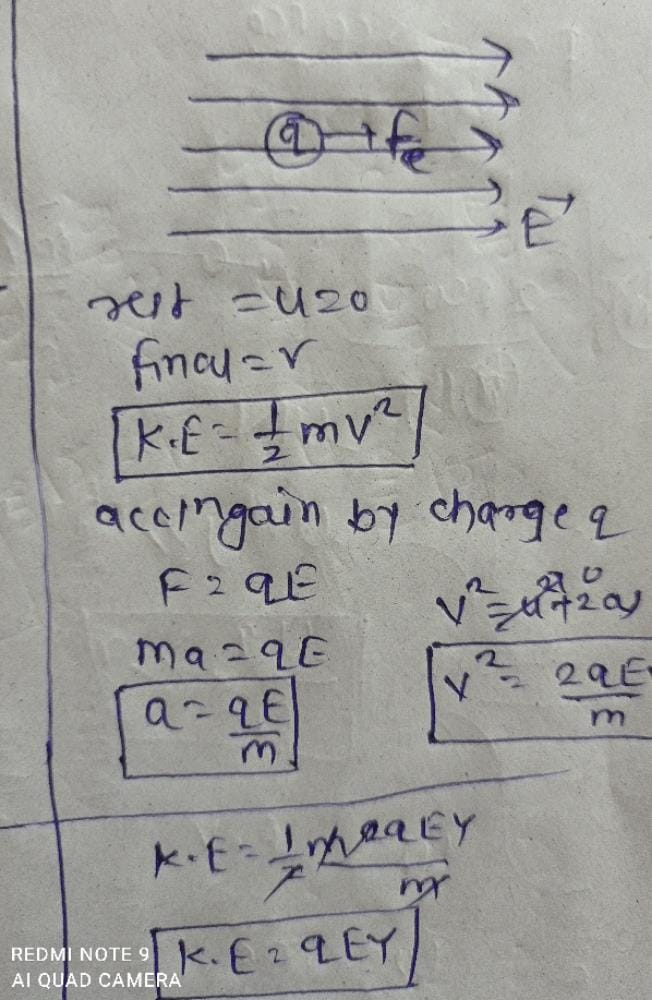
K.E. = Force × distance = qE.y
Most Upvoted Answer
A particle of mass m and charge q is placed atrest in a uniform electr...
Explanation:
When a charged particle is placed in a uniform electric field, it experiences a force given by F=qE where q is the charge of the particle and E is the electric field strength.
If the particle is initially at rest, it will accelerate in the direction of the electric field and gain kinetic energy.
Let us consider the motion of the charged particle in the electric field.
Initial conditions:
- The particle is at rest, so its initial kinetic energy is zero.
- The electric field is uniform, so the force experienced by the particle is constant in magnitude and direction.
Using Newton's second law of motion, we can relate the force experienced by the particle to its acceleration as follows:
F=ma
where F is the force experienced by the particle, m is its mass, and a is its acceleration.
Since the acceleration is constant, we can use the following kinematic equation to relate the distance traveled by the particle to its final velocity:
y=1/2at2
where y is the distance traveled by the particle, t is the time taken, and a is the acceleration.
Rearranging this equation, we get:
t=√(2y/a)
Substituting this value of t in the equation F=ma, we get:
F=ma=qE
Substituting this value of F in the work-energy theorem, we get:
W=Fy=qEy
where W is the work done on the particle by the electric field.
The work done on the particle is equal to the kinetic energy gained by it, so we have:
K=W=qEy
where K is the kinetic energy gained by the particle.
Hence, the correct answer is option 'C' (qEy).
When a charged particle is placed in a uniform electric field, it experiences a force given by F=qE where q is the charge of the particle and E is the electric field strength.
If the particle is initially at rest, it will accelerate in the direction of the electric field and gain kinetic energy.
Let us consider the motion of the charged particle in the electric field.
Initial conditions:
- The particle is at rest, so its initial kinetic energy is zero.
- The electric field is uniform, so the force experienced by the particle is constant in magnitude and direction.
Using Newton's second law of motion, we can relate the force experienced by the particle to its acceleration as follows:
F=ma
where F is the force experienced by the particle, m is its mass, and a is its acceleration.
Since the acceleration is constant, we can use the following kinematic equation to relate the distance traveled by the particle to its final velocity:
y=1/2at2
where y is the distance traveled by the particle, t is the time taken, and a is the acceleration.
Rearranging this equation, we get:
t=√(2y/a)
Substituting this value of t in the equation F=ma, we get:
F=ma=qE
Substituting this value of F in the work-energy theorem, we get:
W=Fy=qEy
where W is the work done on the particle by the electric field.
The work done on the particle is equal to the kinetic energy gained by it, so we have:
K=W=qEy
where K is the kinetic energy gained by the particle.
Hence, the correct answer is option 'C' (qEy).
Free Test
FREE
| Start Free Test |
Community Answer
A particle of mass m and charge q is placed atrest in a uniform electr...
 | Explore Courses for Class 12 exam |  |
Top Courses for Class 12View all





Top Courses for Class 12
Question Description
A particle of mass m and charge q is placed atrest in a uniform electric field E and then released.The kinetic energy attained by the particle aftermoving a distance y is [1998]a)qEy2b)qE2 yc)qEyd)q2 EyCorrect answer is option 'C'. Can you explain this answer? for Class 12 2026 is part of Class 12 preparation. The Question and answers have been prepared according to the Class 12 exam syllabus. Information about A particle of mass m and charge q is placed atrest in a uniform electric field E and then released.The kinetic energy attained by the particle aftermoving a distance y is [1998]a)qEy2b)qE2 yc)qEyd)q2 EyCorrect answer is option 'C'. Can you explain this answer? covers all topics & solutions for Class 12 2026 Exam. Find important definitions, questions, meanings, examples, exercises and tests below for A particle of mass m and charge q is placed atrest in a uniform electric field E and then released.The kinetic energy attained by the particle aftermoving a distance y is [1998]a)qEy2b)qE2 yc)qEyd)q2 EyCorrect answer is option 'C'. Can you explain this answer?.
A particle of mass m and charge q is placed atrest in a uniform electric field E and then released.The kinetic energy attained by the particle aftermoving a distance y is [1998]a)qEy2b)qE2 yc)qEyd)q2 EyCorrect answer is option 'C'. Can you explain this answer? for Class 12 2026 is part of Class 12 preparation. The Question and answers have been prepared according to the Class 12 exam syllabus. Information about A particle of mass m and charge q is placed atrest in a uniform electric field E and then released.The kinetic energy attained by the particle aftermoving a distance y is [1998]a)qEy2b)qE2 yc)qEyd)q2 EyCorrect answer is option 'C'. Can you explain this answer? covers all topics & solutions for Class 12 2026 Exam. Find important definitions, questions, meanings, examples, exercises and tests below for A particle of mass m and charge q is placed atrest in a uniform electric field E and then released.The kinetic energy attained by the particle aftermoving a distance y is [1998]a)qEy2b)qE2 yc)qEyd)q2 EyCorrect answer is option 'C'. Can you explain this answer?.
Solutions for A particle of mass m and charge q is placed atrest in a uniform electric field E and then released.The kinetic energy attained by the particle aftermoving a distance y is [1998]a)qEy2b)qE2 yc)qEyd)q2 EyCorrect answer is option 'C'. Can you explain this answer? in English & in Hindi are available as part of our courses for Class 12. Download more important topics, notes, lectures and mock test series for Class 12 Exam by signing up for free.
Here you can find the meaning of A particle of mass m and charge q is placed atrest in a uniform electric field E and then released.The kinetic energy attained by the particle aftermoving a distance y is [1998]a)qEy2b)qE2 yc)qEyd)q2 EyCorrect answer is option 'C'. Can you explain this answer? defined & explained in the simplest way possible. Besides giving the explanation of A particle of mass m and charge q is placed atrest in a uniform electric field E and then released.The kinetic energy attained by the particle aftermoving a distance y is [1998]a)qEy2b)qE2 yc)qEyd)q2 EyCorrect answer is option 'C'. Can you explain this answer?, a detailed solution for A particle of mass m and charge q is placed atrest in a uniform electric field E and then released.The kinetic energy attained by the particle aftermoving a distance y is [1998]a)qEy2b)qE2 yc)qEyd)q2 EyCorrect answer is option 'C'. Can you explain this answer? has been provided alongside types of A particle of mass m and charge q is placed atrest in a uniform electric field E and then released.The kinetic energy attained by the particle aftermoving a distance y is [1998]a)qEy2b)qE2 yc)qEyd)q2 EyCorrect answer is option 'C'. Can you explain this answer? theory, EduRev gives you an ample number of questions to practice A particle of mass m and charge q is placed atrest in a uniform electric field E and then released.The kinetic energy attained by the particle aftermoving a distance y is [1998]a)qEy2b)qE2 yc)qEyd)q2 EyCorrect answer is option 'C'. Can you explain this answer? tests, examples and also practice Class 12 tests.
| Explore Courses for Class 12 exam | |
Top Courses for Class 12
Explore Courses
Signup for Free!
Signup to see your scores go up within 7 days! Learn & Practice with 1000+ FREE Notes, Videos & Tests.


