


GMAT Exam > GMAT Questions > If [z] denotes the least integer greater than...
Start Learning for Free
If [z] denotes the least integer greater than or equal to z and [z2] = 2, which of the following could be the value of [z]?
I. 2
II. 1
III. -2
- a)I only
- b)II only
- c)III only
- d)I and II only
- e)II and III only
Correct answer is option 'A'. Can you explain this answer?

Verified Answer
If [z] denotes the least integer greater than or equal to z and [z2] =...
Given:
- The function [z]
- [z2] = 2
To find: Can [z] be {2, 1, -2}?
Approach:
- To find which values of [z] are possible and which are not, we need to first know the range of possible values of z. Once we know what z can be, we’ll be able to find what [z] can be.
- We’ll get an idea of the possible values of z from the fact that [z2] = 2
Working Out:
- [z2] = 2
- This means, the least integer that is greater than or equal to z2 is 2.
- So, the value of z2 must be equal to 2 or must lie between 1 and 2 (because if z2 is less than 1 then [z2] would be 1 or less and not 2)
- We can write: 1 < z2 ≤ 2
- The above inequality contains 2 inequalities: z2 > 1 AND z2 ≤ 2
- So now, we’ll solve these inequalities one by one, and then find the values of z that satisfy both these inequalities
- Solving z2 > 1
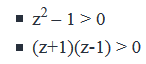
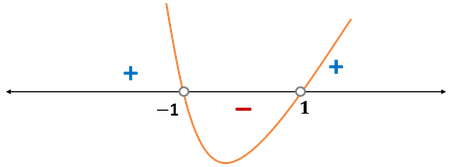
- This means, z < - 1 or z > 1 . . . (1)
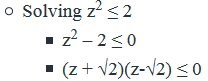
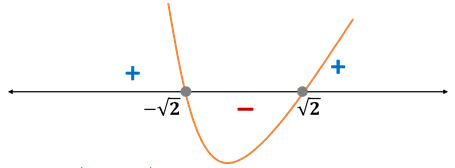
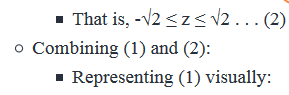



- The gray zones in the above figure represent the overlap zones, that is, those values of z that satisfy both the inequalities
- So, either -√2 ≤ z < -1 or 1 < z ≤ √2
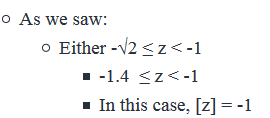
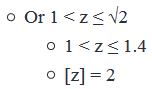
Thus, we see that [z] is either equal to -1 or equal to 2. Out of the 3 given values, only value I (which is 2) is therefore possible.
Looking at the answer choices, we see that the correct answer is Option A
Most Upvoted Answer
If [z] denotes the least integer greater than or equal to z and [z2] =...
Understanding the Problem
To solve the problem, we need to analyze the condition given: [z^2] = 2, where [z] denotes the least integer greater than or equal to z. This means that the smallest integer greater than or equal to z^2 is 2.
Analyzing [z^2] = 2
This implies:
- 2 ≤ z^2 < 3="" from="" this="" inequality,="" we="" can="" derive="" the="" possible="" values="" of="" z:="" -="" taking="" the="" square="" root="" gives:="" √2="" ≤="" z="" />< √3="" or="" -√3="" />< z="" ≤="" -√2="" the="" numerical="" approximations="" for="" these="" roots="" are:="" -="" √2="" ≈="" 1.41="" -="" √3="" ≈="" 1.73="" thus,="" we="" can="" summarize="" the="" ranges="" for="" z="" as:="" -="" 1.41="" ≤="" z="" />< 1.73="" or="" -1.73="" />< z="" ≤="" -1.41="" />Determining Possible Values of [z]
Now, let's check the implications for [z]:
- For 1.41 ≤ z < 1.73:="" -="" the="" least="" integer="" greater="" than="" or="" equal="" to="" z,="" [z],="" can="" only="" be="" 2="" (since="" 1="" />< z="" />< 2).="" -="" for="" -1.73="" />< z="" ≤="" -1.41:="" -="" the="" least="" integer="" greater="" than="" or="" equal="" to="" z,="" [z],="" can="" only="" be="" -1="" (since="" -2="" />< z="" ≤="" -1).="" />Evaluating the Options
Now, let's evaluate the options:
I. 2: Possible since z falls within 1.41 ≤ z < 1.73.="" ii.="" 1:="" not="" possible="" since="" there="" are="" no="" z="" values="" that="" yield="" [z]="1." iii.="" -2:="" not="" possible="" since="" there="" are="" no="" z="" values="" that="" yield="" [z]="-2." />Final Conclusion
The only valid value for [z] that meets the condition [z^2] = 2 is:
- Option I (2) is correct.
Thus, the correct answer is option 'A'.
To solve the problem, we need to analyze the condition given: [z^2] = 2, where [z] denotes the least integer greater than or equal to z. This means that the smallest integer greater than or equal to z^2 is 2.
Analyzing [z^2] = 2
This implies:
- 2 ≤ z^2 < 3="" from="" this="" inequality,="" we="" can="" derive="" the="" possible="" values="" of="" z:="" -="" taking="" the="" square="" root="" gives:="" √2="" ≤="" z="" />< √3="" or="" -√3="" />< z="" ≤="" -√2="" the="" numerical="" approximations="" for="" these="" roots="" are:="" -="" √2="" ≈="" 1.41="" -="" √3="" ≈="" 1.73="" thus,="" we="" can="" summarize="" the="" ranges="" for="" z="" as:="" -="" 1.41="" ≤="" z="" />< 1.73="" or="" -1.73="" />< z="" ≤="" -1.41="" />Determining Possible Values of [z]
Now, let's check the implications for [z]:
- For 1.41 ≤ z < 1.73:="" -="" the="" least="" integer="" greater="" than="" or="" equal="" to="" z,="" [z],="" can="" only="" be="" 2="" (since="" 1="" />< z="" />< 2).="" -="" for="" -1.73="" />< z="" ≤="" -1.41:="" -="" the="" least="" integer="" greater="" than="" or="" equal="" to="" z,="" [z],="" can="" only="" be="" -1="" (since="" -2="" />< z="" ≤="" -1).="" />Evaluating the Options
Now, let's evaluate the options:
I. 2: Possible since z falls within 1.41 ≤ z < 1.73.="" ii.="" 1:="" not="" possible="" since="" there="" are="" no="" z="" values="" that="" yield="" [z]="1." iii.="" -2:="" not="" possible="" since="" there="" are="" no="" z="" values="" that="" yield="" [z]="-2." />Final Conclusion
The only valid value for [z] that meets the condition [z^2] = 2 is:
- Option I (2) is correct.
Thus, the correct answer is option 'A'.

|
Explore Courses for GMAT exam
|

|
Top Courses for GMATView all




Question Description
If [z] denotes the least integer greater than or equal to z and [z2] = 2, which of the following could be the value of [z]?I. 2II. 1III. -2a)I onlyb)II onlyc)III onlyd)I and II onlye)II and III onlyCorrect answer is option 'A'. Can you explain this answer? for GMAT 2026 is part of GMAT preparation. The Question and answers have been prepared according to the GMAT exam syllabus. Information about If [z] denotes the least integer greater than or equal to z and [z2] = 2, which of the following could be the value of [z]?I. 2II. 1III. -2a)I onlyb)II onlyc)III onlyd)I and II onlye)II and III onlyCorrect answer is option 'A'. Can you explain this answer? covers all topics & solutions for GMAT 2026 Exam. Find important definitions, questions, meanings, examples, exercises and tests below for If [z] denotes the least integer greater than or equal to z and [z2] = 2, which of the following could be the value of [z]?I. 2II. 1III. -2a)I onlyb)II onlyc)III onlyd)I and II onlye)II and III onlyCorrect answer is option 'A'. Can you explain this answer?.
If [z] denotes the least integer greater than or equal to z and [z2] = 2, which of the following could be the value of [z]?I. 2II. 1III. -2a)I onlyb)II onlyc)III onlyd)I and II onlye)II and III onlyCorrect answer is option 'A'. Can you explain this answer? for GMAT 2026 is part of GMAT preparation. The Question and answers have been prepared according to the GMAT exam syllabus. Information about If [z] denotes the least integer greater than or equal to z and [z2] = 2, which of the following could be the value of [z]?I. 2II. 1III. -2a)I onlyb)II onlyc)III onlyd)I and II onlye)II and III onlyCorrect answer is option 'A'. Can you explain this answer? covers all topics & solutions for GMAT 2026 Exam. Find important definitions, questions, meanings, examples, exercises and tests below for If [z] denotes the least integer greater than or equal to z and [z2] = 2, which of the following could be the value of [z]?I. 2II. 1III. -2a)I onlyb)II onlyc)III onlyd)I and II onlye)II and III onlyCorrect answer is option 'A'. Can you explain this answer?.
Solutions for If [z] denotes the least integer greater than or equal to z and [z2] = 2, which of the following could be the value of [z]?I. 2II. 1III. -2a)I onlyb)II onlyc)III onlyd)I and II onlye)II and III onlyCorrect answer is option 'A'. Can you explain this answer? in English & in Hindi are available as part of our courses for GMAT.
Download more important topics, notes, lectures and mock test series for GMAT Exam by signing up for free.
Here you can find the meaning of If [z] denotes the least integer greater than or equal to z and [z2] = 2, which of the following could be the value of [z]?I. 2II. 1III. -2a)I onlyb)II onlyc)III onlyd)I and II onlye)II and III onlyCorrect answer is option 'A'. Can you explain this answer? defined & explained in the simplest way possible. Besides giving the explanation of
If [z] denotes the least integer greater than or equal to z and [z2] = 2, which of the following could be the value of [z]?I. 2II. 1III. -2a)I onlyb)II onlyc)III onlyd)I and II onlye)II and III onlyCorrect answer is option 'A'. Can you explain this answer?, a detailed solution for If [z] denotes the least integer greater than or equal to z and [z2] = 2, which of the following could be the value of [z]?I. 2II. 1III. -2a)I onlyb)II onlyc)III onlyd)I and II onlye)II and III onlyCorrect answer is option 'A'. Can you explain this answer? has been provided alongside types of If [z] denotes the least integer greater than or equal to z and [z2] = 2, which of the following could be the value of [z]?I. 2II. 1III. -2a)I onlyb)II onlyc)III onlyd)I and II onlye)II and III onlyCorrect answer is option 'A'. Can you explain this answer? theory, EduRev gives you an
ample number of questions to practice If [z] denotes the least integer greater than or equal to z and [z2] = 2, which of the following could be the value of [z]?I. 2II. 1III. -2a)I onlyb)II onlyc)III onlyd)I and II onlye)II and III onlyCorrect answer is option 'A'. Can you explain this answer? tests, examples and also practice GMAT tests.
|
|
Explore Courses for GMAT exam
|
|

Signup for Free!
Signup to see your scores go up within 7 days! Learn & Practice with 1000+ FREE Notes, Videos & Tests.


