


Electrical Engineering (EE) Exam > Electrical Engineering (EE) Questions > If the length of a wire having uniform resist... Start Learning for Free
If the length of a wire having uniform resistance R is stretched in m times with volume remaining same. What will be new resistance value?
- a)R/m
- b)Rm2
- c)mR
- d)R/m2
Correct answer is option 'B'. Can you explain this answer?

Verified Answer
If the length of a wire having uniform resistance R is stretched in m ...
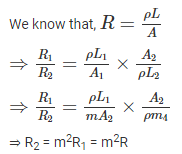
Given that, the length of a wire having uniform resistance R is stretched in m times with volume remaining same.
Let the length of the wire is L1
and the area of the wire is A1
For volume remains to be same
L1A1 = L2A2
⇒ L1A1 = (mL1) (A2)
⇒ A1 = mA2
Most Upvoted Answer
If the length of a wire having uniform resistance R is stretched in m ...
Understanding Resistance in a Stretched Wire
When a wire is stretched while keeping its volume constant, its length and cross-sectional area change, which affects its resistance.
Initial Parameters
- Let the original length of the wire be L.
- Let the original cross-sectional area be A.
- The original resistance is given by R = ρ(L/A), where ρ is the resistivity of the material.
Stretched Wire Characteristics
- If the wire is stretched by a factor of m, the new length (L') becomes L' = mL.
- Since the volume remains the same, the volume before stretching is equal to the volume after stretching: V = A * L = A' * L', where A' is the new cross-sectional area.
Volume Conservation
- Thus, A * L = A' * (mL).
- Rearranging gives A' = A / m.
New Resistance Calculation
- The new resistance (R') can be expressed as:
R' = ρ(L'/A').
- Substituting L' and A':
R' = ρ(mL / (A/m)) = ρ(m^2L/A).
Relating New Resistance to Original Resistance
- We can relate this to the original resistance:
R' = m^2 * (ρ(L/A)) = m^2 * R.
Final Result
- Therefore, the new resistance after stretching the wire is R' = m^2R.
The correct answer is option B) R/m², as it reflects the inverse relationship between resistance and the square of the stretching factor when volume remains constant.
When a wire is stretched while keeping its volume constant, its length and cross-sectional area change, which affects its resistance.
Initial Parameters
- Let the original length of the wire be L.
- Let the original cross-sectional area be A.
- The original resistance is given by R = ρ(L/A), where ρ is the resistivity of the material.
Stretched Wire Characteristics
- If the wire is stretched by a factor of m, the new length (L') becomes L' = mL.
- Since the volume remains the same, the volume before stretching is equal to the volume after stretching: V = A * L = A' * L', where A' is the new cross-sectional area.
Volume Conservation
- Thus, A * L = A' * (mL).
- Rearranging gives A' = A / m.
New Resistance Calculation
- The new resistance (R') can be expressed as:
R' = ρ(L'/A').
- Substituting L' and A':
R' = ρ(mL / (A/m)) = ρ(m^2L/A).
Relating New Resistance to Original Resistance
- We can relate this to the original resistance:
R' = m^2 * (ρ(L/A)) = m^2 * R.
Final Result
- Therefore, the new resistance after stretching the wire is R' = m^2R.
The correct answer is option B) R/m², as it reflects the inverse relationship between resistance and the square of the stretching factor when volume remains constant.
 | Explore Courses for Electrical Engineering (EE) exam |  |
Top Courses for Electrical Engineering (EE)View all




Top Courses for Electrical Engineering (EE)
Question Description
If the length of a wire having uniform resistance R is stretched in m times with volume remaining same. What will be new resistance value?a)R/mb)Rm2c)mRd)R/m2Correct answer is option 'B'. Can you explain this answer? for Electrical Engineering (EE) 2026 is part of Electrical Engineering (EE) preparation. The Question and answers have been prepared according to the Electrical Engineering (EE) exam syllabus. Information about If the length of a wire having uniform resistance R is stretched in m times with volume remaining same. What will be new resistance value?a)R/mb)Rm2c)mRd)R/m2Correct answer is option 'B'. Can you explain this answer? covers all topics & solutions for Electrical Engineering (EE) 2026 Exam. Find important definitions, questions, meanings, examples, exercises and tests below for If the length of a wire having uniform resistance R is stretched in m times with volume remaining same. What will be new resistance value?a)R/mb)Rm2c)mRd)R/m2Correct answer is option 'B'. Can you explain this answer?.
If the length of a wire having uniform resistance R is stretched in m times with volume remaining same. What will be new resistance value?a)R/mb)Rm2c)mRd)R/m2Correct answer is option 'B'. Can you explain this answer? for Electrical Engineering (EE) 2026 is part of Electrical Engineering (EE) preparation. The Question and answers have been prepared according to the Electrical Engineering (EE) exam syllabus. Information about If the length of a wire having uniform resistance R is stretched in m times with volume remaining same. What will be new resistance value?a)R/mb)Rm2c)mRd)R/m2Correct answer is option 'B'. Can you explain this answer? covers all topics & solutions for Electrical Engineering (EE) 2026 Exam. Find important definitions, questions, meanings, examples, exercises and tests below for If the length of a wire having uniform resistance R is stretched in m times with volume remaining same. What will be new resistance value?a)R/mb)Rm2c)mRd)R/m2Correct answer is option 'B'. Can you explain this answer?.
Solutions for If the length of a wire having uniform resistance R is stretched in m times with volume remaining same. What will be new resistance value?a)R/mb)Rm2c)mRd)R/m2Correct answer is option 'B'. Can you explain this answer? in English & in Hindi are available as part of our courses for Electrical Engineering (EE). Download more important topics, notes, lectures and mock test series for Electrical Engineering (EE) Exam by signing up for free.
Here you can find the meaning of If the length of a wire having uniform resistance R is stretched in m times with volume remaining same. What will be new resistance value?a)R/mb)Rm2c)mRd)R/m2Correct answer is option 'B'. Can you explain this answer? defined & explained in the simplest way possible. Besides giving the explanation of If the length of a wire having uniform resistance R is stretched in m times with volume remaining same. What will be new resistance value?a)R/mb)Rm2c)mRd)R/m2Correct answer is option 'B'. Can you explain this answer?, a detailed solution for If the length of a wire having uniform resistance R is stretched in m times with volume remaining same. What will be new resistance value?a)R/mb)Rm2c)mRd)R/m2Correct answer is option 'B'. Can you explain this answer? has been provided alongside types of If the length of a wire having uniform resistance R is stretched in m times with volume remaining same. What will be new resistance value?a)R/mb)Rm2c)mRd)R/m2Correct answer is option 'B'. Can you explain this answer? theory, EduRev gives you an ample number of questions to practice If the length of a wire having uniform resistance R is stretched in m times with volume remaining same. What will be new resistance value?a)R/mb)Rm2c)mRd)R/m2Correct answer is option 'B'. Can you explain this answer? tests, examples and also practice Electrical Engineering (EE) tests.
| Explore Courses for Electrical Engineering (EE) exam | |
Top Courses for Electrical Engineering (EE)
Explore Courses
Signup for Free!
Signup to see your scores go up within 7 days! Learn & Practice with 1000+ FREE Notes, Videos & Tests.


