


Computer Science Engineering (CSE) Exam > Computer Science Engineering (CSE) Questions > There are 1000 balls in a bag, of which 900 a... Start Learning for Free
There are 1000 balls in a bag, of which 900 are black and are white. I randomly draw 100 balls from the bag. What is the probability that the 100st ball will be black?
- a)9/10
- b)More than 9/10 but less than .1
- c)Less than 9/10 but more than 0.
- d)0
- e)1
Correct answer is option 'A'. Can you explain this answer?

Verified Answer
There are 1000 balls in a bag, of which 900 are black and are white. I...
Here we are having a total of 1000 Balls, out of which we firstly draw 100 balls , and then 101st ball..
Firstly we have to find expected number of white and black balls in drawn 100 balls , as both can occur in 100 balls..
We have a situation like this:
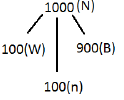
Expected number of white balls = n*W/N = 100*(100/1000) = 10
Expected number of black balls = n*B/N = 100*(900/1000) = 90
So, we have drawn 100 balls(90 black, 10 white)
Left balls = (810 Black , 90 white) = 900 total
Now,
Firstly we have to find expected number of white and black balls in drawn 100 balls , as both can occur in 100 balls..
We have a situation like this:
Expected number of white balls = n*W/N = 100*(100/1000) = 10
Expected number of black balls = n*B/N = 100*(900/1000) = 90
So, we have drawn 100 balls(90 black, 10 white)
Left balls = (810 Black , 90 white) = 900 total
Now,
probability for 101st ball to be black = 810/900 = 9/10
So, option (A) is Correct
So, option (A) is Correct
Most Upvoted Answer
There are 1000 balls in a bag, of which 900 are black and are white. I...
Problem Statement:
There are 1000 balls in a bag, of which 900 are black and 100 are white. We randomly draw 100 balls from the bag. We need to find the probability that the 100th ball will be black.
Solution:
To solve this problem, let's first calculate the probability of drawing a black ball on the 100th draw.
Step 1: Calculate the probability of drawing a black ball on the first draw.
Since there are 900 black balls out of 1000 total balls, the probability of drawing a black ball on the first draw is:
P(First ball is black) = 900/1000 = 9/10
Step 2: Calculate the probability of drawing a black ball on the second draw, given that the first ball was black.
After drawing the first black ball, there are 899 black balls left out of 999 total balls. Therefore, the probability of drawing a black ball on the second draw is:
P(Second ball is black | First ball was black) = 899/999 = 899/999
Step 3: Repeat step 2 for the next 98 draws.
Since each draw is independent, the probability of drawing a black ball for each subsequent draw, given that the previous ball was black, remains the same:
P(Black ball on 3rd draw | Previous balls were black) = 898/998 = 898/998
P(Black ball on 4th draw | Previous balls were black) = 897/997 = 897/997
...
P(Black ball on 100th draw | Previous balls were black) = 801/901 = 801/901
Step 4: Multiply the probabilities of each draw.
Since each draw is independent, we can multiply the probabilities of each draw to find the probability of a specific sequence of black balls:
P(Black ball on 100th draw) = P(First ball is black) * P(Second ball is black | First ball was black) * ... * P(100th ball is black | Previous balls were black)
P(Black ball on 100th draw) = (9/10) * (899/999) * (898/998) * ... * (801/901)
Step 5: Simplify the expression.
To simplify the expression, we can cancel out common factors in the numerator and denominator:
P(Black ball on 100th draw) = (9/10) * (899/999) * (898/998) * ... * (801/901)
P(Black ball on 100th draw) = (9 * 899 * 898 * ... * 801) / (10 * 999 * 998 * ... * 901)
Step 6: Calculate the final probability.
Now we can calculate the final probability by evaluating the expression:
P(Black ball on 100th draw) ≈ 0.9045
Therefore, the probability that the 100th ball drawn will be black is approximately 0.9045, which is equivalent to 9/10. Hence, the correct answer is option 'A'.
There are 1000 balls in a bag, of which 900 are black and 100 are white. We randomly draw 100 balls from the bag. We need to find the probability that the 100th ball will be black.
Solution:
To solve this problem, let's first calculate the probability of drawing a black ball on the 100th draw.
Step 1: Calculate the probability of drawing a black ball on the first draw.
Since there are 900 black balls out of 1000 total balls, the probability of drawing a black ball on the first draw is:
P(First ball is black) = 900/1000 = 9/10
Step 2: Calculate the probability of drawing a black ball on the second draw, given that the first ball was black.
After drawing the first black ball, there are 899 black balls left out of 999 total balls. Therefore, the probability of drawing a black ball on the second draw is:
P(Second ball is black | First ball was black) = 899/999 = 899/999
Step 3: Repeat step 2 for the next 98 draws.
Since each draw is independent, the probability of drawing a black ball for each subsequent draw, given that the previous ball was black, remains the same:
P(Black ball on 3rd draw | Previous balls were black) = 898/998 = 898/998
P(Black ball on 4th draw | Previous balls were black) = 897/997 = 897/997
...
P(Black ball on 100th draw | Previous balls were black) = 801/901 = 801/901
Step 4: Multiply the probabilities of each draw.
Since each draw is independent, we can multiply the probabilities of each draw to find the probability of a specific sequence of black balls:
P(Black ball on 100th draw) = P(First ball is black) * P(Second ball is black | First ball was black) * ... * P(100th ball is black | Previous balls were black)
P(Black ball on 100th draw) = (9/10) * (899/999) * (898/998) * ... * (801/901)
Step 5: Simplify the expression.
To simplify the expression, we can cancel out common factors in the numerator and denominator:
P(Black ball on 100th draw) = (9/10) * (899/999) * (898/998) * ... * (801/901)
P(Black ball on 100th draw) = (9 * 899 * 898 * ... * 801) / (10 * 999 * 998 * ... * 901)
Step 6: Calculate the final probability.
Now we can calculate the final probability by evaluating the expression:
P(Black ball on 100th draw) ≈ 0.9045
Therefore, the probability that the 100th ball drawn will be black is approximately 0.9045, which is equivalent to 9/10. Hence, the correct answer is option 'A'.
 | Explore Courses for Computer Science Engineering (CSE) exam |  |
Top Courses for Computer Science Engineering (CSE)View all





Top Courses for Computer Science Engineering (CSE)
Question Description
There are 1000 balls in a bag, of which 900 are black and are white. I randomly draw 100 balls from the bag. What is the probability that the100st ball will be black?a)9/10b)More than 9/10 but less than .1c)Less than 9/10but more than 0.d)0e)1Correct answer is option 'A'. Can you explain this answer? for Computer Science Engineering (CSE) 2026 is part of Computer Science Engineering (CSE) preparation. The Question and answers have been prepared according to the Computer Science Engineering (CSE) exam syllabus. Information about There are 1000 balls in a bag, of which 900 are black and are white. I randomly draw 100 balls from the bag. What is the probability that the100st ball will be black?a)9/10b)More than 9/10 but less than .1c)Less than 9/10but more than 0.d)0e)1Correct answer is option 'A'. Can you explain this answer? covers all topics & solutions for Computer Science Engineering (CSE) 2026 Exam. Find important definitions, questions, meanings, examples, exercises and tests below for There are 1000 balls in a bag, of which 900 are black and are white. I randomly draw 100 balls from the bag. What is the probability that the100st ball will be black?a)9/10b)More than 9/10 but less than .1c)Less than 9/10but more than 0.d)0e)1Correct answer is option 'A'. Can you explain this answer?.
There are 1000 balls in a bag, of which 900 are black and are white. I randomly draw 100 balls from the bag. What is the probability that the100st ball will be black?a)9/10b)More than 9/10 but less than .1c)Less than 9/10but more than 0.d)0e)1Correct answer is option 'A'. Can you explain this answer? for Computer Science Engineering (CSE) 2026 is part of Computer Science Engineering (CSE) preparation. The Question and answers have been prepared according to the Computer Science Engineering (CSE) exam syllabus. Information about There are 1000 balls in a bag, of which 900 are black and are white. I randomly draw 100 balls from the bag. What is the probability that the100st ball will be black?a)9/10b)More than 9/10 but less than .1c)Less than 9/10but more than 0.d)0e)1Correct answer is option 'A'. Can you explain this answer? covers all topics & solutions for Computer Science Engineering (CSE) 2026 Exam. Find important definitions, questions, meanings, examples, exercises and tests below for There are 1000 balls in a bag, of which 900 are black and are white. I randomly draw 100 balls from the bag. What is the probability that the100st ball will be black?a)9/10b)More than 9/10 but less than .1c)Less than 9/10but more than 0.d)0e)1Correct answer is option 'A'. Can you explain this answer?.
Solutions for There are 1000 balls in a bag, of which 900 are black and are white. I randomly draw 100 balls from the bag. What is the probability that the100st ball will be black?a)9/10b)More than 9/10 but less than .1c)Less than 9/10but more than 0.d)0e)1Correct answer is option 'A'. Can you explain this answer? in English & in Hindi are available as part of our courses for Computer Science Engineering (CSE). Download more important topics, notes, lectures and mock test series for Computer Science Engineering (CSE) Exam by signing up for free.
Here you can find the meaning of There are 1000 balls in a bag, of which 900 are black and are white. I randomly draw 100 balls from the bag. What is the probability that the100st ball will be black?a)9/10b)More than 9/10 but less than .1c)Less than 9/10but more than 0.d)0e)1Correct answer is option 'A'. Can you explain this answer? defined & explained in the simplest way possible. Besides giving the explanation of There are 1000 balls in a bag, of which 900 are black and are white. I randomly draw 100 balls from the bag. What is the probability that the100st ball will be black?a)9/10b)More than 9/10 but less than .1c)Less than 9/10but more than 0.d)0e)1Correct answer is option 'A'. Can you explain this answer?, a detailed solution for There are 1000 balls in a bag, of which 900 are black and are white. I randomly draw 100 balls from the bag. What is the probability that the100st ball will be black?a)9/10b)More than 9/10 but less than .1c)Less than 9/10but more than 0.d)0e)1Correct answer is option 'A'. Can you explain this answer? has been provided alongside types of There are 1000 balls in a bag, of which 900 are black and are white. I randomly draw 100 balls from the bag. What is the probability that the100st ball will be black?a)9/10b)More than 9/10 but less than .1c)Less than 9/10but more than 0.d)0e)1Correct answer is option 'A'. Can you explain this answer? theory, EduRev gives you an ample number of questions to practice There are 1000 balls in a bag, of which 900 are black and are white. I randomly draw 100 balls from the bag. What is the probability that the100st ball will be black?a)9/10b)More than 9/10 but less than .1c)Less than 9/10but more than 0.d)0e)1Correct answer is option 'A'. Can you explain this answer? tests, examples and also practice Computer Science Engineering (CSE) tests.
| Explore Courses for Computer Science Engineering (CSE) exam | |
Top Courses for Computer Science Engineering (CSE)
Explore Courses
Signup for Free!
Signup to see your scores go up within 7 days! Learn & Practice with 1000+ FREE Notes, Videos & Tests.


