


Class 8 Exam > Class 8 Questions > The sum of two opposite angles of a parallelo... Start Learning for Free
The sum of two opposite angles of a parallelogram is 130°. What is the difference between largest and smallest angle of parallelogram?
- a)65°
- b)50°
- c)115°
- d)100°
Correct answer is option 'B'. Can you explain this answer?

Verified Answer
The sum of two opposite angles of a parallelogram is 130°. What is...
Here ABCD is a parallelogram and ∠A + ∠C = 130°
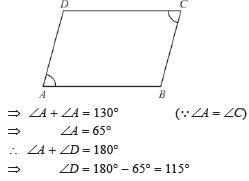
∠B = ∠D = 115°
Difference = 115° - 65° = 50°
∠B = ∠D = 115°
Difference = 115° - 65° = 50°
Most Upvoted Answer
The sum of two opposite angles of a parallelogram is 130°. What is...
Let's call the two opposite angles of the parallelogram A and B. Since opposite angles of a parallelogram are congruent, we know that A = B. The sum of these two angles is 130, so we can set up the equation A + B = 130. Since A = B, we can substitute A for B in the equation, giving us A + A = 130. Simplifying this equation, we have 2A = 130. Dividing both sides of the equation by 2, we find that A = 65. Since A = B, we know that B = 65 as well. Therefore, the measure of each of the two opposite angles of the parallelogram is 65 degrees.
 | Explore Courses for Class 8 exam |  |
Top Courses for Class 8View all



Top Courses for Class 8
Question Description
The sum of two opposite angles of a parallelogram is 130°. What is the difference between largest and smallest angle of parallelogram?a)65°b)50°c)115°d)100°Correct answer is option 'B'. Can you explain this answer? for Class 8 2026 is part of Class 8 preparation. The Question and answers have been prepared according to the Class 8 exam syllabus. Information about The sum of two opposite angles of a parallelogram is 130°. What is the difference between largest and smallest angle of parallelogram?a)65°b)50°c)115°d)100°Correct answer is option 'B'. Can you explain this answer? covers all topics & solutions for Class 8 2026 Exam. Find important definitions, questions, meanings, examples, exercises and tests below for The sum of two opposite angles of a parallelogram is 130°. What is the difference between largest and smallest angle of parallelogram?a)65°b)50°c)115°d)100°Correct answer is option 'B'. Can you explain this answer?.
The sum of two opposite angles of a parallelogram is 130°. What is the difference between largest and smallest angle of parallelogram?a)65°b)50°c)115°d)100°Correct answer is option 'B'. Can you explain this answer? for Class 8 2026 is part of Class 8 preparation. The Question and answers have been prepared according to the Class 8 exam syllabus. Information about The sum of two opposite angles of a parallelogram is 130°. What is the difference between largest and smallest angle of parallelogram?a)65°b)50°c)115°d)100°Correct answer is option 'B'. Can you explain this answer? covers all topics & solutions for Class 8 2026 Exam. Find important definitions, questions, meanings, examples, exercises and tests below for The sum of two opposite angles of a parallelogram is 130°. What is the difference between largest and smallest angle of parallelogram?a)65°b)50°c)115°d)100°Correct answer is option 'B'. Can you explain this answer?.
Solutions for The sum of two opposite angles of a parallelogram is 130°. What is the difference between largest and smallest angle of parallelogram?a)65°b)50°c)115°d)100°Correct answer is option 'B'. Can you explain this answer? in English & in Hindi are available as part of our courses for Class 8. Download more important topics, notes, lectures and mock test series for Class 8 Exam by signing up for free.
Here you can find the meaning of The sum of two opposite angles of a parallelogram is 130°. What is the difference between largest and smallest angle of parallelogram?a)65°b)50°c)115°d)100°Correct answer is option 'B'. Can you explain this answer? defined & explained in the simplest way possible. Besides giving the explanation of The sum of two opposite angles of a parallelogram is 130°. What is the difference between largest and smallest angle of parallelogram?a)65°b)50°c)115°d)100°Correct answer is option 'B'. Can you explain this answer?, a detailed solution for The sum of two opposite angles of a parallelogram is 130°. What is the difference between largest and smallest angle of parallelogram?a)65°b)50°c)115°d)100°Correct answer is option 'B'. Can you explain this answer? has been provided alongside types of The sum of two opposite angles of a parallelogram is 130°. What is the difference between largest and smallest angle of parallelogram?a)65°b)50°c)115°d)100°Correct answer is option 'B'. Can you explain this answer? theory, EduRev gives you an ample number of questions to practice The sum of two opposite angles of a parallelogram is 130°. What is the difference between largest and smallest angle of parallelogram?a)65°b)50°c)115°d)100°Correct answer is option 'B'. Can you explain this answer? tests, examples and also practice Class 8 tests.
| Explore Courses for Class 8 exam | |
Top Courses for Class 8
Explore Courses
Signup for Free!
Signup to see your scores go up within 7 days! Learn & Practice with 1000+ FREE Notes, Videos & Tests.


