


Electrical Engineering (EE) Exam > Electrical Engineering (EE) Questions > An op-amp has a common mode gain of 0.01 and ... Start Learning for Free
An op-amp has a common mode gain of 0.01 and a differential mode gain of 105. Its CMRR would be
- a)10–7
- b)10–3
- c)103
- d)107
Correct answer is option 'D'. Can you explain this answer?

Most Upvoted Answer
An op-amp has a common mode gain of 0.01 and a differential mode gain ...
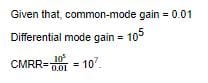
-In electronics, the common mode rejection ratio (CMRR) of a differential amplifier (or other device) is a metric used to quantify the ability of the device to reject common-mode signals, i.e. those that appear simultaneously and in-phase on both inputs.
-
Free Test
FREE
| Start Free Test |
Community Answer
An op-amp has a common mode gain of 0.01 and a differential mode gain ...
CMRR (Common Mode Rejection Ratio) is a measure of an operational amplifier's ability to reject common mode signals. It is defined as the ratio of the differential mode gain to the common mode gain.
Given data:
Common mode gain (ACM) = 0.01
Differential mode gain (ADM) = 105
To calculate CMRR, we can use the formula:
CMRR = ADM / ACM
Let's substitute the given values into the formula:
CMRR = 105 / 0.01
= 10500
Therefore, the CMRR of the op-amp is 10500.
Explanation:
The CMRR of an op-amp is a measure of its ability to reject common mode signals. Common mode signals are those that appear equally on both input terminals of the op-amp, while differential mode signals are the ones that have different amplitudes on the input terminals.
A high CMRR indicates a better ability to reject common mode signals, making the op-amp more suitable for applications that require high precision and accuracy.
In this case, the given op-amp has a common mode gain of 0.01, which means that for a common mode input signal, the output will be amplified by a factor of 0.01. On the other hand, it has a differential mode gain of 105, which means that for a differential mode input signal, the output will be amplified by a factor of 105.
By calculating the ratio of the differential mode gain to the common mode gain (CMRR = ADM / ACM), we get a CMRR value of 10500. This indicates that the op-amp has a very high ability to reject common mode signals, making it suitable for applications where common mode noise needs to be minimized.
Therefore, option D is the correct answer.
Given data:
Common mode gain (ACM) = 0.01
Differential mode gain (ADM) = 105
To calculate CMRR, we can use the formula:
CMRR = ADM / ACM
Let's substitute the given values into the formula:
CMRR = 105 / 0.01
= 10500
Therefore, the CMRR of the op-amp is 10500.
Explanation:
The CMRR of an op-amp is a measure of its ability to reject common mode signals. Common mode signals are those that appear equally on both input terminals of the op-amp, while differential mode signals are the ones that have different amplitudes on the input terminals.
A high CMRR indicates a better ability to reject common mode signals, making the op-amp more suitable for applications that require high precision and accuracy.
In this case, the given op-amp has a common mode gain of 0.01, which means that for a common mode input signal, the output will be amplified by a factor of 0.01. On the other hand, it has a differential mode gain of 105, which means that for a differential mode input signal, the output will be amplified by a factor of 105.
By calculating the ratio of the differential mode gain to the common mode gain (CMRR = ADM / ACM), we get a CMRR value of 10500. This indicates that the op-amp has a very high ability to reject common mode signals, making it suitable for applications where common mode noise needs to be minimized.
Therefore, option D is the correct answer.
 | Explore Courses for Electrical Engineering (EE) exam |  |
Top Courses for Electrical Engineering (EE)View all




Top Courses for Electrical Engineering (EE)
Question Description
An op-amp has a common mode gain of 0.01 and a differential mode gain of 105. Its CMRR would bea)107b)103c)103d)107Correct answer is option 'D'. Can you explain this answer? for Electrical Engineering (EE) 2026 is part of Electrical Engineering (EE) preparation. The Question and answers have been prepared according to the Electrical Engineering (EE) exam syllabus. Information about An op-amp has a common mode gain of 0.01 and a differential mode gain of 105. Its CMRR would bea)107b)103c)103d)107Correct answer is option 'D'. Can you explain this answer? covers all topics & solutions for Electrical Engineering (EE) 2026 Exam. Find important definitions, questions, meanings, examples, exercises and tests below for An op-amp has a common mode gain of 0.01 and a differential mode gain of 105. Its CMRR would bea)107b)103c)103d)107Correct answer is option 'D'. Can you explain this answer?.
An op-amp has a common mode gain of 0.01 and a differential mode gain of 105. Its CMRR would bea)107b)103c)103d)107Correct answer is option 'D'. Can you explain this answer? for Electrical Engineering (EE) 2026 is part of Electrical Engineering (EE) preparation. The Question and answers have been prepared according to the Electrical Engineering (EE) exam syllabus. Information about An op-amp has a common mode gain of 0.01 and a differential mode gain of 105. Its CMRR would bea)107b)103c)103d)107Correct answer is option 'D'. Can you explain this answer? covers all topics & solutions for Electrical Engineering (EE) 2026 Exam. Find important definitions, questions, meanings, examples, exercises and tests below for An op-amp has a common mode gain of 0.01 and a differential mode gain of 105. Its CMRR would bea)107b)103c)103d)107Correct answer is option 'D'. Can you explain this answer?.
Solutions for An op-amp has a common mode gain of 0.01 and a differential mode gain of 105. Its CMRR would bea)107b)103c)103d)107Correct answer is option 'D'. Can you explain this answer? in English & in Hindi are available as part of our courses for Electrical Engineering (EE). Download more important topics, notes, lectures and mock test series for Electrical Engineering (EE) Exam by signing up for free.
Here you can find the meaning of An op-amp has a common mode gain of 0.01 and a differential mode gain of 105. Its CMRR would bea)107b)103c)103d)107Correct answer is option 'D'. Can you explain this answer? defined & explained in the simplest way possible. Besides giving the explanation of An op-amp has a common mode gain of 0.01 and a differential mode gain of 105. Its CMRR would bea)107b)103c)103d)107Correct answer is option 'D'. Can you explain this answer?, a detailed solution for An op-amp has a common mode gain of 0.01 and a differential mode gain of 105. Its CMRR would bea)107b)103c)103d)107Correct answer is option 'D'. Can you explain this answer? has been provided alongside types of An op-amp has a common mode gain of 0.01 and a differential mode gain of 105. Its CMRR would bea)107b)103c)103d)107Correct answer is option 'D'. Can you explain this answer? theory, EduRev gives you an ample number of questions to practice An op-amp has a common mode gain of 0.01 and a differential mode gain of 105. Its CMRR would bea)107b)103c)103d)107Correct answer is option 'D'. Can you explain this answer? tests, examples and also practice Electrical Engineering (EE) tests.
| Explore Courses for Electrical Engineering (EE) exam | |
Top Courses for Electrical Engineering (EE)
Explore Courses
Signup for Free!
Signup to see your scores go up within 7 days! Learn & Practice with 1000+ FREE Notes, Videos & Tests.


