


Mechanical Engineering Exam > Mechanical Engineering Questions > There are two points P and Q on a planar rigi... Start Learning for Free
There are two points P and Q on a planar rigid body. The relative velocity between the two points
- a)should always be perpendicular to PQ
- b)can be oriented along any direction
- c)should always be along PQ
- d)should be along QP when the body undergoes pure translation
Correct answer is option 'A'. Can you explain this answer?

Verified Answer
There are two points P and Q on a planar rigid body. The relative velo...
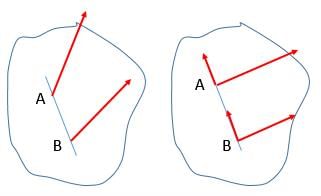
Given any two points A and B on a rigid body, let line AB be passing through points A and B, then the components of velocity of A and B along the line AB are always equal as the distance between A and B never changes or we can say relative velocity along AB is always zero.
Hence the relative velocity of the points must be perpendicular to the line joining them.
Most Upvoted Answer
There are two points P and Q on a planar rigid body. The relative velo...
Explanation:
To understand why the relative velocity between two points on a planar rigid body should always be perpendicular to the line connecting the two points (PQ), let's consider the motion of rigid bodies.
Motion of Rigid Bodies:
When a rigid body undergoes motion, all its constituent particles move simultaneously and undergo the same displacement. The motion of a rigid body can be classified into two types:
1. Translation: In pure translation, all points of the rigid body move along parallel paths, and the relative positions between the points remain constant.
2. Rotation: In rotation, all points of the rigid body move in circular paths about a fixed axis, and the relative positions between the points change.
Relative Velocity:
The relative velocity between two points on a rigid body is the velocity of one point with respect to the other. It is a vector quantity and depends on the motion of the rigid body.
Answering the Given Options:
Now, let's analyze the given options one by one:
a) The relative velocity between two points on a rigid body should always be perpendicular to the line connecting the two points (PQ).
This is because, in pure translation, all points on the rigid body move along parallel paths. As a result, the relative velocity between any two points should always be perpendicular to the line connecting them. This can be visualized by considering the motion of a train. The relative velocity between any two points on the train, let's say two windows, is always perpendicular to the line connecting them.
b) The relative velocity between two points on a rigid body cannot be oriented along any direction.
This option is incorrect because the relative velocity is determined by the motion of the rigid body. It cannot be oriented along any arbitrary direction.
c) The relative velocity between two points on a rigid body should always be along PQ.
This option is incorrect because in pure translation, the relative velocity should always be perpendicular to PQ, as explained earlier.
d) The relative velocity between two points on a rigid body should be along QP when the body undergoes pure translation.
This option is incorrect because, in pure translation, the relative velocity should always be perpendicular to PQ, not along QP.
Hence, the correct answer is option 'A' - The relative velocity between two points on a planar rigid body should always be perpendicular to PQ.
To understand why the relative velocity between two points on a planar rigid body should always be perpendicular to the line connecting the two points (PQ), let's consider the motion of rigid bodies.
Motion of Rigid Bodies:
When a rigid body undergoes motion, all its constituent particles move simultaneously and undergo the same displacement. The motion of a rigid body can be classified into two types:
1. Translation: In pure translation, all points of the rigid body move along parallel paths, and the relative positions between the points remain constant.
2. Rotation: In rotation, all points of the rigid body move in circular paths about a fixed axis, and the relative positions between the points change.
Relative Velocity:
The relative velocity between two points on a rigid body is the velocity of one point with respect to the other. It is a vector quantity and depends on the motion of the rigid body.
Answering the Given Options:
Now, let's analyze the given options one by one:
a) The relative velocity between two points on a rigid body should always be perpendicular to the line connecting the two points (PQ).
This is because, in pure translation, all points on the rigid body move along parallel paths. As a result, the relative velocity between any two points should always be perpendicular to the line connecting them. This can be visualized by considering the motion of a train. The relative velocity between any two points on the train, let's say two windows, is always perpendicular to the line connecting them.
b) The relative velocity between two points on a rigid body cannot be oriented along any direction.
This option is incorrect because the relative velocity is determined by the motion of the rigid body. It cannot be oriented along any arbitrary direction.
c) The relative velocity between two points on a rigid body should always be along PQ.
This option is incorrect because in pure translation, the relative velocity should always be perpendicular to PQ, as explained earlier.
d) The relative velocity between two points on a rigid body should be along QP when the body undergoes pure translation.
This option is incorrect because, in pure translation, the relative velocity should always be perpendicular to PQ, not along QP.
Hence, the correct answer is option 'A' - The relative velocity between two points on a planar rigid body should always be perpendicular to PQ.
 | Explore Courses for Mechanical Engineering exam |  |
Top Courses for Mechanical EngineeringView all





Top Courses for Mechanical Engineering
Question Description
There are two points P and Q on a planar rigid body. The relative velocity between the two pointsa)should always be perpendicular to PQb)can be oriented along any directionc)should always be along PQd)should be along QP when the body undergoes pure translationCorrect answer is option 'A'. Can you explain this answer? for Mechanical Engineering 2026 is part of Mechanical Engineering preparation. The Question and answers have been prepared according to the Mechanical Engineering exam syllabus. Information about There are two points P and Q on a planar rigid body. The relative velocity between the two pointsa)should always be perpendicular to PQb)can be oriented along any directionc)should always be along PQd)should be along QP when the body undergoes pure translationCorrect answer is option 'A'. Can you explain this answer? covers all topics & solutions for Mechanical Engineering 2026 Exam. Find important definitions, questions, meanings, examples, exercises and tests below for There are two points P and Q on a planar rigid body. The relative velocity between the two pointsa)should always be perpendicular to PQb)can be oriented along any directionc)should always be along PQd)should be along QP when the body undergoes pure translationCorrect answer is option 'A'. Can you explain this answer?.
There are two points P and Q on a planar rigid body. The relative velocity between the two pointsa)should always be perpendicular to PQb)can be oriented along any directionc)should always be along PQd)should be along QP when the body undergoes pure translationCorrect answer is option 'A'. Can you explain this answer? for Mechanical Engineering 2026 is part of Mechanical Engineering preparation. The Question and answers have been prepared according to the Mechanical Engineering exam syllabus. Information about There are two points P and Q on a planar rigid body. The relative velocity between the two pointsa)should always be perpendicular to PQb)can be oriented along any directionc)should always be along PQd)should be along QP when the body undergoes pure translationCorrect answer is option 'A'. Can you explain this answer? covers all topics & solutions for Mechanical Engineering 2026 Exam. Find important definitions, questions, meanings, examples, exercises and tests below for There are two points P and Q on a planar rigid body. The relative velocity between the two pointsa)should always be perpendicular to PQb)can be oriented along any directionc)should always be along PQd)should be along QP when the body undergoes pure translationCorrect answer is option 'A'. Can you explain this answer?.
Solutions for There are two points P and Q on a planar rigid body. The relative velocity between the two pointsa)should always be perpendicular to PQb)can be oriented along any directionc)should always be along PQd)should be along QP when the body undergoes pure translationCorrect answer is option 'A'. Can you explain this answer? in English & in Hindi are available as part of our courses for Mechanical Engineering. Download more important topics, notes, lectures and mock test series for Mechanical Engineering Exam by signing up for free.
Here you can find the meaning of There are two points P and Q on a planar rigid body. The relative velocity between the two pointsa)should always be perpendicular to PQb)can be oriented along any directionc)should always be along PQd)should be along QP when the body undergoes pure translationCorrect answer is option 'A'. Can you explain this answer? defined & explained in the simplest way possible. Besides giving the explanation of There are two points P and Q on a planar rigid body. The relative velocity between the two pointsa)should always be perpendicular to PQb)can be oriented along any directionc)should always be along PQd)should be along QP when the body undergoes pure translationCorrect answer is option 'A'. Can you explain this answer?, a detailed solution for There are two points P and Q on a planar rigid body. The relative velocity between the two pointsa)should always be perpendicular to PQb)can be oriented along any directionc)should always be along PQd)should be along QP when the body undergoes pure translationCorrect answer is option 'A'. Can you explain this answer? has been provided alongside types of There are two points P and Q on a planar rigid body. The relative velocity between the two pointsa)should always be perpendicular to PQb)can be oriented along any directionc)should always be along PQd)should be along QP when the body undergoes pure translationCorrect answer is option 'A'. Can you explain this answer? theory, EduRev gives you an ample number of questions to practice There are two points P and Q on a planar rigid body. The relative velocity between the two pointsa)should always be perpendicular to PQb)can be oriented along any directionc)should always be along PQd)should be along QP when the body undergoes pure translationCorrect answer is option 'A'. Can you explain this answer? tests, examples and also practice Mechanical Engineering tests.
| Explore Courses for Mechanical Engineering exam | |
Top Courses for Mechanical Engineering
Explore Courses
Signup for Free!
Signup to see your scores go up within 7 days! Learn & Practice with 1000+ FREE Notes, Videos & Tests.


