


NEET Exam > NEET Questions > Summary chart of epithelial tissue for quick... Start Learning for Free
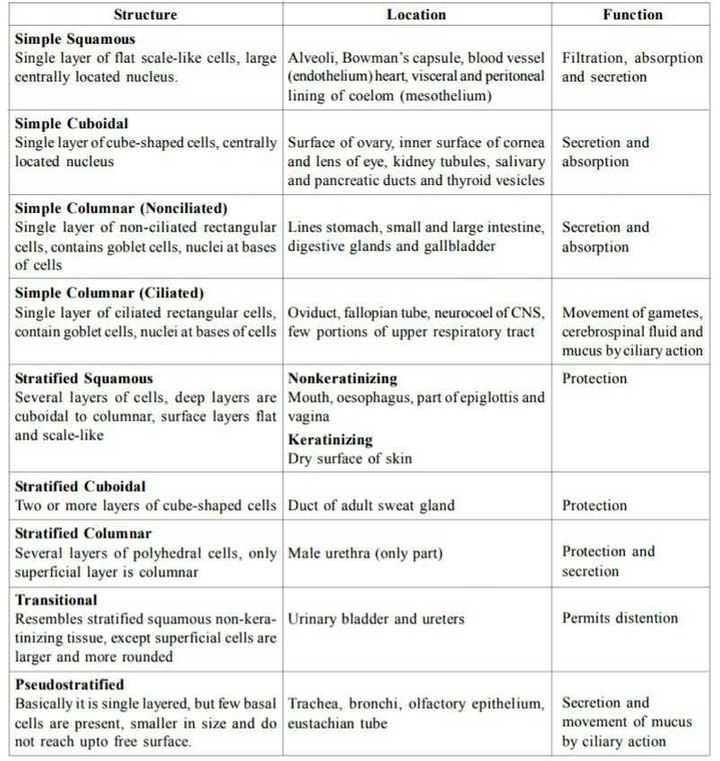
Summary chart of epithelial tissue for quick revision ?

Most Upvoted Answer
Summary chart of epithelial tissue for quick revision ?
Community Answer
Summary chart of epithelial tissue for quick revision ?
Epithelial Tissue Summary Chart
- Definition: Epithelial tissue is a type of tissue that covers the surfaces of the body, lines cavities, and forms glands.
- Types:
- Squamous: Thin, flat cells found in areas where diffusion or filtration occurs.
- Cuboidal: Cube-shaped cells found in glands and kidney tubules.
- Columnar: Tall, rectangular cells found in the digestive tract.
- Transitional: Specialized cells that can stretch found in the bladder.
- Functions:
- Protection: Protects underlying tissues from injury, infection, and dehydration.
- Absorption: Absorbs nutrients and other substances.
- Secretion: Produces and releases substances such as hormones and enzymes.
- Sensation: Contains nerve endings that detect stimuli.
- Characteristics:
- Polarity: Have an apical surface facing the lumen or external environment and a basal surface attached to underlying connective tissue.
- Cellularity: Composed mainly of cells with minimal extracellular matrix.
- Attachment: Attached to a basement membrane that separates epithelial tissue from connective tissue.
- Avascular: Lack blood vessels and rely on diffusion for nutrient exchange.
- Regeneration: Has a high regenerative capacity due to rapid cell division.
- Examples: Skin (stratified squamous), stomach lining (simple columnar), kidney tubules (simple cuboidal), and bladder (transitional).
Epithelial tissue is crucial for maintaining the integrity and function of various organs and structures in the body. Understanding its types, functions, and characteristics is essential for comprehending its role in the body's overall physiology.
- Definition: Epithelial tissue is a type of tissue that covers the surfaces of the body, lines cavities, and forms glands.
- Types:
- Squamous: Thin, flat cells found in areas where diffusion or filtration occurs.
- Cuboidal: Cube-shaped cells found in glands and kidney tubules.
- Columnar: Tall, rectangular cells found in the digestive tract.
- Transitional: Specialized cells that can stretch found in the bladder.
- Functions:
- Protection: Protects underlying tissues from injury, infection, and dehydration.
- Absorption: Absorbs nutrients and other substances.
- Secretion: Produces and releases substances such as hormones and enzymes.
- Sensation: Contains nerve endings that detect stimuli.
- Characteristics:
- Polarity: Have an apical surface facing the lumen or external environment and a basal surface attached to underlying connective tissue.
- Cellularity: Composed mainly of cells with minimal extracellular matrix.
- Attachment: Attached to a basement membrane that separates epithelial tissue from connective tissue.
- Avascular: Lack blood vessels and rely on diffusion for nutrient exchange.
- Regeneration: Has a high regenerative capacity due to rapid cell division.
- Examples: Skin (stratified squamous), stomach lining (simple columnar), kidney tubules (simple cuboidal), and bladder (transitional).
Epithelial tissue is crucial for maintaining the integrity and function of various organs and structures in the body. Understanding its types, functions, and characteristics is essential for comprehending its role in the body's overall physiology.
 | Explore Courses for NEET exam |  |
Top Courses for NEETView all




Top Courses for NEET
Question Description
Summary chart of epithelial tissue for quick revision ? for NEET 2026 is part of NEET preparation. The Question and answers have been prepared according to the NEET exam syllabus. Information about Summary chart of epithelial tissue for quick revision ? covers all topics & solutions for NEET 2026 Exam. Find important definitions, questions, meanings, examples, exercises and tests below for Summary chart of epithelial tissue for quick revision ?.
Summary chart of epithelial tissue for quick revision ? for NEET 2026 is part of NEET preparation. The Question and answers have been prepared according to the NEET exam syllabus. Information about Summary chart of epithelial tissue for quick revision ? covers all topics & solutions for NEET 2026 Exam. Find important definitions, questions, meanings, examples, exercises and tests below for Summary chart of epithelial tissue for quick revision ?.
Solutions for Summary chart of epithelial tissue for quick revision ? in English & in Hindi are available as part of our courses for NEET. Download more important topics, notes, lectures and mock test series for NEET Exam by signing up for free.
Here you can find the meaning of Summary chart of epithelial tissue for quick revision ? defined & explained in the simplest way possible. Besides giving the explanation of Summary chart of epithelial tissue for quick revision ?, a detailed solution for Summary chart of epithelial tissue for quick revision ? has been provided alongside types of Summary chart of epithelial tissue for quick revision ? theory, EduRev gives you an ample number of questions to practice Summary chart of epithelial tissue for quick revision ? tests, examples and also practice NEET tests.
| Explore Courses for NEET exam | |
Top Courses for NEET
Explore Courses
Signup for Free!
Signup to see your scores go up within 7 days! Learn & Practice with 1000+ FREE Notes, Videos & Tests.


