


NEET Exam > NEET Questions > The product of hill reaction are :a)ATP and N... Start Learning for Free
The product of hill reaction are :–
- a)ATP and NADPH2 in chloroplast
- b)ATP and NADPH2 in mitochondria
- c)Only oxygen
- d)A reduced substance NADPH2, ATP and O2 in chloroplast
Correct answer is option 'D'. Can you explain this answer?

Most Upvoted Answer
The product of hill reaction are :a)ATP and NADPH2 in chloroplastb)ATP...
Free Test
FREE
| Start Free Test |
Community Answer
The product of hill reaction are :a)ATP and NADPH2 in chloroplastb)ATP...
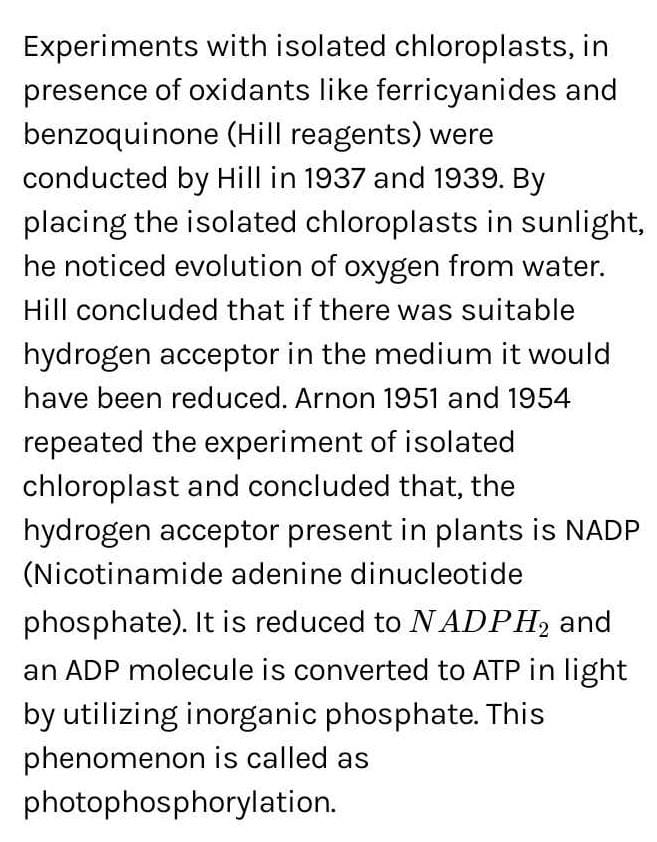
The Hill reaction is a light-dependent reaction that occurs in the chloroplasts of plants. It was discovered by Robert Hill in 1937 and is named after him. This reaction plays a crucial role in the process of photosynthesis by generating energy-rich molecules that are essential for the synthesis of glucose.
The product of the Hill reaction includes three important components: a reduced substance called NADPH2, ATP, and molecular oxygen (O2). Let's discuss each of these products in detail:
1. NADPH2 (Reduced Nicotinamide Adenine Dinucleotide Phosphate):
NADPH2 is an energy-rich molecule that serves as a reducing agent in various metabolic reactions. In the Hill reaction, light energy is absorbed by chlorophyll molecules in the chloroplasts. This energy is then used to transfer electrons from water molecules to NADP+ (Nicotinamide Adenine Dinucleotide Phosphate), resulting in the formation of NADPH2. The transfer of electrons is mediated by an electron transport chain located in the thylakoid membrane of the chloroplast.
2. ATP (Adenosine Triphosphate):
ATP is another crucial product of the Hill reaction. It is a high-energy molecule that serves as the primary energy currency of cells. During the Hill reaction, the light energy absorbed by chlorophyll molecules is also used to generate ATP through a process called photophosphorylation. The energy from the excited electrons is used to pump protons across the thylakoid membrane, creating a proton gradient. This gradient is then harnessed by ATP synthase to produce ATP from ADP (Adenosine Diphosphate) and inorganic phosphate (Pi).
3. Molecular Oxygen (O2):
The final product of the Hill reaction is molecular oxygen (O2). During the process, water molecules (H2O) are split into oxygen, protons (H+), and electrons (e-) through a process called photolysis. The oxygen molecules are released into the atmosphere as a byproduct of photosynthesis, contributing to the oxygen supply on Earth.
In summary, the Hill reaction in chloroplasts produces NADPH2, ATP, and molecular oxygen (O2). These products play vital roles in the subsequent dark reactions of photosynthesis, such as the Calvin cycle, where ATP and NADPH2 are used to convert CO2 into glucose and other organic compounds.
The product of the Hill reaction includes three important components: a reduced substance called NADPH2, ATP, and molecular oxygen (O2). Let's discuss each of these products in detail:
1. NADPH2 (Reduced Nicotinamide Adenine Dinucleotide Phosphate):
NADPH2 is an energy-rich molecule that serves as a reducing agent in various metabolic reactions. In the Hill reaction, light energy is absorbed by chlorophyll molecules in the chloroplasts. This energy is then used to transfer electrons from water molecules to NADP+ (Nicotinamide Adenine Dinucleotide Phosphate), resulting in the formation of NADPH2. The transfer of electrons is mediated by an electron transport chain located in the thylakoid membrane of the chloroplast.
2. ATP (Adenosine Triphosphate):
ATP is another crucial product of the Hill reaction. It is a high-energy molecule that serves as the primary energy currency of cells. During the Hill reaction, the light energy absorbed by chlorophyll molecules is also used to generate ATP through a process called photophosphorylation. The energy from the excited electrons is used to pump protons across the thylakoid membrane, creating a proton gradient. This gradient is then harnessed by ATP synthase to produce ATP from ADP (Adenosine Diphosphate) and inorganic phosphate (Pi).
3. Molecular Oxygen (O2):
The final product of the Hill reaction is molecular oxygen (O2). During the process, water molecules (H2O) are split into oxygen, protons (H+), and electrons (e-) through a process called photolysis. The oxygen molecules are released into the atmosphere as a byproduct of photosynthesis, contributing to the oxygen supply on Earth.
In summary, the Hill reaction in chloroplasts produces NADPH2, ATP, and molecular oxygen (O2). These products play vital roles in the subsequent dark reactions of photosynthesis, such as the Calvin cycle, where ATP and NADPH2 are used to convert CO2 into glucose and other organic compounds.
 | Explore Courses for NEET exam |  |
Top Courses for NEETView all




Top Courses for NEET
Question Description
The product of hill reaction are :a)ATP and NADPH2 in chloroplastb)ATP and NADPH2 in mitochondriac)Only oxygend)A reduced substance NADPH2, ATP and O2 in chloroplastCorrect answer is option 'D'. Can you explain this answer? for NEET 2026 is part of NEET preparation. The Question and answers have been prepared according to the NEET exam syllabus. Information about The product of hill reaction are :a)ATP and NADPH2 in chloroplastb)ATP and NADPH2 in mitochondriac)Only oxygend)A reduced substance NADPH2, ATP and O2 in chloroplastCorrect answer is option 'D'. Can you explain this answer? covers all topics & solutions for NEET 2026 Exam. Find important definitions, questions, meanings, examples, exercises and tests below for The product of hill reaction are :a)ATP and NADPH2 in chloroplastb)ATP and NADPH2 in mitochondriac)Only oxygend)A reduced substance NADPH2, ATP and O2 in chloroplastCorrect answer is option 'D'. Can you explain this answer?.
The product of hill reaction are :a)ATP and NADPH2 in chloroplastb)ATP and NADPH2 in mitochondriac)Only oxygend)A reduced substance NADPH2, ATP and O2 in chloroplastCorrect answer is option 'D'. Can you explain this answer? for NEET 2026 is part of NEET preparation. The Question and answers have been prepared according to the NEET exam syllabus. Information about The product of hill reaction are :a)ATP and NADPH2 in chloroplastb)ATP and NADPH2 in mitochondriac)Only oxygend)A reduced substance NADPH2, ATP and O2 in chloroplastCorrect answer is option 'D'. Can you explain this answer? covers all topics & solutions for NEET 2026 Exam. Find important definitions, questions, meanings, examples, exercises and tests below for The product of hill reaction are :a)ATP and NADPH2 in chloroplastb)ATP and NADPH2 in mitochondriac)Only oxygend)A reduced substance NADPH2, ATP and O2 in chloroplastCorrect answer is option 'D'. Can you explain this answer?.
Solutions for The product of hill reaction are :a)ATP and NADPH2 in chloroplastb)ATP and NADPH2 in mitochondriac)Only oxygend)A reduced substance NADPH2, ATP and O2 in chloroplastCorrect answer is option 'D'. Can you explain this answer? in English & in Hindi are available as part of our courses for NEET. Download more important topics, notes, lectures and mock test series for NEET Exam by signing up for free.
Here you can find the meaning of The product of hill reaction are :a)ATP and NADPH2 in chloroplastb)ATP and NADPH2 in mitochondriac)Only oxygend)A reduced substance NADPH2, ATP and O2 in chloroplastCorrect answer is option 'D'. Can you explain this answer? defined & explained in the simplest way possible. Besides giving the explanation of The product of hill reaction are :a)ATP and NADPH2 in chloroplastb)ATP and NADPH2 in mitochondriac)Only oxygend)A reduced substance NADPH2, ATP and O2 in chloroplastCorrect answer is option 'D'. Can you explain this answer?, a detailed solution for The product of hill reaction are :a)ATP and NADPH2 in chloroplastb)ATP and NADPH2 in mitochondriac)Only oxygend)A reduced substance NADPH2, ATP and O2 in chloroplastCorrect answer is option 'D'. Can you explain this answer? has been provided alongside types of The product of hill reaction are :a)ATP and NADPH2 in chloroplastb)ATP and NADPH2 in mitochondriac)Only oxygend)A reduced substance NADPH2, ATP and O2 in chloroplastCorrect answer is option 'D'. Can you explain this answer? theory, EduRev gives you an ample number of questions to practice The product of hill reaction are :a)ATP and NADPH2 in chloroplastb)ATP and NADPH2 in mitochondriac)Only oxygend)A reduced substance NADPH2, ATP and O2 in chloroplastCorrect answer is option 'D'. Can you explain this answer? tests, examples and also practice NEET tests.
| Explore Courses for NEET exam | |
Top Courses for NEET
Explore Courses
Signup for Free!
Signup to see your scores go up within 7 days! Learn & Practice with 1000+ FREE Notes, Videos & Tests.


