


NEET Exam > NEET Questions > Mohl's half experiment proves that during pho... Start Learning for Free
Mohl's half experiment proves that during photosynthesis
- a)oxygen is released
- b)chlorophyll is necessary
- c)carbon dioxide is necessary
- d)organic substance is produced
Correct answer is option 'C'. Can you explain this answer?

Most Upvoted Answer
Mohl's half experiment proves that during photosynthesisa)oxygen is re...
Free Test
FREE
| Start Free Test |
Community Answer
Mohl's half experiment proves that during photosynthesisa)oxygen is re...
Explanation:
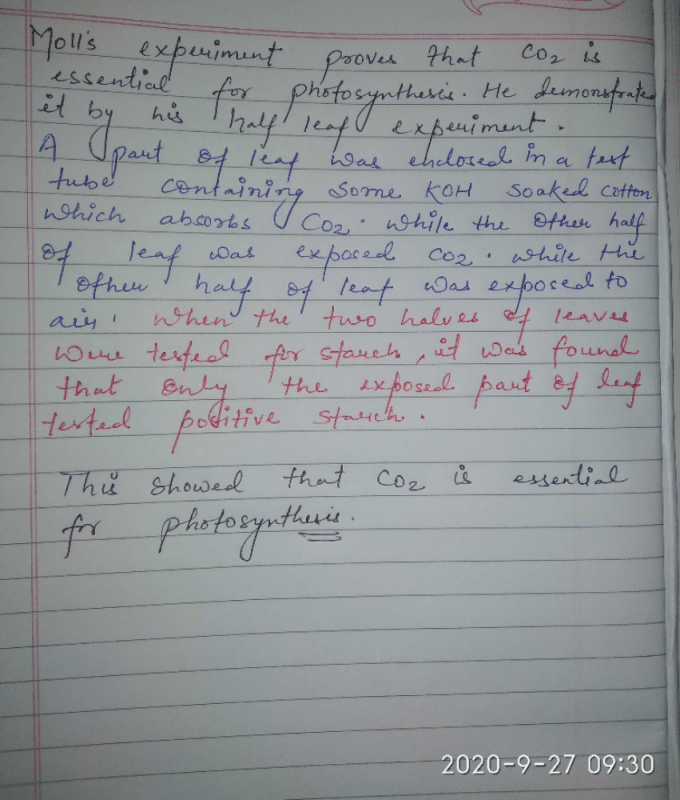
Mohl's half experiment is a technique to prove that carbon dioxide is necessary for photosynthesis. The experiment involves splitting a leaf into two halves and exposing one half to carbon dioxide and the other half to oxygen. The experiment is performed in a bell jar where the leaf is exposed to light.
The following points explain the experiment and the results:
- Preparation: A potted plant is kept in a bell jar and a leaf is selected for the experiment. The leaf is split into two halves with a sharp blade, making sure that the midrib is not cut. One half is exposed to carbon dioxide while the other half is exposed to oxygen. The bell jar is sealed to prevent air from escaping.
- Observation: After a few hours, the leaf exposed to carbon dioxide releases oxygen bubbles while the other half does not release any bubbles. This is because the half exposed to carbon dioxide undergoes photosynthesis, which produces oxygen as a byproduct. The half exposed to oxygen does not undergo photosynthesis and hence does not produce any oxygen.
- Conclusion: The experiment proves that carbon dioxide is necessary for photosynthesis. This is because the half exposed to carbon dioxide produces oxygen, which is a byproduct of photosynthesis. The half exposed to oxygen does not produce any oxygen because it cannot undergo photosynthesis without carbon dioxide.
Therefore, option C (carbon dioxide is necessary) is the correct answer.
Mohl's half experiment is a technique to prove that carbon dioxide is necessary for photosynthesis. The experiment involves splitting a leaf into two halves and exposing one half to carbon dioxide and the other half to oxygen. The experiment is performed in a bell jar where the leaf is exposed to light.
The following points explain the experiment and the results:
- Preparation: A potted plant is kept in a bell jar and a leaf is selected for the experiment. The leaf is split into two halves with a sharp blade, making sure that the midrib is not cut. One half is exposed to carbon dioxide while the other half is exposed to oxygen. The bell jar is sealed to prevent air from escaping.
- Observation: After a few hours, the leaf exposed to carbon dioxide releases oxygen bubbles while the other half does not release any bubbles. This is because the half exposed to carbon dioxide undergoes photosynthesis, which produces oxygen as a byproduct. The half exposed to oxygen does not undergo photosynthesis and hence does not produce any oxygen.
- Conclusion: The experiment proves that carbon dioxide is necessary for photosynthesis. This is because the half exposed to carbon dioxide produces oxygen, which is a byproduct of photosynthesis. The half exposed to oxygen does not produce any oxygen because it cannot undergo photosynthesis without carbon dioxide.
Therefore, option C (carbon dioxide is necessary) is the correct answer.
 | Explore Courses for NEET exam |  |
Top Courses for NEETView all




Top Courses for NEET
Question Description
Mohl's half experiment proves that during photosynthesisa)oxygen is releasedb)chlorophyll is necessaryc)carbon dioxide is necessaryd)organic substance is producedCorrect answer is option 'C'. Can you explain this answer? for NEET 2026 is part of NEET preparation. The Question and answers have been prepared according to the NEET exam syllabus. Information about Mohl's half experiment proves that during photosynthesisa)oxygen is releasedb)chlorophyll is necessaryc)carbon dioxide is necessaryd)organic substance is producedCorrect answer is option 'C'. Can you explain this answer? covers all topics & solutions for NEET 2026 Exam. Find important definitions, questions, meanings, examples, exercises and tests below for Mohl's half experiment proves that during photosynthesisa)oxygen is releasedb)chlorophyll is necessaryc)carbon dioxide is necessaryd)organic substance is producedCorrect answer is option 'C'. Can you explain this answer?.
Mohl's half experiment proves that during photosynthesisa)oxygen is releasedb)chlorophyll is necessaryc)carbon dioxide is necessaryd)organic substance is producedCorrect answer is option 'C'. Can you explain this answer? for NEET 2026 is part of NEET preparation. The Question and answers have been prepared according to the NEET exam syllabus. Information about Mohl's half experiment proves that during photosynthesisa)oxygen is releasedb)chlorophyll is necessaryc)carbon dioxide is necessaryd)organic substance is producedCorrect answer is option 'C'. Can you explain this answer? covers all topics & solutions for NEET 2026 Exam. Find important definitions, questions, meanings, examples, exercises and tests below for Mohl's half experiment proves that during photosynthesisa)oxygen is releasedb)chlorophyll is necessaryc)carbon dioxide is necessaryd)organic substance is producedCorrect answer is option 'C'. Can you explain this answer?.
Solutions for Mohl's half experiment proves that during photosynthesisa)oxygen is releasedb)chlorophyll is necessaryc)carbon dioxide is necessaryd)organic substance is producedCorrect answer is option 'C'. Can you explain this answer? in English & in Hindi are available as part of our courses for NEET. Download more important topics, notes, lectures and mock test series for NEET Exam by signing up for free.
Here you can find the meaning of Mohl's half experiment proves that during photosynthesisa)oxygen is releasedb)chlorophyll is necessaryc)carbon dioxide is necessaryd)organic substance is producedCorrect answer is option 'C'. Can you explain this answer? defined & explained in the simplest way possible. Besides giving the explanation of Mohl's half experiment proves that during photosynthesisa)oxygen is releasedb)chlorophyll is necessaryc)carbon dioxide is necessaryd)organic substance is producedCorrect answer is option 'C'. Can you explain this answer?, a detailed solution for Mohl's half experiment proves that during photosynthesisa)oxygen is releasedb)chlorophyll is necessaryc)carbon dioxide is necessaryd)organic substance is producedCorrect answer is option 'C'. Can you explain this answer? has been provided alongside types of Mohl's half experiment proves that during photosynthesisa)oxygen is releasedb)chlorophyll is necessaryc)carbon dioxide is necessaryd)organic substance is producedCorrect answer is option 'C'. Can you explain this answer? theory, EduRev gives you an ample number of questions to practice Mohl's half experiment proves that during photosynthesisa)oxygen is releasedb)chlorophyll is necessaryc)carbon dioxide is necessaryd)organic substance is producedCorrect answer is option 'C'. Can you explain this answer? tests, examples and also practice NEET tests.
| Explore Courses for NEET exam | |
Top Courses for NEET
Explore Courses
Signup for Free!
Signup to see your scores go up within 7 days! Learn & Practice with 1000+ FREE Notes, Videos & Tests.


