


Class 9 Exam > Class 9 Questions > What is plasmolysis in plant cells? Start Learning for Free
What is plasmolysis in plant cells?

Most Upvoted Answer
What is plasmolysis in plant cells?
The below mentioned article provides a study note on the plasmolysis in plant cell.
In many plant cells, the protoplasm may shrink completely away from the cell wall and collect as a spherical mass in the centre or in one corner of the cell.
This phenomenon is called plasmolysis. When this contraction or withdrawal of protoplasm away from the cell wall has just commenced, i.e., when the turgour or the hydrostatic pressure on the cell wall has just been released (turgour is zero), the cell is then said to be at incipient plasmolysis or threshold plasmolysis.
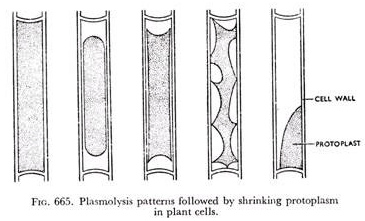
The pattern followed and set up by shrinking protoplasm seems to be typical for each kind of cell (Fig. 665) although it can be modified to certain extent by the physiological condition of cell at that time.
The space between the cell wall and the contracting protoplasm will be filled up by the external solution as the cellulose cell wall without the adhering protoplasmic layer, is now permeable to both the solvent and solute alike and not differentially permeable.
In such a plasmolysed plant cell the release of turgour from the cell wall increases evidently the suction pressure of the cell, and the suction pressure being now freed from any other imposed pressure upon it, becomes equal to the osmotic pressure of the cell sap.
Evidently, such a cell will potentially have the maximum water absorbing capacity for both the osmotic and suction pressures are now equal in magnitude. If such a plasmolysed cell is transferred from hypertonic solution and to pure water, it will slowly recover by the net inward movement of water (if deplasmolysis, as it is sometimes called or inward movement of water, is too rapid, it may result in the death of the cell due to sudden stretching of protoplasm) subjecting the cell wall to a progressively imposed turgour pressure and in consequence, reducing the suction pressure of the cell.
When the turgour pressure becomes equal to the osmotic pressure, the suction pressure of such a cell is zero and the cell has taken up the maximum amount of water from the surrounding medium. Such a cell is known as turgid and the phenomenon associated with it, turgidity.
Plasmolysis can be conveniently demonstrated in plant cells under microscope containing coloured (blue or red anthocyanins) cell sap since the contracting protoplasm can now be readily distinguished in the cell matrix.
Community Answer
What is plasmolysis in plant cells?
Plasmolysis in Plant Cells
Plasmolysis is a phenomenon that occurs in plant cells when they are exposed to a hypertonic solution, causing water to move out of the cell. This process leads to the shrinking of the cell's contents and the detachment of the plasma membrane from the cell wall.
Process of Plasmolysis
- When a plant cell is placed in a hypertonic solution, the concentration of solutes outside the cell is higher than inside the cell.
- Water inside the cell moves out through osmosis, towards the area of higher solute concentration.
- As water exits the cell, the vacuole shrinks, and the plasma membrane pulls away from the cell wall.
- This results in the cell losing turgor pressure and becoming flaccid.
Consequences of Plasmolysis
- Plasmolysis can disrupt various cellular functions as the cell loses its normal shape and structure.
- The loss of turgor pressure can affect the plant's ability to maintain its rigidity and support itself.
- Continued exposure to a hypertonic solution can lead to irreversible damage to the cell.
Importance of Plasmolysis
- Plasmolysis is an essential process for studying the osmotic properties of plant cells.
- It helps researchers understand how cells respond to changes in their external environment.
- Plasmolysis is also used in agricultural practices to study the effects of drought and salinity stress on plants.
In conclusion, plasmolysis is a crucial phenomenon in plant cells that occurs when they are exposed to a hypertonic solution. Understanding this process is essential for studying plant physiology and developing strategies to improve crop resilience to environmental stressors.
 | Explore Courses for Class 9 exam |  |
Top Courses for Class 9View all





Top Courses for Class 9
Question Description
What is plasmolysis in plant cells? for Class 9 2026 is part of Class 9 preparation. The Question and answers have been prepared according to the Class 9 exam syllabus. Information about What is plasmolysis in plant cells? covers all topics & solutions for Class 9 2026 Exam. Find important definitions, questions, meanings, examples, exercises and tests below for What is plasmolysis in plant cells?.
What is plasmolysis in plant cells? for Class 9 2026 is part of Class 9 preparation. The Question and answers have been prepared according to the Class 9 exam syllabus. Information about What is plasmolysis in plant cells? covers all topics & solutions for Class 9 2026 Exam. Find important definitions, questions, meanings, examples, exercises and tests below for What is plasmolysis in plant cells?.
Solutions for What is plasmolysis in plant cells? in English & in Hindi are available as part of our courses for Class 9. Download more important topics, notes, lectures and mock test series for Class 9 Exam by signing up for free.
Here you can find the meaning of What is plasmolysis in plant cells? defined & explained in the simplest way possible. Besides giving the explanation of What is plasmolysis in plant cells?, a detailed solution for What is plasmolysis in plant cells? has been provided alongside types of What is plasmolysis in plant cells? theory, EduRev gives you an ample number of questions to practice What is plasmolysis in plant cells? tests, examples and also practice Class 9 tests.
| Explore Courses for Class 9 exam | |
Top Courses for Class 9
Explore Courses
Signup for Free!
Signup to see your scores go up within 7 days! Learn & Practice with 1000+ FREE Notes, Videos & Tests.


