


NEET Exam > NEET Questions > During ionisation of H2O, H+ is captured bya)... Start Learning for Free
During ionisation of H2O, H+ is captured by
- a)Chlorophyll
- b)NADP
- c)O2
- d)Cytochrome
Correct answer is option 'B'. Can you explain this answer?

Verified Answer
During ionisation of H2O, H+ is captured bya)Chlorophyllb)NADPc)O2d)Cy...
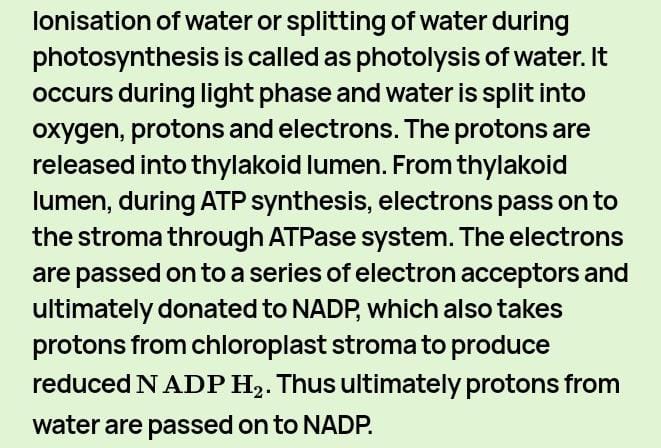
Ionisation of water or splitting of water during photosynthesis is called as photolysis of water. It occurs during light phase and water is split into oxygen, protons and electrons. The protons are released into thylakoid lumen. From thylakoid lumen, during ATP synthesis, electrons pass on to the stroma through ATPase system. The electrons are passed on to a series of electron acceptors and ultimately donated to NADP, which also takes protons from chloroplast stroma to produce reduced NADPH2. Thus ultimately protons from water are passed on to NADP.
Most Upvoted Answer
During ionisation of H2O, H+ is captured bya)Chlorophyllb)NADPc)O2d)Cy...
Free Test
FREE
| Start Free Test |
Community Answer
During ionisation of H2O, H+ is captured bya)Chlorophyllb)NADPc)O2d)Cy...
Explanation:
During the process of ionization of water (H2O), one hydrogen atom (H) is captured by NADP (Nicotinamide adenine dinucleotide phosphate), which is an important molecule involved in various metabolic processes in living organisms.
Ionization of Water:
Water (H2O) is a polar molecule, which means it has a slightly positive charge on the hydrogen atoms and a slightly negative charge on the oxygen atom. In the presence of an external force, such as light energy, water molecules can undergo ionization or dissociation.
The ionization of water can be represented by the following equation:
H2O -> H+ + OH-
In this reaction, one hydrogen atom (H) is released as a positively charged ion (H+ or a proton), and the remaining hydroxyl group (OH-) is released as a negatively charged ion.
Role of NADP:
NADP is a coenzyme that plays a crucial role in various metabolic processes, particularly in photosynthesis. It acts as an electron carrier, accepting and donating electrons during redox reactions.
During the process of photosynthesis, NADP acts as an electron acceptor during the light-dependent reactions. It accepts high-energy electrons from chlorophyll and becomes reduced to NADPH. This NADPH molecule carries the energized electrons to the Calvin cycle, where it acts as a reducing agent in the synthesis of glucose.
In the context of the given question, NADP captures the released hydrogen ion (H+) during the ionization of water. This capture of the hydrogen ion by NADP is an essential step in the conversion of light energy into chemical energy during photosynthesis.
Therefore, during the ionization of water, H is captured by NADP.
Conclusion:
In summary, during the ionization of water, one hydrogen atom (H) is captured by NADP, which is an important molecule involved in various metabolic processes, especially in photosynthesis.
During the process of ionization of water (H2O), one hydrogen atom (H) is captured by NADP (Nicotinamide adenine dinucleotide phosphate), which is an important molecule involved in various metabolic processes in living organisms.
Ionization of Water:
Water (H2O) is a polar molecule, which means it has a slightly positive charge on the hydrogen atoms and a slightly negative charge on the oxygen atom. In the presence of an external force, such as light energy, water molecules can undergo ionization or dissociation.
The ionization of water can be represented by the following equation:
H2O -> H+ + OH-
In this reaction, one hydrogen atom (H) is released as a positively charged ion (H+ or a proton), and the remaining hydroxyl group (OH-) is released as a negatively charged ion.
Role of NADP:
NADP is a coenzyme that plays a crucial role in various metabolic processes, particularly in photosynthesis. It acts as an electron carrier, accepting and donating electrons during redox reactions.
During the process of photosynthesis, NADP acts as an electron acceptor during the light-dependent reactions. It accepts high-energy electrons from chlorophyll and becomes reduced to NADPH. This NADPH molecule carries the energized electrons to the Calvin cycle, where it acts as a reducing agent in the synthesis of glucose.
In the context of the given question, NADP captures the released hydrogen ion (H+) during the ionization of water. This capture of the hydrogen ion by NADP is an essential step in the conversion of light energy into chemical energy during photosynthesis.
Therefore, during the ionization of water, H is captured by NADP.
Conclusion:
In summary, during the ionization of water, one hydrogen atom (H) is captured by NADP, which is an important molecule involved in various metabolic processes, especially in photosynthesis.
 | Explore Courses for NEET exam |  |
Top Courses for NEETView all




Top Courses for NEET
Question Description
During ionisation of H2O, H+ is captured bya)Chlorophyllb)NADPc)O2d)CytochromeCorrect answer is option 'B'. Can you explain this answer? for NEET 2026 is part of NEET preparation. The Question and answers have been prepared according to the NEET exam syllabus. Information about During ionisation of H2O, H+ is captured bya)Chlorophyllb)NADPc)O2d)CytochromeCorrect answer is option 'B'. Can you explain this answer? covers all topics & solutions for NEET 2026 Exam. Find important definitions, questions, meanings, examples, exercises and tests below for During ionisation of H2O, H+ is captured bya)Chlorophyllb)NADPc)O2d)CytochromeCorrect answer is option 'B'. Can you explain this answer?.
During ionisation of H2O, H+ is captured bya)Chlorophyllb)NADPc)O2d)CytochromeCorrect answer is option 'B'. Can you explain this answer? for NEET 2026 is part of NEET preparation. The Question and answers have been prepared according to the NEET exam syllabus. Information about During ionisation of H2O, H+ is captured bya)Chlorophyllb)NADPc)O2d)CytochromeCorrect answer is option 'B'. Can you explain this answer? covers all topics & solutions for NEET 2026 Exam. Find important definitions, questions, meanings, examples, exercises and tests below for During ionisation of H2O, H+ is captured bya)Chlorophyllb)NADPc)O2d)CytochromeCorrect answer is option 'B'. Can you explain this answer?.
Solutions for During ionisation of H2O, H+ is captured bya)Chlorophyllb)NADPc)O2d)CytochromeCorrect answer is option 'B'. Can you explain this answer? in English & in Hindi are available as part of our courses for NEET. Download more important topics, notes, lectures and mock test series for NEET Exam by signing up for free.
Here you can find the meaning of During ionisation of H2O, H+ is captured bya)Chlorophyllb)NADPc)O2d)CytochromeCorrect answer is option 'B'. Can you explain this answer? defined & explained in the simplest way possible. Besides giving the explanation of During ionisation of H2O, H+ is captured bya)Chlorophyllb)NADPc)O2d)CytochromeCorrect answer is option 'B'. Can you explain this answer?, a detailed solution for During ionisation of H2O, H+ is captured bya)Chlorophyllb)NADPc)O2d)CytochromeCorrect answer is option 'B'. Can you explain this answer? has been provided alongside types of During ionisation of H2O, H+ is captured bya)Chlorophyllb)NADPc)O2d)CytochromeCorrect answer is option 'B'. Can you explain this answer? theory, EduRev gives you an ample number of questions to practice During ionisation of H2O, H+ is captured bya)Chlorophyllb)NADPc)O2d)CytochromeCorrect answer is option 'B'. Can you explain this answer? tests, examples and also practice NEET tests.
| Explore Courses for NEET exam | |
Top Courses for NEET
Explore Courses
Signup for Free!
Signup to see your scores go up within 7 days! Learn & Practice with 1000+ FREE Notes, Videos & Tests.


