


NEET Exam > NEET Questions > A ball is thrown vertically upwards with a ve... Start Learning for Free
A ball is thrown vertically upwards with a velocity of 20 m s-1 from the top of a multistorey building of 25 m high. the time taken by the ball to reach the ground is
- a)2 s
- b)3 s
- c)5 s
- d)7 s
Correct answer is option 'C'. Can you explain this answer?

Most Upvoted Answer
A ball is thrown vertically upwards with a velocity of 20 m s-1 from t...
Let t1 be the time taken by the ball to reach the highest point.
here, v = 0, u = 20ms−1, a = −g = −10ms−2, t = t1
As v = u + at
∴ 0 = 20 + (−10)t1 or t1 = 2s
Taking vertical downward motion of the ball from the highest point to ground.
Here, u = 0, a = +g = 10ms−2, S = 20 m + 25 m = 45 m, t = t2
here, v = 0, u = 20ms−1, a = −g = −10ms−2, t = t1
As v = u + at
∴ 0 = 20 + (−10)t1 or t1 = 2s
Taking vertical downward motion of the ball from the highest point to ground.
Here, u = 0, a = +g = 10ms−2, S = 20 m + 25 m = 45 m, t = t2
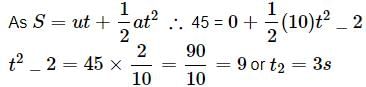
Total time taken by the ball to reach the ground = t1 + t2 = 2s + 3s = 5s
Free Test
FREE
| Start Free Test |
Community Answer
A ball is thrown vertically upwards with a velocity of 20 m s-1 from t...
Given information:
- Initial velocity, u = 20 m/s (upwards)
- Height of the building, h = 25 m
Approach:
- We need to find the time taken by the ball to reach the ground.
- We can use the equation of motion to solve this problem.
- We know that the final velocity of the ball when it reaches the ground will be zero and the acceleration due to gravity is acting in the downward direction.
Calculations:
- Let's assume that the time taken by the ball to reach the ground is t.
- Using the equation of motion, v = u + gt, where v is the final velocity, u is the initial velocity, g is the acceleration due to gravity, and t is the time.
- In this case, the final velocity of the ball is 0 m/s, the initial velocity is 20 m/s (upwards), and the acceleration due to gravity is -9.8 m/s^2 (downwards).
- Therefore, 0 = 20 - 9.8t.
- Solving this equation, we get t = 2.04 s (approximately).
Conclusion:
- The time taken by the ball to reach the ground is approximately 2.04 seconds.
- Since the question asks for the nearest whole number option, the correct answer is option 'C' (5 seconds).
- Initial velocity, u = 20 m/s (upwards)
- Height of the building, h = 25 m
Approach:
- We need to find the time taken by the ball to reach the ground.
- We can use the equation of motion to solve this problem.
- We know that the final velocity of the ball when it reaches the ground will be zero and the acceleration due to gravity is acting in the downward direction.
Calculations:
- Let's assume that the time taken by the ball to reach the ground is t.
- Using the equation of motion, v = u + gt, where v is the final velocity, u is the initial velocity, g is the acceleration due to gravity, and t is the time.
- In this case, the final velocity of the ball is 0 m/s, the initial velocity is 20 m/s (upwards), and the acceleration due to gravity is -9.8 m/s^2 (downwards).
- Therefore, 0 = 20 - 9.8t.
- Solving this equation, we get t = 2.04 s (approximately).
Conclusion:
- The time taken by the ball to reach the ground is approximately 2.04 seconds.
- Since the question asks for the nearest whole number option, the correct answer is option 'C' (5 seconds).
 | Explore Courses for NEET exam |  |
Top Courses for NEETView all





Top Courses for NEET
Question Description
A ball is thrown vertically upwards with a velocity of 20 m s-1 from the top of a multistorey building of 25 m high. the time taken by the ball to reach the ground isa)2 sb)3 sc)5 sd)7 sCorrect answer is option 'C'. Can you explain this answer? for NEET 2026 is part of NEET preparation. The Question and answers have been prepared according to the NEET exam syllabus. Information about A ball is thrown vertically upwards with a velocity of 20 m s-1 from the top of a multistorey building of 25 m high. the time taken by the ball to reach the ground isa)2 sb)3 sc)5 sd)7 sCorrect answer is option 'C'. Can you explain this answer? covers all topics & solutions for NEET 2026 Exam. Find important definitions, questions, meanings, examples, exercises and tests below for A ball is thrown vertically upwards with a velocity of 20 m s-1 from the top of a multistorey building of 25 m high. the time taken by the ball to reach the ground isa)2 sb)3 sc)5 sd)7 sCorrect answer is option 'C'. Can you explain this answer?.
A ball is thrown vertically upwards with a velocity of 20 m s-1 from the top of a multistorey building of 25 m high. the time taken by the ball to reach the ground isa)2 sb)3 sc)5 sd)7 sCorrect answer is option 'C'. Can you explain this answer? for NEET 2026 is part of NEET preparation. The Question and answers have been prepared according to the NEET exam syllabus. Information about A ball is thrown vertically upwards with a velocity of 20 m s-1 from the top of a multistorey building of 25 m high. the time taken by the ball to reach the ground isa)2 sb)3 sc)5 sd)7 sCorrect answer is option 'C'. Can you explain this answer? covers all topics & solutions for NEET 2026 Exam. Find important definitions, questions, meanings, examples, exercises and tests below for A ball is thrown vertically upwards with a velocity of 20 m s-1 from the top of a multistorey building of 25 m high. the time taken by the ball to reach the ground isa)2 sb)3 sc)5 sd)7 sCorrect answer is option 'C'. Can you explain this answer?.
Solutions for A ball is thrown vertically upwards with a velocity of 20 m s-1 from the top of a multistorey building of 25 m high. the time taken by the ball to reach the ground isa)2 sb)3 sc)5 sd)7 sCorrect answer is option 'C'. Can you explain this answer? in English & in Hindi are available as part of our courses for NEET. Download more important topics, notes, lectures and mock test series for NEET Exam by signing up for free.
Here you can find the meaning of A ball is thrown vertically upwards with a velocity of 20 m s-1 from the top of a multistorey building of 25 m high. the time taken by the ball to reach the ground isa)2 sb)3 sc)5 sd)7 sCorrect answer is option 'C'. Can you explain this answer? defined & explained in the simplest way possible. Besides giving the explanation of A ball is thrown vertically upwards with a velocity of 20 m s-1 from the top of a multistorey building of 25 m high. the time taken by the ball to reach the ground isa)2 sb)3 sc)5 sd)7 sCorrect answer is option 'C'. Can you explain this answer?, a detailed solution for A ball is thrown vertically upwards with a velocity of 20 m s-1 from the top of a multistorey building of 25 m high. the time taken by the ball to reach the ground isa)2 sb)3 sc)5 sd)7 sCorrect answer is option 'C'. Can you explain this answer? has been provided alongside types of A ball is thrown vertically upwards with a velocity of 20 m s-1 from the top of a multistorey building of 25 m high. the time taken by the ball to reach the ground isa)2 sb)3 sc)5 sd)7 sCorrect answer is option 'C'. Can you explain this answer? theory, EduRev gives you an ample number of questions to practice A ball is thrown vertically upwards with a velocity of 20 m s-1 from the top of a multistorey building of 25 m high. the time taken by the ball to reach the ground isa)2 sb)3 sc)5 sd)7 sCorrect answer is option 'C'. Can you explain this answer? tests, examples and also practice NEET tests.
| Explore Courses for NEET exam | |
Top Courses for NEET
Explore Courses
Signup for Free!
Signup to see your scores go up within 7 days! Learn & Practice with 1000+ FREE Notes, Videos & Tests.


