


NEET Exam > NEET Questions > In humans, polydactyly (i.e, presence of extr... Start Learning for Free
In humans, polydactyly (i.e, presence of extra fingers and toes) is determined by a dominant autosomal allele (P) and the normal condition is determined by a recessive allele (p). Find out the possible genotypes of family members 1, 2 and 3 in the given pedigree.
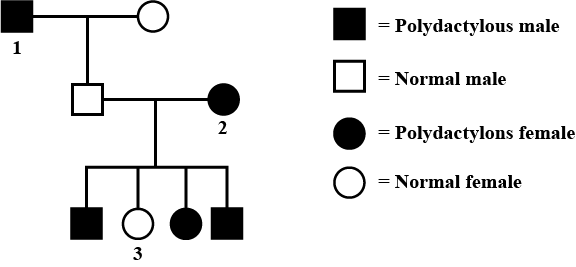
Codes are:
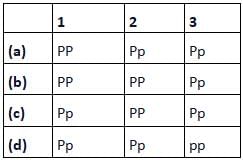
- a)a
- b)b
- c)c
- d)d
Correct answer is option 'D'. Can you explain this answer?

Most Upvoted Answer
In humans, polydactyly (i.e, presence of extra fingers and toes) is de...
Understanding Hemophilia
Hemophilia is a genetic disorder that primarily affects blood clotting, leading to excessive bleeding. It is primarily inherited in a sex-linked recessive manner, which is crucial to understanding the assertion and reason provided.
Assertion (A): All daughters of a man affected by hemophilia will be carriers of the disease.
- Hemophilia is linked to the X chromosome.
- Males have one X and one Y chromosome (XY), while females have two X chromosomes (XX).
- A father with hemophilia will pass his Y chromosome to his sons (who cannot inherit the disorder) and his X chromosome to his daughters.
- Therefore, all daughters will inherit one affected X chromosome, making them carriers of hemophilia.
Reason (R): Hemophilia is a sex-linked recessive disorder carried on the X chromosome.
- This statement is true as hemophilia is indeed carried on the X chromosome.
- Because it is recessive, females need two affected X chromosomes to express the disorder, but only one affected X chromosome to be a carrier.
Conclusion: Why Option D is Correct
- Both the assertion and reason are true.
- The reason explains why the assertion is correct: daughters receive one X chromosome from their hemophiliac father, making them carriers.
- Thus, option 'D' (Both A and R are true, and R is the correct explanation of A) is the correct choice.
In summary, the genetic inheritance pattern of hemophilia ensures that all daughters of an affected male will be carriers due to the sex-linked nature of the disorder.
Hemophilia is a genetic disorder that primarily affects blood clotting, leading to excessive bleeding. It is primarily inherited in a sex-linked recessive manner, which is crucial to understanding the assertion and reason provided.
Assertion (A): All daughters of a man affected by hemophilia will be carriers of the disease.
- Hemophilia is linked to the X chromosome.
- Males have one X and one Y chromosome (XY), while females have two X chromosomes (XX).
- A father with hemophilia will pass his Y chromosome to his sons (who cannot inherit the disorder) and his X chromosome to his daughters.
- Therefore, all daughters will inherit one affected X chromosome, making them carriers of hemophilia.
Reason (R): Hemophilia is a sex-linked recessive disorder carried on the X chromosome.
- This statement is true as hemophilia is indeed carried on the X chromosome.
- Because it is recessive, females need two affected X chromosomes to express the disorder, but only one affected X chromosome to be a carrier.
Conclusion: Why Option D is Correct
- Both the assertion and reason are true.
- The reason explains why the assertion is correct: daughters receive one X chromosome from their hemophiliac father, making them carriers.
- Thus, option 'D' (Both A and R are true, and R is the correct explanation of A) is the correct choice.
In summary, the genetic inheritance pattern of hemophilia ensures that all daughters of an affected male will be carriers due to the sex-linked nature of the disorder.
Free Test
FREE
| Start Free Test |
Community Answer
In humans, polydactyly (i.e, presence of extra fingers and toes) is de...
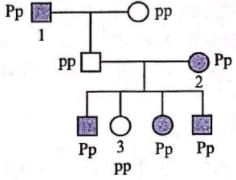
Given pedigree chart for polydactyly (autosomal dominant trait) can be explained as follows :
 | Explore Courses for NEET exam |  |
Top Courses for NEETView all




Top Courses for NEET
Question Description
In humans, polydactyly (i.e, presence of extra fingers and toes) is determined by a dominant autosomal allele (P) and the normal condition is determined by a recessive allele (p). Find out the possible genotypes of family members 1, 2 and 3 in the given pedigree.Codes are:a)ab)bc)cd)dCorrect answer is option 'D'. Can you explain this answer? for NEET 2026 is part of NEET preparation. The Question and answers have been prepared according to the NEET exam syllabus. Information about In humans, polydactyly (i.e, presence of extra fingers and toes) is determined by a dominant autosomal allele (P) and the normal condition is determined by a recessive allele (p). Find out the possible genotypes of family members 1, 2 and 3 in the given pedigree.Codes are:a)ab)bc)cd)dCorrect answer is option 'D'. Can you explain this answer? covers all topics & solutions for NEET 2026 Exam. Find important definitions, questions, meanings, examples, exercises and tests below for In humans, polydactyly (i.e, presence of extra fingers and toes) is determined by a dominant autosomal allele (P) and the normal condition is determined by a recessive allele (p). Find out the possible genotypes of family members 1, 2 and 3 in the given pedigree.Codes are:a)ab)bc)cd)dCorrect answer is option 'D'. Can you explain this answer?.
In humans, polydactyly (i.e, presence of extra fingers and toes) is determined by a dominant autosomal allele (P) and the normal condition is determined by a recessive allele (p). Find out the possible genotypes of family members 1, 2 and 3 in the given pedigree.Codes are:a)ab)bc)cd)dCorrect answer is option 'D'. Can you explain this answer? for NEET 2026 is part of NEET preparation. The Question and answers have been prepared according to the NEET exam syllabus. Information about In humans, polydactyly (i.e, presence of extra fingers and toes) is determined by a dominant autosomal allele (P) and the normal condition is determined by a recessive allele (p). Find out the possible genotypes of family members 1, 2 and 3 in the given pedigree.Codes are:a)ab)bc)cd)dCorrect answer is option 'D'. Can you explain this answer? covers all topics & solutions for NEET 2026 Exam. Find important definitions, questions, meanings, examples, exercises and tests below for In humans, polydactyly (i.e, presence of extra fingers and toes) is determined by a dominant autosomal allele (P) and the normal condition is determined by a recessive allele (p). Find out the possible genotypes of family members 1, 2 and 3 in the given pedigree.Codes are:a)ab)bc)cd)dCorrect answer is option 'D'. Can you explain this answer?.
Solutions for In humans, polydactyly (i.e, presence of extra fingers and toes) is determined by a dominant autosomal allele (P) and the normal condition is determined by a recessive allele (p). Find out the possible genotypes of family members 1, 2 and 3 in the given pedigree.Codes are:a)ab)bc)cd)dCorrect answer is option 'D'. Can you explain this answer? in English & in Hindi are available as part of our courses for NEET. Download more important topics, notes, lectures and mock test series for NEET Exam by signing up for free.
Here you can find the meaning of In humans, polydactyly (i.e, presence of extra fingers and toes) is determined by a dominant autosomal allele (P) and the normal condition is determined by a recessive allele (p). Find out the possible genotypes of family members 1, 2 and 3 in the given pedigree.Codes are:a)ab)bc)cd)dCorrect answer is option 'D'. Can you explain this answer? defined & explained in the simplest way possible. Besides giving the explanation of In humans, polydactyly (i.e, presence of extra fingers and toes) is determined by a dominant autosomal allele (P) and the normal condition is determined by a recessive allele (p). Find out the possible genotypes of family members 1, 2 and 3 in the given pedigree.Codes are:a)ab)bc)cd)dCorrect answer is option 'D'. Can you explain this answer?, a detailed solution for In humans, polydactyly (i.e, presence of extra fingers and toes) is determined by a dominant autosomal allele (P) and the normal condition is determined by a recessive allele (p). Find out the possible genotypes of family members 1, 2 and 3 in the given pedigree.Codes are:a)ab)bc)cd)dCorrect answer is option 'D'. Can you explain this answer? has been provided alongside types of In humans, polydactyly (i.e, presence of extra fingers and toes) is determined by a dominant autosomal allele (P) and the normal condition is determined by a recessive allele (p). Find out the possible genotypes of family members 1, 2 and 3 in the given pedigree.Codes are:a)ab)bc)cd)dCorrect answer is option 'D'. Can you explain this answer? theory, EduRev gives you an ample number of questions to practice In humans, polydactyly (i.e, presence of extra fingers and toes) is determined by a dominant autosomal allele (P) and the normal condition is determined by a recessive allele (p). Find out the possible genotypes of family members 1, 2 and 3 in the given pedigree.Codes are:a)ab)bc)cd)dCorrect answer is option 'D'. Can you explain this answer? tests, examples and also practice NEET tests.
| Explore Courses for NEET exam | |
Top Courses for NEET
Explore Courses
Signup for Free!
Signup to see your scores go up within 7 days! Learn & Practice with 1000+ FREE Notes, Videos & Tests.


