


Class 10 Exam > Class 10 Questions > What is homologous series? Start Learning for Free
What is homologous series?

Community Answer
What is homologous series?
**Homologous Series**
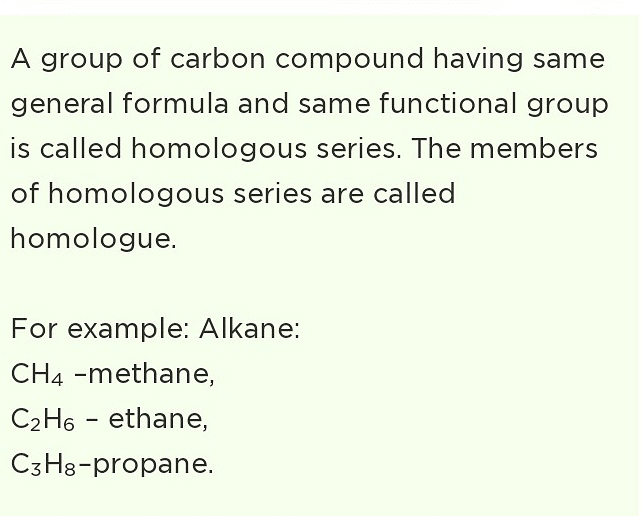
A homologous series is a group of organic compounds that have similar chemical properties and follow a specific pattern in their structural formula. These compounds have the same functional group and exhibit a gradual increase in the number of carbon atoms and molecular weight as we move from one member to the next. The general formula for a homologous series can be represented as R-H, where R is the functional group and H is a hydrogen atom.
**Characteristics of a Homologous Series:**
1. **Same Functional Group:** All compounds in a homologous series possess the same functional group, which gives them similar chemical properties. For example, the homologous series of alcohols all have the -OH functional group.
2. **Gradual Increase in Carbon Chain Length:** Each member of a homologous series has a specific number of carbon atoms in its structure. As we move from one member to the next, the number of carbon atoms increases by one. This results in an increase in molecular weight and physical properties (such as boiling point and density) as well.
3. **Similar Chemical Properties:** Due to the presence of the same functional group, compounds in a homologous series exhibit similar chemical reactions and behavior. For example, alcohols can undergo similar reactions like oxidation and esterification.
4. **Physical Properties Show Gradual Variation:** The physical properties of compounds in a homologous series also show a gradual variation. For instance, the boiling point and melting point increase as the number of carbon atoms increases due to the increased London dispersion forces.
**Importance of Homologous Series:**
1. **Predictability:** The presence of a specific pattern in a homologous series allows us to predict the properties and behavior of new compounds in the series. This helps in understanding and studying organic compounds more efficiently.
2. **Identification and Classification:** Homologous series help in classifying and identifying organic compounds based on their functional groups and structural similarities.
3. **Synthetic Chemistry:** Homologous series provide a foundation for synthetic chemistry, as they allow chemists to create new compounds by modifying the existing ones. The knowledge of a homologous series helps in designing and developing new drugs, polymers, and other useful organic compounds.
4. **Structure-Property Relationship:** The gradual variation in physical properties within a homologous series establishes a relationship between the structure and properties of organic compounds. This relationship aids in understanding the structure-property correlation in organic chemistry.
In conclusion, a homologous series is a group of organic compounds with similar chemical properties and a specific pattern in their structural formula. It helps in predicting the properties of new compounds, classifying organic compounds, synthetic chemistry, and understanding the relationship between structure and properties in organic compounds.
A homologous series is a group of organic compounds that have similar chemical properties and follow a specific pattern in their structural formula. These compounds have the same functional group and exhibit a gradual increase in the number of carbon atoms and molecular weight as we move from one member to the next. The general formula for a homologous series can be represented as R-H, where R is the functional group and H is a hydrogen atom.
**Characteristics of a Homologous Series:**
1. **Same Functional Group:** All compounds in a homologous series possess the same functional group, which gives them similar chemical properties. For example, the homologous series of alcohols all have the -OH functional group.
2. **Gradual Increase in Carbon Chain Length:** Each member of a homologous series has a specific number of carbon atoms in its structure. As we move from one member to the next, the number of carbon atoms increases by one. This results in an increase in molecular weight and physical properties (such as boiling point and density) as well.
3. **Similar Chemical Properties:** Due to the presence of the same functional group, compounds in a homologous series exhibit similar chemical reactions and behavior. For example, alcohols can undergo similar reactions like oxidation and esterification.
4. **Physical Properties Show Gradual Variation:** The physical properties of compounds in a homologous series also show a gradual variation. For instance, the boiling point and melting point increase as the number of carbon atoms increases due to the increased London dispersion forces.
**Importance of Homologous Series:**
1. **Predictability:** The presence of a specific pattern in a homologous series allows us to predict the properties and behavior of new compounds in the series. This helps in understanding and studying organic compounds more efficiently.
2. **Identification and Classification:** Homologous series help in classifying and identifying organic compounds based on their functional groups and structural similarities.
3. **Synthetic Chemistry:** Homologous series provide a foundation for synthetic chemistry, as they allow chemists to create new compounds by modifying the existing ones. The knowledge of a homologous series helps in designing and developing new drugs, polymers, and other useful organic compounds.
4. **Structure-Property Relationship:** The gradual variation in physical properties within a homologous series establishes a relationship between the structure and properties of organic compounds. This relationship aids in understanding the structure-property correlation in organic chemistry.
In conclusion, a homologous series is a group of organic compounds with similar chemical properties and a specific pattern in their structural formula. It helps in predicting the properties of new compounds, classifying organic compounds, synthetic chemistry, and understanding the relationship between structure and properties in organic compounds.
 | Explore Courses for Class 10 exam |  |
Top Courses for Class 10View all





Top Courses for Class 10
Question Description
What is homologous series? for Class 10 2026 is part of Class 10 preparation. The Question and answers have been prepared according to the Class 10 exam syllabus. Information about What is homologous series? covers all topics & solutions for Class 10 2026 Exam. Find important definitions, questions, meanings, examples, exercises and tests below for What is homologous series?.
What is homologous series? for Class 10 2026 is part of Class 10 preparation. The Question and answers have been prepared according to the Class 10 exam syllabus. Information about What is homologous series? covers all topics & solutions for Class 10 2026 Exam. Find important definitions, questions, meanings, examples, exercises and tests below for What is homologous series?.
Solutions for What is homologous series? in English & in Hindi are available as part of our courses for Class 10. Download more important topics, notes, lectures and mock test series for Class 10 Exam by signing up for free.
Here you can find the meaning of What is homologous series? defined & explained in the simplest way possible. Besides giving the explanation of What is homologous series?, a detailed solution for What is homologous series? has been provided alongside types of What is homologous series? theory, EduRev gives you an ample number of questions to practice What is homologous series? tests, examples and also practice Class 10 tests.
| Explore Courses for Class 10 exam | |
Top Courses for Class 10
Explore Courses
Signup for Free!
Signup to see your scores go up within 7 days! Learn & Practice with 1000+ FREE Notes, Videos & Tests.


