


Electrical Engineering (EE) Exam > Electrical Engineering (EE) Questions > Find the value of source current (I) from the... Start Learning for Free
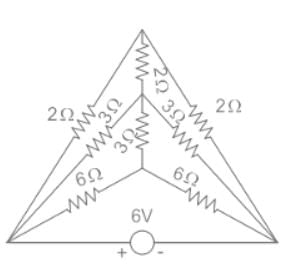
Find the value of source current (I) from the circuit as shown below
- a)1 A
- b)2 A
- c)3 A
- d)4 A
Correct answer is option 'C'. Can you explain this answer?

Verified Answer
Find the value of source current (I) from the circuit as shown belowa)...
Concept:
Wheatstone Bridge:
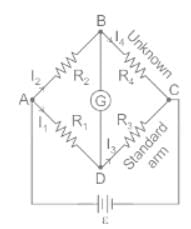
- The Wheatstone Bridge has four resistors R1, R2, R3, and R4.
- A Voltage source is connected across one pair of diagonally opposite points A and C. This is called the battery arm.
- Between the other two vertices, B and D, a galvanometer G is connected. This is called the Galvanometer arm.
- For the sake of simplicity, let us assume that the cell has no internal resistance.
Balanced Bridge:
- The resistors are arranged in such a manner that the current through the galvanometer is zero, i.e. Ig = 0.
- The bridge is said to be balanced when deflection in the galvanometer is zero i.e. no current flows through the galvanometer or in other words VB = VD.
- Under the balanced condition,
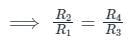
- The above equation relates the four resistors is called the balance condition of the Wheatstone Bridge for which the galvanometer will show zero or null deflection.
Explanation:
According to the question given below:
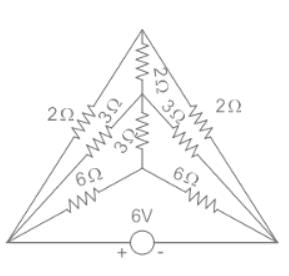
- In the above figure, there are two sets of Balanced Wheatstone bridges.
- We know the condition for a balanced Wheatstone bridge is
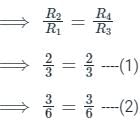
- The condition holds true for both the equations mentioned above, therefore, the current in the 2 Ω and 3 Ω is zero.
- We can replace 2 Ω and 3 Ω from the circuit with an open circuit.
- The resistances of the top horizontal line are in series (Ignoring the 2 Ω branch, since no current passes through it).
⇒ Rtop = 2 Ω + 2 Ω = 4 Ω
- The resistances of the middle horizontal line are in series (Ignoring the 3 Ω resistance branch, since no current passes through it).
⇒ Rmidddle = 3 Ω + 3 Ω = 6Ω
- The resistances in the bottom horizontal line are in series.
⇒ Rbottom = 6 Ω + 6 Ω = 12 Ω
- The net resistance is (considering Rtop, Rmiddle, and Rbottom).
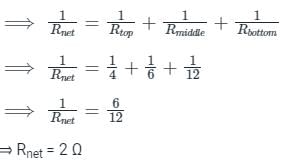
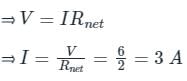
- The current through the battery (I) could be obtained by Ohm's Law,
Most Upvoted Answer
Find the value of source current (I) from the circuit as shown belowa)...
Concept:
Wheatstone Bridge:
- The Wheatstone Bridge has four resistors R1, R2, R3, and R4.
- A Voltage source is connected across one pair of diagonally opposite points A and C. This is called the battery arm.
- Between the other two vertices, B and D, a galvanometer G is connected. This is called the Galvanometer arm.
- For the sake of simplicity, let us assume that the cell has no internal resistance.
Balanced Bridge:
- The resistors are arranged in such a manner that the current through the galvanometer is zero, i.e. Ig = 0.
- The bridge is said to be balanced when deflection in the galvanometer is zero i.e. no current flows through the galvanometer or in other words VB = VD.
- Under the balanced condition,
- The above equation relates the four resistors is called the balance condition of the Wheatstone Bridge for which the galvanometer will show zero or null deflection.
Explanation:
According to the question given below:
- In the above figure, there are two sets of Balanced Wheatstone bridges.
- We know the condition for a balanced Wheatstone bridge is
- The condition holds true for both the equations mentioned above, therefore, the current in the 2 Ω and 3 Ω is zero.
- We can replace 2 Ω and 3 Ω from the circuit with an open circuit.
- The resistances of the top horizontal line are in series (Ignoring the 2 Ω branch, since no current passes through it).
⇒ Rtop = 2 Ω + 2 Ω = 4 Ω
- The resistances of the middle horizontal line are in series (Ignoring the 3 Ω resistance branch, since no current passes through it).
⇒ Rmidddle = 3 Ω + 3 Ω = 6Ω
- The resistances in the bottom horizontal line are in series.
⇒ Rbottom = 6 Ω + 6 Ω = 12 Ω
- The net resistance is (considering Rtop, Rmiddle, and Rbottom).
- The current through the battery (I) could be obtained by Ohm's Law,
 | Explore Courses for Electrical Engineering (EE) exam |  |
Top Courses for Electrical Engineering (EE)View all



Top Courses for Electrical Engineering (EE)
Question Description
Find the value of source current (I) from the circuit as shown belowa)1 Ab)2 Ac)3 Ad)4 ACorrect answer is option 'C'. Can you explain this answer? for Electrical Engineering (EE) 2026 is part of Electrical Engineering (EE) preparation. The Question and answers have been prepared according to the Electrical Engineering (EE) exam syllabus. Information about Find the value of source current (I) from the circuit as shown belowa)1 Ab)2 Ac)3 Ad)4 ACorrect answer is option 'C'. Can you explain this answer? covers all topics & solutions for Electrical Engineering (EE) 2026 Exam. Find important definitions, questions, meanings, examples, exercises and tests below for Find the value of source current (I) from the circuit as shown belowa)1 Ab)2 Ac)3 Ad)4 ACorrect answer is option 'C'. Can you explain this answer?.
Find the value of source current (I) from the circuit as shown belowa)1 Ab)2 Ac)3 Ad)4 ACorrect answer is option 'C'. Can you explain this answer? for Electrical Engineering (EE) 2026 is part of Electrical Engineering (EE) preparation. The Question and answers have been prepared according to the Electrical Engineering (EE) exam syllabus. Information about Find the value of source current (I) from the circuit as shown belowa)1 Ab)2 Ac)3 Ad)4 ACorrect answer is option 'C'. Can you explain this answer? covers all topics & solutions for Electrical Engineering (EE) 2026 Exam. Find important definitions, questions, meanings, examples, exercises and tests below for Find the value of source current (I) from the circuit as shown belowa)1 Ab)2 Ac)3 Ad)4 ACorrect answer is option 'C'. Can you explain this answer?.
Solutions for Find the value of source current (I) from the circuit as shown belowa)1 Ab)2 Ac)3 Ad)4 ACorrect answer is option 'C'. Can you explain this answer? in English & in Hindi are available as part of our courses for Electrical Engineering (EE). Download more important topics, notes, lectures and mock test series for Electrical Engineering (EE) Exam by signing up for free.
Here you can find the meaning of Find the value of source current (I) from the circuit as shown belowa)1 Ab)2 Ac)3 Ad)4 ACorrect answer is option 'C'. Can you explain this answer? defined & explained in the simplest way possible. Besides giving the explanation of Find the value of source current (I) from the circuit as shown belowa)1 Ab)2 Ac)3 Ad)4 ACorrect answer is option 'C'. Can you explain this answer?, a detailed solution for Find the value of source current (I) from the circuit as shown belowa)1 Ab)2 Ac)3 Ad)4 ACorrect answer is option 'C'. Can you explain this answer? has been provided alongside types of Find the value of source current (I) from the circuit as shown belowa)1 Ab)2 Ac)3 Ad)4 ACorrect answer is option 'C'. Can you explain this answer? theory, EduRev gives you an ample number of questions to practice Find the value of source current (I) from the circuit as shown belowa)1 Ab)2 Ac)3 Ad)4 ACorrect answer is option 'C'. Can you explain this answer? tests, examples and also practice Electrical Engineering (EE) tests.
| Explore Courses for Electrical Engineering (EE) exam | |
Top Courses for Electrical Engineering (EE)
Explore Courses
Signup for Free!
Signup to see your scores go up within 7 days! Learn & Practice with 1000+ FREE Notes, Videos & Tests.


