


Electrical Engineering (EE) Exam > Electrical Engineering (EE) Questions > A moving iron type instrument is used for the... Start Learning for Free
A moving iron type instrument is used for the measurement of:-
- a)AC only
- b)DC only
- c)AC and DC both
- d)None of the above
Correct answer is option 'C'. Can you explain this answer?

Most Upvoted Answer
A moving iron type instrument is used for the measurement of:-a)AC onl...

Free Test
FREE
| Start Free Test |
Community Answer
A moving iron type instrument is used for the measurement of:-a)AC onl...
Introduction:
A moving iron type instrument is a type of instrument used for the measurement of electrical quantities such as current and voltage. It is commonly used in both AC and DC circuits due to its versatility and ability to measure a wide range of electrical parameters.
Explanation:
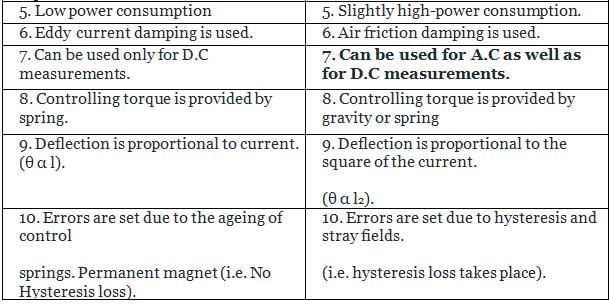
The moving iron type instrument operates on the principle of the attraction between a fixed coil and a movable iron piece. The iron piece is attached to a pointer, which moves over a calibrated scale to indicate the measured value. The amount of attraction between the coil and the iron piece depends on the magnitude and direction of the current flowing through the coil.
AC Measurement:
When an alternating current (AC) flows through the coil, the direction of the current changes periodically. As a result, the iron piece is attracted and repelled by the coil in sync with the changes in the current. This movement of the iron piece causes the pointer to oscillate back and forth, indicating the RMS (Root Mean Square) value of the AC current. The moving iron type instrument is capable of accurately measuring AC current due to its ability to respond to the rapid changes in the current direction.
DC Measurement:
In the case of direct current (DC), the current flows through the coil in a constant direction. The iron piece is attracted towards the coil and aligns itself with the magnetic field produced by the coil. The amount of attraction is proportional to the strength of the current. As a result, the iron piece moves and causes the pointer to deflect, indicating the value of the DC current. The moving iron type instrument is also suitable for measuring DC current due to its ability to respond to the static magnetic field produced by the coil.
Conclusion:
The moving iron type instrument is capable of measuring both AC and DC currents. Its design allows it to respond to the rapid changes in the current direction in AC circuits and the constant current flow in DC circuits. This makes it a versatile instrument for electrical measurements in various applications.
A moving iron type instrument is a type of instrument used for the measurement of electrical quantities such as current and voltage. It is commonly used in both AC and DC circuits due to its versatility and ability to measure a wide range of electrical parameters.
Explanation:
The moving iron type instrument operates on the principle of the attraction between a fixed coil and a movable iron piece. The iron piece is attached to a pointer, which moves over a calibrated scale to indicate the measured value. The amount of attraction between the coil and the iron piece depends on the magnitude and direction of the current flowing through the coil.
AC Measurement:
When an alternating current (AC) flows through the coil, the direction of the current changes periodically. As a result, the iron piece is attracted and repelled by the coil in sync with the changes in the current. This movement of the iron piece causes the pointer to oscillate back and forth, indicating the RMS (Root Mean Square) value of the AC current. The moving iron type instrument is capable of accurately measuring AC current due to its ability to respond to the rapid changes in the current direction.
DC Measurement:
In the case of direct current (DC), the current flows through the coil in a constant direction. The iron piece is attracted towards the coil and aligns itself with the magnetic field produced by the coil. The amount of attraction is proportional to the strength of the current. As a result, the iron piece moves and causes the pointer to deflect, indicating the value of the DC current. The moving iron type instrument is also suitable for measuring DC current due to its ability to respond to the static magnetic field produced by the coil.
Conclusion:
The moving iron type instrument is capable of measuring both AC and DC currents. Its design allows it to respond to the rapid changes in the current direction in AC circuits and the constant current flow in DC circuits. This makes it a versatile instrument for electrical measurements in various applications.
 | Explore Courses for Electrical Engineering (EE) exam |  |
Top Courses for Electrical Engineering (EE)View all


Top Courses for Electrical Engineering (EE)
Question Description
A moving iron type instrument is used for the measurement of:-a)AC onlyb)DC onlyc)AC and DC bothd)None of the aboveCorrect answer is option 'C'. Can you explain this answer? for Electrical Engineering (EE) 2026 is part of Electrical Engineering (EE) preparation. The Question and answers have been prepared according to the Electrical Engineering (EE) exam syllabus. Information about A moving iron type instrument is used for the measurement of:-a)AC onlyb)DC onlyc)AC and DC bothd)None of the aboveCorrect answer is option 'C'. Can you explain this answer? covers all topics & solutions for Electrical Engineering (EE) 2026 Exam. Find important definitions, questions, meanings, examples, exercises and tests below for A moving iron type instrument is used for the measurement of:-a)AC onlyb)DC onlyc)AC and DC bothd)None of the aboveCorrect answer is option 'C'. Can you explain this answer?.
A moving iron type instrument is used for the measurement of:-a)AC onlyb)DC onlyc)AC and DC bothd)None of the aboveCorrect answer is option 'C'. Can you explain this answer? for Electrical Engineering (EE) 2026 is part of Electrical Engineering (EE) preparation. The Question and answers have been prepared according to the Electrical Engineering (EE) exam syllabus. Information about A moving iron type instrument is used for the measurement of:-a)AC onlyb)DC onlyc)AC and DC bothd)None of the aboveCorrect answer is option 'C'. Can you explain this answer? covers all topics & solutions for Electrical Engineering (EE) 2026 Exam. Find important definitions, questions, meanings, examples, exercises and tests below for A moving iron type instrument is used for the measurement of:-a)AC onlyb)DC onlyc)AC and DC bothd)None of the aboveCorrect answer is option 'C'. Can you explain this answer?.
Solutions for A moving iron type instrument is used for the measurement of:-a)AC onlyb)DC onlyc)AC and DC bothd)None of the aboveCorrect answer is option 'C'. Can you explain this answer? in English & in Hindi are available as part of our courses for Electrical Engineering (EE). Download more important topics, notes, lectures and mock test series for Electrical Engineering (EE) Exam by signing up for free.
Here you can find the meaning of A moving iron type instrument is used for the measurement of:-a)AC onlyb)DC onlyc)AC and DC bothd)None of the aboveCorrect answer is option 'C'. Can you explain this answer? defined & explained in the simplest way possible. Besides giving the explanation of A moving iron type instrument is used for the measurement of:-a)AC onlyb)DC onlyc)AC and DC bothd)None of the aboveCorrect answer is option 'C'. Can you explain this answer?, a detailed solution for A moving iron type instrument is used for the measurement of:-a)AC onlyb)DC onlyc)AC and DC bothd)None of the aboveCorrect answer is option 'C'. Can you explain this answer? has been provided alongside types of A moving iron type instrument is used for the measurement of:-a)AC onlyb)DC onlyc)AC and DC bothd)None of the aboveCorrect answer is option 'C'. Can you explain this answer? theory, EduRev gives you an ample number of questions to practice A moving iron type instrument is used for the measurement of:-a)AC onlyb)DC onlyc)AC and DC bothd)None of the aboveCorrect answer is option 'C'. Can you explain this answer? tests, examples and also practice Electrical Engineering (EE) tests.
| Explore Courses for Electrical Engineering (EE) exam | |
Top Courses for Electrical Engineering (EE)
Explore Courses
Signup for Free!
Signup to see your scores go up within 7 days! Learn & Practice with 1000+ FREE Notes, Videos & Tests.


