


Electrical Engineering (EE) Exam > Electrical Engineering (EE) Questions > For the measurement of high resistances follo... Start Learning for Free
For the measurement of high resistances following methods are used:
1. Loss of Charge Method
2. Direct Deflection Method
3. Substitution Method
Which of the following is/are correct?
- a)1 and 2
- b)2 and 3
- c)Only 1
- d)1 and 3
Correct answer is option 'A'. Can you explain this answer?

Most Upvoted Answer
For the measurement of high resistances following methods are used:1. ...
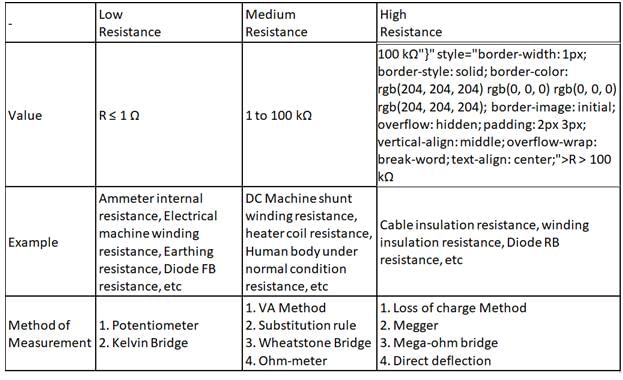
The Measurement of Resistance according to classification is shown below:
Free Test
FREE
| Start Free Test |
Community Answer
For the measurement of high resistances following methods are used:1. ...
High Resistance Measurement Methods
In the field of electrical engineering, measuring high resistances accurately is crucial. The methods listed can be categorized based on their principles and applications.
1. Loss of Charge Method
- This method involves charging a capacitor through the high resistance and then measuring the time taken for the capacitor to discharge.
- The discharge rate provides a measure of the resistance, as it is directly related to the resistance value.
- This method is effective for very high resistances, typically in the range of megohms to gigohms.
2. Direct Deflection Method
- This technique uses a galvanometer to measure the current flowing through a high resistance.
- The resistance is determined by observing the deflection of the galvanometer needle.
- Direct deflection methods are commonly used for medium to high resistances but have limitations in precision at extremely high values.
3. Substitution Method
- In this method, a known resistance is substituted for the unknown resistance in a circuit to achieve a balance.
- While it is a valid method for measuring resistance, it is not typically used for very high resistances.
- The substitution method is more suited for lower resistances or when precise calibration is needed.
Conclusion
The correct answer, option 'A', indicates that the Loss of Charge Method and the Direct Deflection Method are appropriate for high resistance measurements. The Substitution Method, while valid, is not primarily designed for high resistances, making it less relevant in this context.
In the field of electrical engineering, measuring high resistances accurately is crucial. The methods listed can be categorized based on their principles and applications.
1. Loss of Charge Method
- This method involves charging a capacitor through the high resistance and then measuring the time taken for the capacitor to discharge.
- The discharge rate provides a measure of the resistance, as it is directly related to the resistance value.
- This method is effective for very high resistances, typically in the range of megohms to gigohms.
2. Direct Deflection Method
- This technique uses a galvanometer to measure the current flowing through a high resistance.
- The resistance is determined by observing the deflection of the galvanometer needle.
- Direct deflection methods are commonly used for medium to high resistances but have limitations in precision at extremely high values.
3. Substitution Method
- In this method, a known resistance is substituted for the unknown resistance in a circuit to achieve a balance.
- While it is a valid method for measuring resistance, it is not typically used for very high resistances.
- The substitution method is more suited for lower resistances or when precise calibration is needed.
Conclusion
The correct answer, option 'A', indicates that the Loss of Charge Method and the Direct Deflection Method are appropriate for high resistance measurements. The Substitution Method, while valid, is not primarily designed for high resistances, making it less relevant in this context.
 | Explore Courses for Electrical Engineering (EE) exam |  |
Top Courses for Electrical Engineering (EE)View all



Top Courses for Electrical Engineering (EE)
Question Description
For the measurement of high resistances following methods are used:1. Loss of Charge Method2. Direct Deflection Method3. Substitution MethodWhich of the following is/are correct?a)1 and 2b)2 and 3c)Only 1d)1 and 3Correct answer is option 'A'. Can you explain this answer? for Electrical Engineering (EE) 2026 is part of Electrical Engineering (EE) preparation. The Question and answers have been prepared according to the Electrical Engineering (EE) exam syllabus. Information about For the measurement of high resistances following methods are used:1. Loss of Charge Method2. Direct Deflection Method3. Substitution MethodWhich of the following is/are correct?a)1 and 2b)2 and 3c)Only 1d)1 and 3Correct answer is option 'A'. Can you explain this answer? covers all topics & solutions for Electrical Engineering (EE) 2026 Exam. Find important definitions, questions, meanings, examples, exercises and tests below for For the measurement of high resistances following methods are used:1. Loss of Charge Method2. Direct Deflection Method3. Substitution MethodWhich of the following is/are correct?a)1 and 2b)2 and 3c)Only 1d)1 and 3Correct answer is option 'A'. Can you explain this answer?.
For the measurement of high resistances following methods are used:1. Loss of Charge Method2. Direct Deflection Method3. Substitution MethodWhich of the following is/are correct?a)1 and 2b)2 and 3c)Only 1d)1 and 3Correct answer is option 'A'. Can you explain this answer? for Electrical Engineering (EE) 2026 is part of Electrical Engineering (EE) preparation. The Question and answers have been prepared according to the Electrical Engineering (EE) exam syllabus. Information about For the measurement of high resistances following methods are used:1. Loss of Charge Method2. Direct Deflection Method3. Substitution MethodWhich of the following is/are correct?a)1 and 2b)2 and 3c)Only 1d)1 and 3Correct answer is option 'A'. Can you explain this answer? covers all topics & solutions for Electrical Engineering (EE) 2026 Exam. Find important definitions, questions, meanings, examples, exercises and tests below for For the measurement of high resistances following methods are used:1. Loss of Charge Method2. Direct Deflection Method3. Substitution MethodWhich of the following is/are correct?a)1 and 2b)2 and 3c)Only 1d)1 and 3Correct answer is option 'A'. Can you explain this answer?.
Solutions for For the measurement of high resistances following methods are used:1. Loss of Charge Method2. Direct Deflection Method3. Substitution MethodWhich of the following is/are correct?a)1 and 2b)2 and 3c)Only 1d)1 and 3Correct answer is option 'A'. Can you explain this answer? in English & in Hindi are available as part of our courses for Electrical Engineering (EE). Download more important topics, notes, lectures and mock test series for Electrical Engineering (EE) Exam by signing up for free.
Here you can find the meaning of For the measurement of high resistances following methods are used:1. Loss of Charge Method2. Direct Deflection Method3. Substitution MethodWhich of the following is/are correct?a)1 and 2b)2 and 3c)Only 1d)1 and 3Correct answer is option 'A'. Can you explain this answer? defined & explained in the simplest way possible. Besides giving the explanation of For the measurement of high resistances following methods are used:1. Loss of Charge Method2. Direct Deflection Method3. Substitution MethodWhich of the following is/are correct?a)1 and 2b)2 and 3c)Only 1d)1 and 3Correct answer is option 'A'. Can you explain this answer?, a detailed solution for For the measurement of high resistances following methods are used:1. Loss of Charge Method2. Direct Deflection Method3. Substitution MethodWhich of the following is/are correct?a)1 and 2b)2 and 3c)Only 1d)1 and 3Correct answer is option 'A'. Can you explain this answer? has been provided alongside types of For the measurement of high resistances following methods are used:1. Loss of Charge Method2. Direct Deflection Method3. Substitution MethodWhich of the following is/are correct?a)1 and 2b)2 and 3c)Only 1d)1 and 3Correct answer is option 'A'. Can you explain this answer? theory, EduRev gives you an ample number of questions to practice For the measurement of high resistances following methods are used:1. Loss of Charge Method2. Direct Deflection Method3. Substitution MethodWhich of the following is/are correct?a)1 and 2b)2 and 3c)Only 1d)1 and 3Correct answer is option 'A'. Can you explain this answer? tests, examples and also practice Electrical Engineering (EE) tests.
| Explore Courses for Electrical Engineering (EE) exam | |
Top Courses for Electrical Engineering (EE)
Explore Courses
Signup for Free!
Signup to see your scores go up within 7 days! Learn & Practice with 1000+ FREE Notes, Videos & Tests.


