


Electrical Engineering (EE) Exam > Electrical Engineering (EE) Questions > What does Millman’s theorem yield?a)Equ... Start Learning for Free
What does Millman’s theorem yield?
- a)Equivalent voltage source
- b)Equivalent resistance
- c)Equivalent admittance
- d)Equivalent impedance
Correct answer is option 'A'. Can you explain this answer?

Most Upvoted Answer
What does Millman’s theorem yield?a)Equivalent voltage sourceb)E...
Millman's Theorem
Millman's theorem is a circuit analysis technique that allows the combination of multiple voltage sources in parallel with their internal resistances into a single equivalent voltage source. This equivalent voltage source is calculated by taking the weighted sum of the individual voltage sources based on their respective internal resistances.
Yield of Millman's Theorem
- Equivalent voltage source: Millman's theorem yields an equivalent voltage source that represents the combined effect of multiple voltage sources in parallel. This equivalent voltage source simplifies the circuit analysis by reducing the circuit to a single voltage source.
- Equivalent resistance, admittance, and impedance are not directly calculated using Millman's theorem. The focus is on determining the equivalent voltage source.
Using Millman's theorem, one can simplify complex circuits with multiple voltage sources in parallel into a more manageable form for analysis. This simplification aids in understanding the behavior of the circuit and helps in calculating the desired electrical parameters.
Free Test
FREE
| Start Free Test |
Community Answer
What does Millman’s theorem yield?a)Equivalent voltage sourceb)E...
Milliman's Theorem:
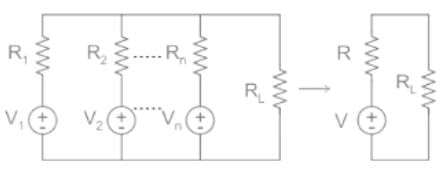
Millman's Theorem states that it is possible to replace numbers of voltage sources with finite internal resistance operating in parallel with a single voltage source with a series of equivalent resistance.
Millman's Theorem states that it is possible to replace numbers of voltage sources with finite internal resistance operating in parallel with a single voltage source with a series of equivalent resistance.
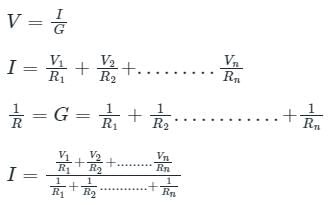
According to Ohm's Law:
V = IR
 | Explore Courses for Electrical Engineering (EE) exam |  |
Top Courses for Electrical Engineering (EE)View all


Top Courses for Electrical Engineering (EE)
Question Description
What does Millman’s theorem yield?a)Equivalent voltage sourceb)Equivalent resistancec)Equivalent admittanced)Equivalent impedanceCorrect answer is option 'A'. Can you explain this answer? for Electrical Engineering (EE) 2026 is part of Electrical Engineering (EE) preparation. The Question and answers have been prepared according to the Electrical Engineering (EE) exam syllabus. Information about What does Millman’s theorem yield?a)Equivalent voltage sourceb)Equivalent resistancec)Equivalent admittanced)Equivalent impedanceCorrect answer is option 'A'. Can you explain this answer? covers all topics & solutions for Electrical Engineering (EE) 2026 Exam. Find important definitions, questions, meanings, examples, exercises and tests below for What does Millman’s theorem yield?a)Equivalent voltage sourceb)Equivalent resistancec)Equivalent admittanced)Equivalent impedanceCorrect answer is option 'A'. Can you explain this answer?.
What does Millman’s theorem yield?a)Equivalent voltage sourceb)Equivalent resistancec)Equivalent admittanced)Equivalent impedanceCorrect answer is option 'A'. Can you explain this answer? for Electrical Engineering (EE) 2026 is part of Electrical Engineering (EE) preparation. The Question and answers have been prepared according to the Electrical Engineering (EE) exam syllabus. Information about What does Millman’s theorem yield?a)Equivalent voltage sourceb)Equivalent resistancec)Equivalent admittanced)Equivalent impedanceCorrect answer is option 'A'. Can you explain this answer? covers all topics & solutions for Electrical Engineering (EE) 2026 Exam. Find important definitions, questions, meanings, examples, exercises and tests below for What does Millman’s theorem yield?a)Equivalent voltage sourceb)Equivalent resistancec)Equivalent admittanced)Equivalent impedanceCorrect answer is option 'A'. Can you explain this answer?.
Solutions for What does Millman’s theorem yield?a)Equivalent voltage sourceb)Equivalent resistancec)Equivalent admittanced)Equivalent impedanceCorrect answer is option 'A'. Can you explain this answer? in English & in Hindi are available as part of our courses for Electrical Engineering (EE). Download more important topics, notes, lectures and mock test series for Electrical Engineering (EE) Exam by signing up for free.
Here you can find the meaning of What does Millman’s theorem yield?a)Equivalent voltage sourceb)Equivalent resistancec)Equivalent admittanced)Equivalent impedanceCorrect answer is option 'A'. Can you explain this answer? defined & explained in the simplest way possible. Besides giving the explanation of What does Millman’s theorem yield?a)Equivalent voltage sourceb)Equivalent resistancec)Equivalent admittanced)Equivalent impedanceCorrect answer is option 'A'. Can you explain this answer?, a detailed solution for What does Millman’s theorem yield?a)Equivalent voltage sourceb)Equivalent resistancec)Equivalent admittanced)Equivalent impedanceCorrect answer is option 'A'. Can you explain this answer? has been provided alongside types of What does Millman’s theorem yield?a)Equivalent voltage sourceb)Equivalent resistancec)Equivalent admittanced)Equivalent impedanceCorrect answer is option 'A'. Can you explain this answer? theory, EduRev gives you an ample number of questions to practice What does Millman’s theorem yield?a)Equivalent voltage sourceb)Equivalent resistancec)Equivalent admittanced)Equivalent impedanceCorrect answer is option 'A'. Can you explain this answer? tests, examples and also practice Electrical Engineering (EE) tests.
| Explore Courses for Electrical Engineering (EE) exam | |
Top Courses for Electrical Engineering (EE)
Explore Courses
Signup for Free!
Signup to see your scores go up within 7 days! Learn & Practice with 1000+ FREE Notes, Videos & Tests.


