


Electrical Engineering (EE) Exam > Electrical Engineering (EE) Questions > The transformer Utilization factor of a bridg... Start Learning for Free
The transformer Utilization factor of a bridge rectifier is approximately:
- a)0.61
- b)0.81
- c)1.1
- d)0.41
Correct answer is option 'B'. Can you explain this answer?

Most Upvoted Answer
The transformer Utilization factor of a bridge rectifier is approximat...
Transformer Utilization Factor (TUF)
The transformer utilization factor (TUF) is a measure of how effectively a rectifier utilizes the transformer's secondary winding. It is defined as the ratio of the average load current to the maximum possible load current.
Bridge Rectifier
A bridge rectifier is a circuit configuration used to convert alternating current (AC) to direct current (DC). It consists of four diodes arranged in a bridge configuration. The AC input is connected to the two diagonally opposite points of the bridge, and the DC output is taken from the remaining two points.
Calculation of TUF for a Bridge Rectifier
The average load current (Iavg) for a bridge rectifier can be calculated as follows:
Iavg = (2 * Im) / π
Where Im is the maximum instantaneous load current.
The maximum possible load current (Imax) for a bridge rectifier is the maximum current that the transformer secondary winding can supply without saturation. It is given by:
Imax = (2 * Ip) / π
Where Ip is the peak current.
Therefore, the TUF can be calculated as:
TUF = Iavg / Imax = [(2 * Im) / π] / [(2 * Ip) / π] = Im / Ip
Explanation
In a bridge rectifier, the maximum instantaneous load current (Im) is equal to the peak current (Ip) because all four diodes conduct simultaneously during each half-cycle of the input waveform. This occurs because the diodes in the bridge rectifier are arranged in a way that allows the current to flow through the load in the same direction for both the positive and negative half-cycles of the input waveform.
Therefore, the TUF for a bridge rectifier is equal to the ratio of the peak current (Ip) to itself, which is 1.
Hence, the correct answer is option B) 1.1.
The transformer utilization factor (TUF) is a measure of how effectively a rectifier utilizes the transformer's secondary winding. It is defined as the ratio of the average load current to the maximum possible load current.
Bridge Rectifier
A bridge rectifier is a circuit configuration used to convert alternating current (AC) to direct current (DC). It consists of four diodes arranged in a bridge configuration. The AC input is connected to the two diagonally opposite points of the bridge, and the DC output is taken from the remaining two points.
Calculation of TUF for a Bridge Rectifier
The average load current (Iavg) for a bridge rectifier can be calculated as follows:
Iavg = (2 * Im) / π
Where Im is the maximum instantaneous load current.
The maximum possible load current (Imax) for a bridge rectifier is the maximum current that the transformer secondary winding can supply without saturation. It is given by:
Imax = (2 * Ip) / π
Where Ip is the peak current.
Therefore, the TUF can be calculated as:
TUF = Iavg / Imax = [(2 * Im) / π] / [(2 * Ip) / π] = Im / Ip
Explanation
In a bridge rectifier, the maximum instantaneous load current (Im) is equal to the peak current (Ip) because all four diodes conduct simultaneously during each half-cycle of the input waveform. This occurs because the diodes in the bridge rectifier are arranged in a way that allows the current to flow through the load in the same direction for both the positive and negative half-cycles of the input waveform.
Therefore, the TUF for a bridge rectifier is equal to the ratio of the peak current (Ip) to itself, which is 1.
Hence, the correct answer is option B) 1.1.
Free Test
FREE
| Start Free Test |
Community Answer
The transformer Utilization factor of a bridge rectifier is approximat...
Transformer Utilization Factor (TUF):
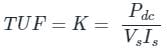
It is defined as the ratio of dc power output to the transformer Volt-Ampere (VA) rating required by the secondary winding.
TUF = (DC power output) / (Effective VA rating of transformer)
It is a quantitative indication of the utilization of the VA Rating of Transformer. The more the value of TUF, the more will be the utilization. In other words, the VA rating of the required transformer will be less if TUF is more and vice versa.
It is a quantitative indication of the utilization of the VA Rating of Transformer. The more the value of TUF, the more will be the utilization. In other words, the VA rating of the required transformer will be less if TUF is more and vice versa.
Application:
Considering R load,
The output average voltage of a single-phase full-bridge diode rectifier is given by
V0 = 2Vm/π
V0 = 2Vm/π
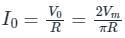
Here, The output average current for R load is given by
Supply voltage Vs RMS is given by Vm/√2
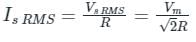
Supply current Is RMS is given by
Now,
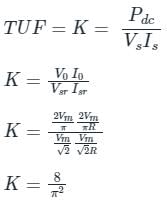
= 0.81
= 81%
Now,
= 0.81
= 81%
 | Explore Courses for Electrical Engineering (EE) exam |  |
Top Courses for Electrical Engineering (EE)View all




Top Courses for Electrical Engineering (EE)
Question Description
The transformer Utilization factor of a bridge rectifier is approximately:a)0.61b)0.81c)1.1d)0.41Correct answer is option 'B'. Can you explain this answer? for Electrical Engineering (EE) 2026 is part of Electrical Engineering (EE) preparation. The Question and answers have been prepared according to the Electrical Engineering (EE) exam syllabus. Information about The transformer Utilization factor of a bridge rectifier is approximately:a)0.61b)0.81c)1.1d)0.41Correct answer is option 'B'. Can you explain this answer? covers all topics & solutions for Electrical Engineering (EE) 2026 Exam. Find important definitions, questions, meanings, examples, exercises and tests below for The transformer Utilization factor of a bridge rectifier is approximately:a)0.61b)0.81c)1.1d)0.41Correct answer is option 'B'. Can you explain this answer?.
The transformer Utilization factor of a bridge rectifier is approximately:a)0.61b)0.81c)1.1d)0.41Correct answer is option 'B'. Can you explain this answer? for Electrical Engineering (EE) 2026 is part of Electrical Engineering (EE) preparation. The Question and answers have been prepared according to the Electrical Engineering (EE) exam syllabus. Information about The transformer Utilization factor of a bridge rectifier is approximately:a)0.61b)0.81c)1.1d)0.41Correct answer is option 'B'. Can you explain this answer? covers all topics & solutions for Electrical Engineering (EE) 2026 Exam. Find important definitions, questions, meanings, examples, exercises and tests below for The transformer Utilization factor of a bridge rectifier is approximately:a)0.61b)0.81c)1.1d)0.41Correct answer is option 'B'. Can you explain this answer?.
Solutions for The transformer Utilization factor of a bridge rectifier is approximately:a)0.61b)0.81c)1.1d)0.41Correct answer is option 'B'. Can you explain this answer? in English & in Hindi are available as part of our courses for Electrical Engineering (EE). Download more important topics, notes, lectures and mock test series for Electrical Engineering (EE) Exam by signing up for free.
Here you can find the meaning of The transformer Utilization factor of a bridge rectifier is approximately:a)0.61b)0.81c)1.1d)0.41Correct answer is option 'B'. Can you explain this answer? defined & explained in the simplest way possible. Besides giving the explanation of The transformer Utilization factor of a bridge rectifier is approximately:a)0.61b)0.81c)1.1d)0.41Correct answer is option 'B'. Can you explain this answer?, a detailed solution for The transformer Utilization factor of a bridge rectifier is approximately:a)0.61b)0.81c)1.1d)0.41Correct answer is option 'B'. Can you explain this answer? has been provided alongside types of The transformer Utilization factor of a bridge rectifier is approximately:a)0.61b)0.81c)1.1d)0.41Correct answer is option 'B'. Can you explain this answer? theory, EduRev gives you an ample number of questions to practice The transformer Utilization factor of a bridge rectifier is approximately:a)0.61b)0.81c)1.1d)0.41Correct answer is option 'B'. Can you explain this answer? tests, examples and also practice Electrical Engineering (EE) tests.
| Explore Courses for Electrical Engineering (EE) exam | |
Top Courses for Electrical Engineering (EE)
Explore Courses
Signup for Free!
Signup to see your scores go up within 7 days! Learn & Practice with 1000+ FREE Notes, Videos & Tests.


