


Electrical Engineering (EE) Exam > Electrical Engineering (EE) Questions > How many input lines are there in a ‘Fu... Start Learning for Free
How many input lines are there in a ‘Full Adder’?
- a)2
- b)4
- c)1
- d)3
Correct answer is option 'D'. Can you explain this answer?

Verified Answer
How many input lines are there in a ‘Full Adder’?a)2b)4c)1...
Combinational Logic circuits are circuits for which the present output depends only on the present input, i.e. there is no memory element to store the past output.
A combinational circuit can have ‘n’ number of inputs and ‘m’ number of outputs as shown:

Full Adder:
Full Adder:
- It is a combinational circuit used for the addition of binary numbers.
- It can add two one-bit numbers A and B, and carry C.
- The full adder is a three-input and two output combinational circuit.
The basic block diagram for a Full Adder is as shown:

A Full adder can be realized using two half adders as shown:
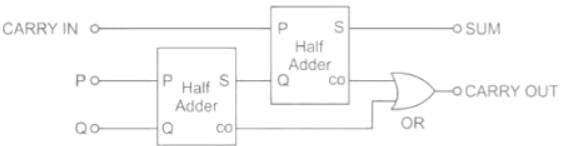
A Full adder can be realized using two half adders as shown:
A full adder can be implemented using 2 XOR, 2 AND, 1 OR as shown in figure:

Important Point
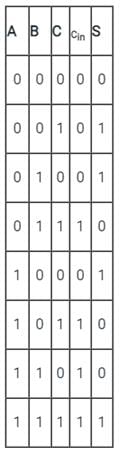
The truth table of a full adder logic is:
Important Point
The truth table of a full adder logic is:
The Sum output bit of a full adder is given by:
S = A ⊕ B ⊕ C
The carry output bit of a full adder is given by:
X1 = AB + BC + AC
Multiplexers:
Multiplexers:
- A multiplexer is Many to one data selector.
- A multiplexer selects one of the many data available at its input depending on the bits on the select line.
- For 2m inputs, there are m select lines that determine which input is to be connected to the output, i.e.
Number of control lines = log2(number of input lines)
Important Point
Sequential Circuits: The block diagram shown below explains this:

The memory elements used are flip flops or latches.
Important Point
Sequential Circuits: The block diagram shown below explains this:
The memory elements used are flip flops or latches.
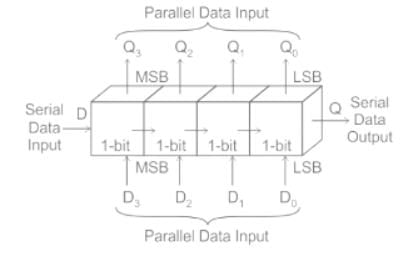
Shift Register: A shift register has the capability to store one bit and if another bit is to store, in such situation it deletes the previous data and stores them. There are four kinds of shift registers:
- Serial-In Serial Out
- Serial-In Parallel Out
- Parallel-In serial Out
- Parallel-In Parallel Out
Most Upvoted Answer
How many input lines are there in a ‘Full Adder’?a)2b)4c)1...
Combinational Logic circuits are circuits for which the present output depends only on the present input, i.e. there is no memory element to store the past output.
A combinational circuit can have ‘n’ number of inputs and ‘m’ number of outputs as shown:
Full Adder:
Full Adder:
- It is a combinational circuit used for the addition of binary numbers.
- It can add two one-bit numbers A and B, and carry C.
- The full adder is a three-input and two output combinational circuit.
The basic block diagram for a Full Adder is as shown:
A Full adder can be realized using two half adders as shown:

A Full adder can be realized using two half adders as shown:
A full adder can be implemented using 2 XOR, 2 AND, 1 OR as shown in figure:

Important Point
The truth table of a full adder logic is:

Important Point
The truth table of a full adder logic is:
The Sum output bit of a full adder is given by:
S = A ⊕ B ⊕ C
The carry output bit of a full adder is given by:
X1 = AB + BC + AC
Multiplexers:
Multiplexers:
- A multiplexer is Many to one data selector.
- A multiplexer selects one of the many data available at its input depending on the bits on the select line.
- For 2m inputs, there are m select lines that determine which input is to be connected to the output, i.e.
Number of control lines = log2(number of input lines)
Important Point
Sequential Circuits: The block diagram shown below explains this:
The memory elements used are flip flops or latches.
Important Point
Sequential Circuits: The block diagram shown below explains this:
The memory elements used are flip flops or latches.
Shift Register: A shift register has the capability to store one bit and if another bit is to store, in such situation it deletes the previous data and stores them. There are four kinds of shift registers:
- Serial-In Serial Out
- Serial-In Parallel Out
- Parallel-In serial Out
- Parallel-In Parallel Out
 | Explore Courses for Electrical Engineering (EE) exam |  |
Top Courses for Electrical Engineering (EE)View all




Top Courses for Electrical Engineering (EE)
Question Description
How many input lines are there in a ‘Full Adder’?a)2b)4c)1d)3Correct answer is option 'D'. Can you explain this answer? for Electrical Engineering (EE) 2026 is part of Electrical Engineering (EE) preparation. The Question and answers have been prepared according to the Electrical Engineering (EE) exam syllabus. Information about How many input lines are there in a ‘Full Adder’?a)2b)4c)1d)3Correct answer is option 'D'. Can you explain this answer? covers all topics & solutions for Electrical Engineering (EE) 2026 Exam. Find important definitions, questions, meanings, examples, exercises and tests below for How many input lines are there in a ‘Full Adder’?a)2b)4c)1d)3Correct answer is option 'D'. Can you explain this answer?.
How many input lines are there in a ‘Full Adder’?a)2b)4c)1d)3Correct answer is option 'D'. Can you explain this answer? for Electrical Engineering (EE) 2026 is part of Electrical Engineering (EE) preparation. The Question and answers have been prepared according to the Electrical Engineering (EE) exam syllabus. Information about How many input lines are there in a ‘Full Adder’?a)2b)4c)1d)3Correct answer is option 'D'. Can you explain this answer? covers all topics & solutions for Electrical Engineering (EE) 2026 Exam. Find important definitions, questions, meanings, examples, exercises and tests below for How many input lines are there in a ‘Full Adder’?a)2b)4c)1d)3Correct answer is option 'D'. Can you explain this answer?.
Solutions for How many input lines are there in a ‘Full Adder’?a)2b)4c)1d)3Correct answer is option 'D'. Can you explain this answer? in English & in Hindi are available as part of our courses for Electrical Engineering (EE). Download more important topics, notes, lectures and mock test series for Electrical Engineering (EE) Exam by signing up for free.
Here you can find the meaning of How many input lines are there in a ‘Full Adder’?a)2b)4c)1d)3Correct answer is option 'D'. Can you explain this answer? defined & explained in the simplest way possible. Besides giving the explanation of How many input lines are there in a ‘Full Adder’?a)2b)4c)1d)3Correct answer is option 'D'. Can you explain this answer?, a detailed solution for How many input lines are there in a ‘Full Adder’?a)2b)4c)1d)3Correct answer is option 'D'. Can you explain this answer? has been provided alongside types of How many input lines are there in a ‘Full Adder’?a)2b)4c)1d)3Correct answer is option 'D'. Can you explain this answer? theory, EduRev gives you an ample number of questions to practice How many input lines are there in a ‘Full Adder’?a)2b)4c)1d)3Correct answer is option 'D'. Can you explain this answer? tests, examples and also practice Electrical Engineering (EE) tests.
| Explore Courses for Electrical Engineering (EE) exam | |
Top Courses for Electrical Engineering (EE)
Explore Courses
Signup for Free!
Signup to see your scores go up within 7 days! Learn & Practice with 1000+ FREE Notes, Videos & Tests.


