


Electrical Engineering (EE) Exam > Electrical Engineering (EE) Questions > Consider the following statements pertaining ... Start Learning for Free
Consider the following statements pertaining to root locus techniques:
1. Routh-Hurwitz criterion may be used to find the intersections of the root loci on the imaginary axis.
2. Breakaway points on the root loci of an equation corresponds to multiple-order roots of the equation.
3. The breakaway points on the root loci of 1 + KG(s) H(s) = 0 must satisfy
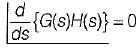
4. n root loci arrive or depart a breakaway point at 180/n degrees.
Which of these statements are correct?
1. Routh-Hurwitz criterion may be used to find the intersections of the root loci on the imaginary axis.
2. Breakaway points on the root loci of an equation corresponds to multiple-order roots of the equation.
3. The breakaway points on the root loci of 1 + KG(s) H(s) = 0 must satisfy
4. n root loci arrive or depart a breakaway point at 180/n degrees.
Which of these statements are correct?
- a)1, 2 and 3
- b)2, 3 and 4.
- c)1, 2, 3 and 4
- d)1, 2 and 4
Correct answer is option 'C'. Can you explain this answer?

Most Upvoted Answer
Consider the following statements pertaining to root locus techniques:...
Statement 1 is true. The Routh-Hurwitz criterion is used to detect when closed-loop characteristic polynomial roots lie on the imaginary axis by forming the Routh array; setting an entire row to zero (or examining sign changes) yields the frequencies and gain values at which imaginary-axis crossings occur.
Statement 2 is true. A breakaway or break-in point on the real axis corresponds to a point where two or more root-locus branches meet or separate. At that point the characteristic equation has a repeated (multiple-order) root, e.g., a double root for two branches meeting.
Statement 3 is true. Let L(s)=G(s)H(s). From 1+K L(s)=0 we get K = -1/L(s). A breakaway/break-in on the real axis occurs where dK/ds = 0 (extremum of K versus s). Differentiating gives:
K = -1/L(s)
dK/ds = 0 ⇒ (1/L(s)^2)·dL/ds = 0 ⇒ dL/ds = 0.
Thus the breakaway points satisfy d/ds [G(s)H(s)] = 0.
Statement 4 is false. For a root of multiplicity n the angles of arrival/departure are given by θ = (2q+1)π/n (i.e. θ = (2q+1)×180°/n) for q = 0,1,...,n-1. Adjacent branches are separated by 360°/n. The single value "180°/n" alone is not the general correct statement; it is incomplete and therefore the given statement is incorrect.
Conclusion: Statements 1, 2 and 3 are correct and statement 4 is incorrect; hence Option A is the correct choice.
 | Explore Courses for Electrical Engineering (EE) exam |  |
Top Courses for Electrical Engineering (EE)View all




Top Courses for Electrical Engineering (EE)
Question Description
Consider the following statements pertaining to root locus techniques:1. Routh-Hurwitz criterion may be used to find the intersections of the root loci on the imaginary axis.2. Breakaway points on the root loci of an equation corresponds to multiple-order roots of the equation.3. The breakaway points on theroot loci of 1 + KG(s) H(s) = 0 must satisfy4. n root loci arrive or depart a breakaway pointat 180/ndegrees.Which of these statements are correct?a)1, 2 and 3 b)2, 3 and 4.c)1, 2, 3 and 4 d)1, 2 and 4Correct answer is option 'C'. Can you explain this answer? for Electrical Engineering (EE) 2026 is part of Electrical Engineering (EE) preparation. The Question and answers have been prepared according to the Electrical Engineering (EE) exam syllabus. Information about Consider the following statements pertaining to root locus techniques:1. Routh-Hurwitz criterion may be used to find the intersections of the root loci on the imaginary axis.2. Breakaway points on the root loci of an equation corresponds to multiple-order roots of the equation.3. The breakaway points on theroot loci of 1 + KG(s) H(s) = 0 must satisfy4. n root loci arrive or depart a breakaway pointat 180/ndegrees.Which of these statements are correct?a)1, 2 and 3 b)2, 3 and 4.c)1, 2, 3 and 4 d)1, 2 and 4Correct answer is option 'C'. Can you explain this answer? covers all topics & solutions for Electrical Engineering (EE) 2026 Exam. Find important definitions, questions, meanings, examples, exercises and tests below for Consider the following statements pertaining to root locus techniques:1. Routh-Hurwitz criterion may be used to find the intersections of the root loci on the imaginary axis.2. Breakaway points on the root loci of an equation corresponds to multiple-order roots of the equation.3. The breakaway points on theroot loci of 1 + KG(s) H(s) = 0 must satisfy4. n root loci arrive or depart a breakaway pointat 180/ndegrees.Which of these statements are correct?a)1, 2 and 3 b)2, 3 and 4.c)1, 2, 3 and 4 d)1, 2 and 4Correct answer is option 'C'. Can you explain this answer?.
Consider the following statements pertaining to root locus techniques:1. Routh-Hurwitz criterion may be used to find the intersections of the root loci on the imaginary axis.2. Breakaway points on the root loci of an equation corresponds to multiple-order roots of the equation.3. The breakaway points on theroot loci of 1 + KG(s) H(s) = 0 must satisfy4. n root loci arrive or depart a breakaway pointat 180/ndegrees.Which of these statements are correct?a)1, 2 and 3 b)2, 3 and 4.c)1, 2, 3 and 4 d)1, 2 and 4Correct answer is option 'C'. Can you explain this answer? for Electrical Engineering (EE) 2026 is part of Electrical Engineering (EE) preparation. The Question and answers have been prepared according to the Electrical Engineering (EE) exam syllabus. Information about Consider the following statements pertaining to root locus techniques:1. Routh-Hurwitz criterion may be used to find the intersections of the root loci on the imaginary axis.2. Breakaway points on the root loci of an equation corresponds to multiple-order roots of the equation.3. The breakaway points on theroot loci of 1 + KG(s) H(s) = 0 must satisfy4. n root loci arrive or depart a breakaway pointat 180/ndegrees.Which of these statements are correct?a)1, 2 and 3 b)2, 3 and 4.c)1, 2, 3 and 4 d)1, 2 and 4Correct answer is option 'C'. Can you explain this answer? covers all topics & solutions for Electrical Engineering (EE) 2026 Exam. Find important definitions, questions, meanings, examples, exercises and tests below for Consider the following statements pertaining to root locus techniques:1. Routh-Hurwitz criterion may be used to find the intersections of the root loci on the imaginary axis.2. Breakaway points on the root loci of an equation corresponds to multiple-order roots of the equation.3. The breakaway points on theroot loci of 1 + KG(s) H(s) = 0 must satisfy4. n root loci arrive or depart a breakaway pointat 180/ndegrees.Which of these statements are correct?a)1, 2 and 3 b)2, 3 and 4.c)1, 2, 3 and 4 d)1, 2 and 4Correct answer is option 'C'. Can you explain this answer?.
Solutions for Consider the following statements pertaining to root locus techniques:1. Routh-Hurwitz criterion may be used to find the intersections of the root loci on the imaginary axis.2. Breakaway points on the root loci of an equation corresponds to multiple-order roots of the equation.3. The breakaway points on theroot loci of 1 + KG(s) H(s) = 0 must satisfy4. n root loci arrive or depart a breakaway pointat 180/ndegrees.Which of these statements are correct?a)1, 2 and 3 b)2, 3 and 4.c)1, 2, 3 and 4 d)1, 2 and 4Correct answer is option 'C'. Can you explain this answer? in English & in Hindi are available as part of our courses for Electrical Engineering (EE). Download more important topics, notes, lectures and mock test series for Electrical Engineering (EE) Exam by signing up for free.
Here you can find the meaning of Consider the following statements pertaining to root locus techniques:1. Routh-Hurwitz criterion may be used to find the intersections of the root loci on the imaginary axis.2. Breakaway points on the root loci of an equation corresponds to multiple-order roots of the equation.3. The breakaway points on theroot loci of 1 + KG(s) H(s) = 0 must satisfy4. n root loci arrive or depart a breakaway pointat 180/ndegrees.Which of these statements are correct?a)1, 2 and 3 b)2, 3 and 4.c)1, 2, 3 and 4 d)1, 2 and 4Correct answer is option 'C'. Can you explain this answer? defined & explained in the simplest way possible. Besides giving the explanation of Consider the following statements pertaining to root locus techniques:1. Routh-Hurwitz criterion may be used to find the intersections of the root loci on the imaginary axis.2. Breakaway points on the root loci of an equation corresponds to multiple-order roots of the equation.3. The breakaway points on theroot loci of 1 + KG(s) H(s) = 0 must satisfy4. n root loci arrive or depart a breakaway pointat 180/ndegrees.Which of these statements are correct?a)1, 2 and 3 b)2, 3 and 4.c)1, 2, 3 and 4 d)1, 2 and 4Correct answer is option 'C'. Can you explain this answer?, a detailed solution for Consider the following statements pertaining to root locus techniques:1. Routh-Hurwitz criterion may be used to find the intersections of the root loci on the imaginary axis.2. Breakaway points on the root loci of an equation corresponds to multiple-order roots of the equation.3. The breakaway points on theroot loci of 1 + KG(s) H(s) = 0 must satisfy4. n root loci arrive or depart a breakaway pointat 180/ndegrees.Which of these statements are correct?a)1, 2 and 3 b)2, 3 and 4.c)1, 2, 3 and 4 d)1, 2 and 4Correct answer is option 'C'. Can you explain this answer? has been provided alongside types of Consider the following statements pertaining to root locus techniques:1. Routh-Hurwitz criterion may be used to find the intersections of the root loci on the imaginary axis.2. Breakaway points on the root loci of an equation corresponds to multiple-order roots of the equation.3. The breakaway points on theroot loci of 1 + KG(s) H(s) = 0 must satisfy4. n root loci arrive or depart a breakaway pointat 180/ndegrees.Which of these statements are correct?a)1, 2 and 3 b)2, 3 and 4.c)1, 2, 3 and 4 d)1, 2 and 4Correct answer is option 'C'. Can you explain this answer? theory, EduRev gives you an ample number of questions to practice Consider the following statements pertaining to root locus techniques:1. Routh-Hurwitz criterion may be used to find the intersections of the root loci on the imaginary axis.2. Breakaway points on the root loci of an equation corresponds to multiple-order roots of the equation.3. The breakaway points on theroot loci of 1 + KG(s) H(s) = 0 must satisfy4. n root loci arrive or depart a breakaway pointat 180/ndegrees.Which of these statements are correct?a)1, 2 and 3 b)2, 3 and 4.c)1, 2, 3 and 4 d)1, 2 and 4Correct answer is option 'C'. Can you explain this answer? tests, examples and also practice Electrical Engineering (EE) tests.
| Explore Courses for Electrical Engineering (EE) exam | |
Top Courses for Electrical Engineering (EE)
Explore Courses
Signup for Free!
Signup to see your scores go up within 7 days! Learn & Practice with 1000+ FREE Notes, Videos & Tests.


