


Electrical Engineering (EE) Exam > Electrical Engineering (EE) Questions > The logic XOR operation of (4AC0)16 and (B53F... Start Learning for Free
The logic XOR operation of (4AC0)16 and (B53F)16 results________
- a)AACB
- b)0000
- c)FFFF
- d)ABCD
Correct answer is option 'C'. Can you explain this answer?

Most Upvoted Answer
The logic XOR operation of (4AC0)16 and (B53F)16 results________a)AACB...
Logic XOR of hexadecimal numbers
XOR or exclusive OR is a logical operation that outputs true only when the two binary inputs are different. XOR operation is represented by the symbol ⊕. When used with hexadecimal numbers, the XOR operation is performed on each pair of corresponding bits.
Given hexadecimal numbers (4AC0)16 and (B53F)16, the XOR operation can be performed as follows:
4AC0 = 0100 1010 1100 0000
B53F = 1011 0101 0011 1111
XOR = 1111 1111 1111 1111
The result of the XOR operation is (FFFF)16, which is option C.
Explanation
- XOR operation: The XOR operation is a binary operation that takes two binary inputs and outputs true only if the inputs are different. The XOR operation is represented by the symbol ⊕.
- Conversion to binary: To perform the XOR operation on hexadecimal numbers, we need to convert them to binary. Each hexadecimal digit represents four binary digits or bits. For example, (4AC0)16 is equivalent to (0100 1010 1100 0000)2 in binary.
- Performing XOR: Once the numbers are in binary form, we can perform the XOR operation on each pair of corresponding bits. If both bits are the same, the result is 0. If the bits are different, the result is 1.
- Result: After performing the XOR operation on each pair of bits, we get the binary result of (1111 1111 1111 1111)2, which is equivalent to (FFFF)16 in hexadecimal form.
Conclusion
The logic XOR operation of (4AC0)16 and (B53F)16 results in (FFFF)16. This result is obtained by converting the hexadecimal numbers to binary, performing the XOR operation on each pair of corresponding bits, and converting the binary result back to hexadecimal form.
XOR or exclusive OR is a logical operation that outputs true only when the two binary inputs are different. XOR operation is represented by the symbol ⊕. When used with hexadecimal numbers, the XOR operation is performed on each pair of corresponding bits.
Given hexadecimal numbers (4AC0)16 and (B53F)16, the XOR operation can be performed as follows:
4AC0 = 0100 1010 1100 0000
B53F = 1011 0101 0011 1111
XOR = 1111 1111 1111 1111
The result of the XOR operation is (FFFF)16, which is option C.
Explanation
- XOR operation: The XOR operation is a binary operation that takes two binary inputs and outputs true only if the inputs are different. The XOR operation is represented by the symbol ⊕.
- Conversion to binary: To perform the XOR operation on hexadecimal numbers, we need to convert them to binary. Each hexadecimal digit represents four binary digits or bits. For example, (4AC0)16 is equivalent to (0100 1010 1100 0000)2 in binary.
- Performing XOR: Once the numbers are in binary form, we can perform the XOR operation on each pair of corresponding bits. If both bits are the same, the result is 0. If the bits are different, the result is 1.
- Result: After performing the XOR operation on each pair of bits, we get the binary result of (1111 1111 1111 1111)2, which is equivalent to (FFFF)16 in hexadecimal form.
Conclusion
The logic XOR operation of (4AC0)16 and (B53F)16 results in (FFFF)16. This result is obtained by converting the hexadecimal numbers to binary, performing the XOR operation on each pair of corresponding bits, and converting the binary result back to hexadecimal form.
Free Test
FREE
| Start Free Test |
Community Answer
The logic XOR operation of (4AC0)16 and (B53F)16 results________a)AACB...
- Here we have to perform an XOR operation on two Hexadecimal numbers.
- The boolean expression for XOR is

- The truth table for XOR is:
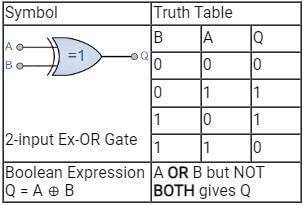
- Means A and B are the expressions given to us in Hex code. So, we need to find the binary equivalent of the Hexadecimal numbers. This is because these codes will be executed in 1 and 0 in the CPU.
- The following table is to be memorized in order to convert Hexadecimal to Binary:
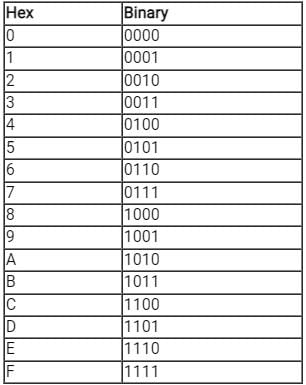
- Therefore, (4AC0)16 = 0100101011000000
- And (B53F)16 = 1011010100111111
- Now follow the Truth Table to perform the operation on every bit in XOR gate:
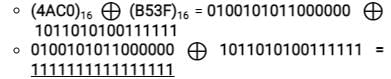
- So the result obtained is (1111111111111111)2 which is the Binary Equivalent of (FFFF)16 (using the table given above).
- Hence the correct answer is FFFF.
 | Explore Courses for Electrical Engineering (EE) exam |  |
Top Courses for Electrical Engineering (EE)View all




Top Courses for Electrical Engineering (EE)
Question Description
The logic XOR operation of (4AC0)16 and (B53F)16 results________a)AACBb)0000c)FFFFd)ABCDCorrect answer is option 'C'. Can you explain this answer? for Electrical Engineering (EE) 2026 is part of Electrical Engineering (EE) preparation. The Question and answers have been prepared according to the Electrical Engineering (EE) exam syllabus. Information about The logic XOR operation of (4AC0)16 and (B53F)16 results________a)AACBb)0000c)FFFFd)ABCDCorrect answer is option 'C'. Can you explain this answer? covers all topics & solutions for Electrical Engineering (EE) 2026 Exam. Find important definitions, questions, meanings, examples, exercises and tests below for The logic XOR operation of (4AC0)16 and (B53F)16 results________a)AACBb)0000c)FFFFd)ABCDCorrect answer is option 'C'. Can you explain this answer?.
The logic XOR operation of (4AC0)16 and (B53F)16 results________a)AACBb)0000c)FFFFd)ABCDCorrect answer is option 'C'. Can you explain this answer? for Electrical Engineering (EE) 2026 is part of Electrical Engineering (EE) preparation. The Question and answers have been prepared according to the Electrical Engineering (EE) exam syllabus. Information about The logic XOR operation of (4AC0)16 and (B53F)16 results________a)AACBb)0000c)FFFFd)ABCDCorrect answer is option 'C'. Can you explain this answer? covers all topics & solutions for Electrical Engineering (EE) 2026 Exam. Find important definitions, questions, meanings, examples, exercises and tests below for The logic XOR operation of (4AC0)16 and (B53F)16 results________a)AACBb)0000c)FFFFd)ABCDCorrect answer is option 'C'. Can you explain this answer?.
Solutions for The logic XOR operation of (4AC0)16 and (B53F)16 results________a)AACBb)0000c)FFFFd)ABCDCorrect answer is option 'C'. Can you explain this answer? in English & in Hindi are available as part of our courses for Electrical Engineering (EE). Download more important topics, notes, lectures and mock test series for Electrical Engineering (EE) Exam by signing up for free.
Here you can find the meaning of The logic XOR operation of (4AC0)16 and (B53F)16 results________a)AACBb)0000c)FFFFd)ABCDCorrect answer is option 'C'. Can you explain this answer? defined & explained in the simplest way possible. Besides giving the explanation of The logic XOR operation of (4AC0)16 and (B53F)16 results________a)AACBb)0000c)FFFFd)ABCDCorrect answer is option 'C'. Can you explain this answer?, a detailed solution for The logic XOR operation of (4AC0)16 and (B53F)16 results________a)AACBb)0000c)FFFFd)ABCDCorrect answer is option 'C'. Can you explain this answer? has been provided alongside types of The logic XOR operation of (4AC0)16 and (B53F)16 results________a)AACBb)0000c)FFFFd)ABCDCorrect answer is option 'C'. Can you explain this answer? theory, EduRev gives you an ample number of questions to practice The logic XOR operation of (4AC0)16 and (B53F)16 results________a)AACBb)0000c)FFFFd)ABCDCorrect answer is option 'C'. Can you explain this answer? tests, examples and also practice Electrical Engineering (EE) tests.
| Explore Courses for Electrical Engineering (EE) exam | |
Top Courses for Electrical Engineering (EE)
Explore Courses
Signup for Free!
Signup to see your scores go up within 7 days! Learn & Practice with 1000+ FREE Notes, Videos & Tests.


