


Electrical Engineering (EE) Exam > Electrical Engineering (EE) Questions > Determine the octal equivalent of (432267)10?... Start Learning for Free
Determine the octal equivalent of (432267)10?
- a)(432267)8
- b)(346731)8
- c)(2164432)8
- d)None of the above
Correct answer is option 'D'. Can you explain this answer?

Most Upvoted Answer
Determine the octal equivalent of (432267)10?a)(432267)8b)(346731)8c)(...
Conversion to Octal
To convert a decimal number to octal, we need to divide the decimal number by 8 successively and note down the remainders at each step. The octal equivalent will be the remainders read in reverse order.
Calculation
Starting with the decimal number (432267)10:
Step 1: 432267 ÷ 8 = 54033 with a remainder of 3
Step 2: 54033 ÷ 8 = 6754 with a remainder of 1
Step 3: 6754 ÷ 8 = 844 with a remainder of 2
Step 4: 844 ÷ 8 = 105 with a remainder of 4
Step 5: 105 ÷ 8 = 13 with a remainder of 1
Step 6: 13 ÷ 8 = 1 with a remainder of 5
Step 7: 1 ÷ 8 = 0 with a remainder of 1
Octal Equivalent
Reading the remainders in reverse order, we get the octal equivalent as (1514213)8.
Therefore, the octal equivalent of the decimal number (432267)10 is not provided in the options given.
Free Test
FREE
| Start Free Test |
Community Answer
Determine the octal equivalent of (432267)10?a)(432267)8b)(346731)8c)(...
Concept:
Following are the steps to convert decimal to octal:
- If the provided decimal number is less than the number 8 then the octal number is the same.
- If the provided decimal number is larger than 7 then divide it by number 8.
- take a note of the remainder, received after division
- Repeat step 2 and 3 with the quotient until it is less than 8
- Now, note the remainders in the reverse order (bottom to top)
- The resultant thus received is the equivalent octal number to the provided decimal number.
Explanation:
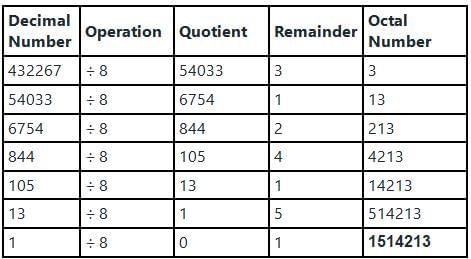
Hence, (432267)10 = (1514213)8
Hence, (432267)10 = (1514213)8
 | Explore Courses for Electrical Engineering (EE) exam |  |
Top Courses for Electrical Engineering (EE)View all




Top Courses for Electrical Engineering (EE)
Question Description
Determine the octal equivalent of (432267)10?a)(432267)8b)(346731)8c)(2164432)8d)None of the aboveCorrect answer is option 'D'. Can you explain this answer? for Electrical Engineering (EE) 2026 is part of Electrical Engineering (EE) preparation. The Question and answers have been prepared according to the Electrical Engineering (EE) exam syllabus. Information about Determine the octal equivalent of (432267)10?a)(432267)8b)(346731)8c)(2164432)8d)None of the aboveCorrect answer is option 'D'. Can you explain this answer? covers all topics & solutions for Electrical Engineering (EE) 2026 Exam. Find important definitions, questions, meanings, examples, exercises and tests below for Determine the octal equivalent of (432267)10?a)(432267)8b)(346731)8c)(2164432)8d)None of the aboveCorrect answer is option 'D'. Can you explain this answer?.
Determine the octal equivalent of (432267)10?a)(432267)8b)(346731)8c)(2164432)8d)None of the aboveCorrect answer is option 'D'. Can you explain this answer? for Electrical Engineering (EE) 2026 is part of Electrical Engineering (EE) preparation. The Question and answers have been prepared according to the Electrical Engineering (EE) exam syllabus. Information about Determine the octal equivalent of (432267)10?a)(432267)8b)(346731)8c)(2164432)8d)None of the aboveCorrect answer is option 'D'. Can you explain this answer? covers all topics & solutions for Electrical Engineering (EE) 2026 Exam. Find important definitions, questions, meanings, examples, exercises and tests below for Determine the octal equivalent of (432267)10?a)(432267)8b)(346731)8c)(2164432)8d)None of the aboveCorrect answer is option 'D'. Can you explain this answer?.
Solutions for Determine the octal equivalent of (432267)10?a)(432267)8b)(346731)8c)(2164432)8d)None of the aboveCorrect answer is option 'D'. Can you explain this answer? in English & in Hindi are available as part of our courses for Electrical Engineering (EE). Download more important topics, notes, lectures and mock test series for Electrical Engineering (EE) Exam by signing up for free.
Here you can find the meaning of Determine the octal equivalent of (432267)10?a)(432267)8b)(346731)8c)(2164432)8d)None of the aboveCorrect answer is option 'D'. Can you explain this answer? defined & explained in the simplest way possible. Besides giving the explanation of Determine the octal equivalent of (432267)10?a)(432267)8b)(346731)8c)(2164432)8d)None of the aboveCorrect answer is option 'D'. Can you explain this answer?, a detailed solution for Determine the octal equivalent of (432267)10?a)(432267)8b)(346731)8c)(2164432)8d)None of the aboveCorrect answer is option 'D'. Can you explain this answer? has been provided alongside types of Determine the octal equivalent of (432267)10?a)(432267)8b)(346731)8c)(2164432)8d)None of the aboveCorrect answer is option 'D'. Can you explain this answer? theory, EduRev gives you an ample number of questions to practice Determine the octal equivalent of (432267)10?a)(432267)8b)(346731)8c)(2164432)8d)None of the aboveCorrect answer is option 'D'. Can you explain this answer? tests, examples and also practice Electrical Engineering (EE) tests.
| Explore Courses for Electrical Engineering (EE) exam | |
Top Courses for Electrical Engineering (EE)
Explore Courses
Signup for Free!
Signup to see your scores go up within 7 days! Learn & Practice with 1000+ FREE Notes, Videos & Tests.


