


Electrical Engineering (EE) Exam > Electrical Engineering (EE) Questions > In G - S method of power flow problem, the nu... Start Learning for Free
In G - S method of power flow problem, the number of iterations
- a)depends on no of buses
- b)depends on tolerance
- c)depends on voltage control buses
- d)remains fixed
Correct answer is option 'B'. Can you explain this answer?

Most Upvoted Answer
In G - S method of power flow problem, the number of iterationsa)depen...
The G - S method of power flow problem
The Gauss-Seidel (G-S) method is an iterative algorithm used to solve power flow problems in electrical power systems. It is widely used due to its simplicity and efficiency. The G-S method iteratively calculates the bus voltages and line flows until convergence is achieved.
The number of iterations in G-S method
The number of iterations required in the G-S method depends on the tolerance level set for convergence. The tolerance level determines the acceptable difference between the calculated values in successive iterations. Once this tolerance level is met, the solution is considered converged, and no further iterations are required.
Dependence on tolerance
The number of iterations in the G-S method depends on the tolerance level set for convergence. A lower tolerance level means a higher accuracy requirement, which may require more iterations to achieve. Conversely, a higher tolerance level allows for less accurate solutions and may require fewer iterations.
The G-S method checks the convergence criterion after each iteration. If the calculated values in successive iterations differ by less than the specified tolerance level, the algorithm stops iterating. Therefore, the number of iterations needed is directly related to the specified tolerance level.
Dependence on other factors
The number of iterations in the G-S method is not dependent on the number of buses or the presence of voltage control buses. These factors affect the complexity and size of the power flow problem but do not directly influence the number of iterations required for convergence.
Conclusion
In summary, the number of iterations in the G-S method of power flow problem depends on the tolerance level set for convergence. It is not influenced by the number of buses or the presence of voltage control buses. By adjusting the tolerance level, the trade-off between accuracy and computational efficiency can be controlled.
The Gauss-Seidel (G-S) method is an iterative algorithm used to solve power flow problems in electrical power systems. It is widely used due to its simplicity and efficiency. The G-S method iteratively calculates the bus voltages and line flows until convergence is achieved.
The number of iterations in G-S method
The number of iterations required in the G-S method depends on the tolerance level set for convergence. The tolerance level determines the acceptable difference between the calculated values in successive iterations. Once this tolerance level is met, the solution is considered converged, and no further iterations are required.
Dependence on tolerance
The number of iterations in the G-S method depends on the tolerance level set for convergence. A lower tolerance level means a higher accuracy requirement, which may require more iterations to achieve. Conversely, a higher tolerance level allows for less accurate solutions and may require fewer iterations.
The G-S method checks the convergence criterion after each iteration. If the calculated values in successive iterations differ by less than the specified tolerance level, the algorithm stops iterating. Therefore, the number of iterations needed is directly related to the specified tolerance level.
Dependence on other factors
The number of iterations in the G-S method is not dependent on the number of buses or the presence of voltage control buses. These factors affect the complexity and size of the power flow problem but do not directly influence the number of iterations required for convergence.
Conclusion
In summary, the number of iterations in the G-S method of power flow problem depends on the tolerance level set for convergence. It is not influenced by the number of buses or the presence of voltage control buses. By adjusting the tolerance level, the trade-off between accuracy and computational efficiency can be controlled.
Free Test
FREE
| Start Free Test |
Community Answer
In G - S method of power flow problem, the number of iterationsa)depen...
- The reason the Gauss-Seidel method is commonly known as the successive displacement method is that the second unknown is determined from the first unknown in the current iteration, the third unknown is determined from the first and second unknowns, etc.
- In the G-S method of power flow problem, the number of iterations depends on tolerance.
Gauss-Seidel method:
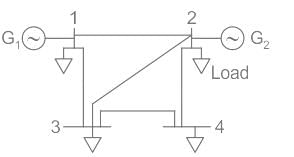
Consider a 4-bus sample power system as shown in the figure, BUS 1 is considered a slack bus, where voltage magnitude and its angle are known.
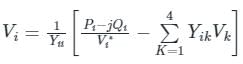
In this case w = 4 and slack bus s = 1. From we can write
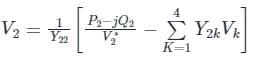



In the Gauss-Seidel method, the new calculated voltage at (K + 1) i.e. V (K + 1) immediately replaces V (p) and is used in the solution of the subsequent equations.
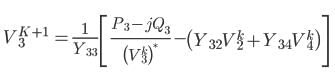
Therefore, the above set of equations can be written in iterative form, i.e.,



Note that bus 1 is the slack bus.
Under normal operating conditions, the voltage magnitude of buses is in the neighborhood of 1.0 per unit or close to the voltage magnitude of the slack bus.
Therefore, an initial starting voltage of (1.0 + j 0.0) for unknown voltages is satisfactory, and the converged solution correlates with the actual operating states.
Consider a 4-bus sample power system as shown in the figure, BUS 1 is considered a slack bus, where voltage magnitude and its angle are known.
In this case w = 4 and slack bus s = 1. From we can write
In the Gauss-Seidel method, the new calculated voltage at (K + 1) i.e. V (K + 1) immediately replaces V (p) and is used in the solution of the subsequent equations.
Therefore, the above set of equations can be written in iterative form, i.e.,
Note that bus 1 is the slack bus.
Under normal operating conditions, the voltage magnitude of buses is in the neighborhood of 1.0 per unit or close to the voltage magnitude of the slack bus.
Therefore, an initial starting voltage of (1.0 + j 0.0) for unknown voltages is satisfactory, and the converged solution correlates with the actual operating states.
 | Explore Courses for Electrical Engineering (EE) exam |  |
Top Courses for Electrical Engineering (EE)View all




Top Courses for Electrical Engineering (EE)
Question Description
In G - S method of power flow problem, the number of iterationsa)depends on no of busesb)depends on tolerancec)depends on voltage control busesd)remains fixedCorrect answer is option 'B'. Can you explain this answer? for Electrical Engineering (EE) 2026 is part of Electrical Engineering (EE) preparation. The Question and answers have been prepared according to the Electrical Engineering (EE) exam syllabus. Information about In G - S method of power flow problem, the number of iterationsa)depends on no of busesb)depends on tolerancec)depends on voltage control busesd)remains fixedCorrect answer is option 'B'. Can you explain this answer? covers all topics & solutions for Electrical Engineering (EE) 2026 Exam. Find important definitions, questions, meanings, examples, exercises and tests below for In G - S method of power flow problem, the number of iterationsa)depends on no of busesb)depends on tolerancec)depends on voltage control busesd)remains fixedCorrect answer is option 'B'. Can you explain this answer?.
In G - S method of power flow problem, the number of iterationsa)depends on no of busesb)depends on tolerancec)depends on voltage control busesd)remains fixedCorrect answer is option 'B'. Can you explain this answer? for Electrical Engineering (EE) 2026 is part of Electrical Engineering (EE) preparation. The Question and answers have been prepared according to the Electrical Engineering (EE) exam syllabus. Information about In G - S method of power flow problem, the number of iterationsa)depends on no of busesb)depends on tolerancec)depends on voltage control busesd)remains fixedCorrect answer is option 'B'. Can you explain this answer? covers all topics & solutions for Electrical Engineering (EE) 2026 Exam. Find important definitions, questions, meanings, examples, exercises and tests below for In G - S method of power flow problem, the number of iterationsa)depends on no of busesb)depends on tolerancec)depends on voltage control busesd)remains fixedCorrect answer is option 'B'. Can you explain this answer?.
Solutions for In G - S method of power flow problem, the number of iterationsa)depends on no of busesb)depends on tolerancec)depends on voltage control busesd)remains fixedCorrect answer is option 'B'. Can you explain this answer? in English & in Hindi are available as part of our courses for Electrical Engineering (EE). Download more important topics, notes, lectures and mock test series for Electrical Engineering (EE) Exam by signing up for free.
Here you can find the meaning of In G - S method of power flow problem, the number of iterationsa)depends on no of busesb)depends on tolerancec)depends on voltage control busesd)remains fixedCorrect answer is option 'B'. Can you explain this answer? defined & explained in the simplest way possible. Besides giving the explanation of In G - S method of power flow problem, the number of iterationsa)depends on no of busesb)depends on tolerancec)depends on voltage control busesd)remains fixedCorrect answer is option 'B'. Can you explain this answer?, a detailed solution for In G - S method of power flow problem, the number of iterationsa)depends on no of busesb)depends on tolerancec)depends on voltage control busesd)remains fixedCorrect answer is option 'B'. Can you explain this answer? has been provided alongside types of In G - S method of power flow problem, the number of iterationsa)depends on no of busesb)depends on tolerancec)depends on voltage control busesd)remains fixedCorrect answer is option 'B'. Can you explain this answer? theory, EduRev gives you an ample number of questions to practice In G - S method of power flow problem, the number of iterationsa)depends on no of busesb)depends on tolerancec)depends on voltage control busesd)remains fixedCorrect answer is option 'B'. Can you explain this answer? tests, examples and also practice Electrical Engineering (EE) tests.
| Explore Courses for Electrical Engineering (EE) exam | |
Top Courses for Electrical Engineering (EE)
Explore Courses
Signup for Free!
Signup to see your scores go up within 7 days! Learn & Practice with 1000+ FREE Notes, Videos & Tests.


