


Electronics and Communication Engineering (ECE) Exam > Electronics and Communication Engineering (ECE) Questions > The given mathematical representation belongs... Start Learning for Free
The given mathematical representation belongs to:
y(t) = x(t - T)
y(t) = x(t - T)
- a)time multiplication
- b)time division
- c)time scaling
- d)time reversal
- e)time shifting
Correct answer is option 'E'. Can you explain this answer?

Most Upvoted Answer
The given mathematical representation belongs to:y(t) = x(t - T)a)time...
Explanation:
Time Shifting:
- The given mathematical representation y(t) = x(t - T) involves a time shift parameter T.
- Time shifting refers to a transformation in which a signal is shifted along the time axis by a certain amount.
Understanding the Representation:
- In this case, the input signal x(t) is being shifted by a time delay of T units to obtain the output signal y(t).
- The parameter T determines the amount of shift applied to the input signal.
Interpretation:
- When the input signal x(t) is shifted to the right by T units, the output signal y(t) will be delayed by T units compared to the original signal.
- This time shift affects the entire waveform of the signal, causing it to be shifted in time.
Significance of Time Shifting:
- Time shifting is a fundamental operation in signal processing and is used in various applications such as filtering, modulation, and synchronization.
- It allows signals to be aligned or synchronized in time to perform operations such as correlation, convolution, and signal analysis.
Conclusion:
- Therefore, the given mathematical representation y(t) = x(t - T) corresponds to time shifting, where the input signal x(t) is shifted by a time delay of T units to obtain the output signal y(t).
Time Shifting:
- The given mathematical representation y(t) = x(t - T) involves a time shift parameter T.
- Time shifting refers to a transformation in which a signal is shifted along the time axis by a certain amount.
Understanding the Representation:
- In this case, the input signal x(t) is being shifted by a time delay of T units to obtain the output signal y(t).
- The parameter T determines the amount of shift applied to the input signal.
Interpretation:
- When the input signal x(t) is shifted to the right by T units, the output signal y(t) will be delayed by T units compared to the original signal.
- This time shift affects the entire waveform of the signal, causing it to be shifted in time.
Significance of Time Shifting:
- Time shifting is a fundamental operation in signal processing and is used in various applications such as filtering, modulation, and synchronization.
- It allows signals to be aligned or synchronized in time to perform operations such as correlation, convolution, and signal analysis.
Conclusion:
- Therefore, the given mathematical representation y(t) = x(t - T) corresponds to time shifting, where the input signal x(t) is shifted by a time delay of T units to obtain the output signal y(t).
Free Test
FREE
| Start Free Test |
Community Answer
The given mathematical representation belongs to:y(t) = x(t - T)a)time...
Time-shifting property: When a signal is shifted in time domain it is said to be delayed or advanced based on whether the signal is shifted to the right or left.
For example:
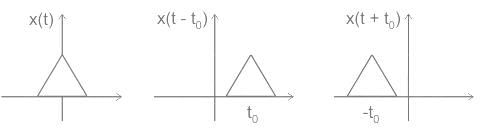
For example:
 | Explore Courses for Electronics and Communication Engineering (ECE) exam |  |
Top Courses for Electronics and Communication Engineering (ECE)View all




Top Courses for Electronics and Communication Engineering (ECE)
Question Description
The given mathematical representation belongs to:y(t) = x(t - T)a)time multiplicationb)time divisionc)time scalingd)time reversale)time shiftingCorrect answer is option 'E'. Can you explain this answer? for Electronics and Communication Engineering (ECE) 2026 is part of Electronics and Communication Engineering (ECE) preparation. The Question and answers have been prepared according to the Electronics and Communication Engineering (ECE) exam syllabus. Information about The given mathematical representation belongs to:y(t) = x(t - T)a)time multiplicationb)time divisionc)time scalingd)time reversale)time shiftingCorrect answer is option 'E'. Can you explain this answer? covers all topics & solutions for Electronics and Communication Engineering (ECE) 2026 Exam. Find important definitions, questions, meanings, examples, exercises and tests below for The given mathematical representation belongs to:y(t) = x(t - T)a)time multiplicationb)time divisionc)time scalingd)time reversale)time shiftingCorrect answer is option 'E'. Can you explain this answer?.
The given mathematical representation belongs to:y(t) = x(t - T)a)time multiplicationb)time divisionc)time scalingd)time reversale)time shiftingCorrect answer is option 'E'. Can you explain this answer? for Electronics and Communication Engineering (ECE) 2026 is part of Electronics and Communication Engineering (ECE) preparation. The Question and answers have been prepared according to the Electronics and Communication Engineering (ECE) exam syllabus. Information about The given mathematical representation belongs to:y(t) = x(t - T)a)time multiplicationb)time divisionc)time scalingd)time reversale)time shiftingCorrect answer is option 'E'. Can you explain this answer? covers all topics & solutions for Electronics and Communication Engineering (ECE) 2026 Exam. Find important definitions, questions, meanings, examples, exercises and tests below for The given mathematical representation belongs to:y(t) = x(t - T)a)time multiplicationb)time divisionc)time scalingd)time reversale)time shiftingCorrect answer is option 'E'. Can you explain this answer?.
Solutions for The given mathematical representation belongs to:y(t) = x(t - T)a)time multiplicationb)time divisionc)time scalingd)time reversale)time shiftingCorrect answer is option 'E'. Can you explain this answer? in English & in Hindi are available as part of our courses for Electronics and Communication Engineering (ECE). Download more important topics, notes, lectures and mock test series for Electronics and Communication Engineering (ECE) Exam by signing up for free.
Here you can find the meaning of The given mathematical representation belongs to:y(t) = x(t - T)a)time multiplicationb)time divisionc)time scalingd)time reversale)time shiftingCorrect answer is option 'E'. Can you explain this answer? defined & explained in the simplest way possible. Besides giving the explanation of The given mathematical representation belongs to:y(t) = x(t - T)a)time multiplicationb)time divisionc)time scalingd)time reversale)time shiftingCorrect answer is option 'E'. Can you explain this answer?, a detailed solution for The given mathematical representation belongs to:y(t) = x(t - T)a)time multiplicationb)time divisionc)time scalingd)time reversale)time shiftingCorrect answer is option 'E'. Can you explain this answer? has been provided alongside types of The given mathematical representation belongs to:y(t) = x(t - T)a)time multiplicationb)time divisionc)time scalingd)time reversale)time shiftingCorrect answer is option 'E'. Can you explain this answer? theory, EduRev gives you an ample number of questions to practice The given mathematical representation belongs to:y(t) = x(t - T)a)time multiplicationb)time divisionc)time scalingd)time reversale)time shiftingCorrect answer is option 'E'. Can you explain this answer? tests, examples and also practice Electronics and Communication Engineering (ECE) tests.
| Explore Courses for Electronics and Communication Engineering (ECE) exam | |
Top Courses for Electronics and Communication Engineering (ECE)
Explore Courses
Signup for Free!
Signup to see your scores go up within 7 days! Learn & Practice with 1000+ FREE Notes, Videos & Tests.
x![]()

All Videos you need for Electronics and Communication Engineering (ECE)
Videos that teach & bring a smile


