


Electronics and Communication Engineering (ECE) Exam > Electronics and Communication Engineering (ECE) Questions > System is said to be marginally stable, ifa)G... Start Learning for Free
System is said to be marginally stable, if
- a)Gain crossover frequency > Phase crossover frequency
- b)Gain crossover frequency = Phase crossover frequency
- c)Gain crossover frequency < Phase crossover frequency
- d)Gain crossover frequency ≠ Phase crossover frequency
Correct answer is option 'B'. Can you explain this answer?

Most Upvoted Answer
System is said to be marginally stable, ifa)Gain crossover frequency &...
Explanation:
Marginally Stable System:
A marginally stable system is a system where the gain crossover frequency is equal to the phase crossover frequency. In other words, the gain margin and phase margin are both zero.
Gain Crossover Frequency:
The gain crossover frequency is the frequency at which the magnitude of the open-loop transfer function is equal to 1 or 0 dB.
Phase Crossover Frequency:
The phase crossover frequency is the frequency at which the phase of the open-loop transfer function is equal to -180 degrees.
Relation between Gain and Phase Crossover Frequencies:
In a marginally stable system, the gain crossover frequency is equal to the phase crossover frequency. This means that the system is on the verge of instability, as there is no margin for stability. Any slight variation in parameters can potentially push the system into instability.
Conclusion:
Therefore, in a marginally stable system, the gain crossover frequency is equal to the phase crossover frequency. This balance between gain and phase margins indicates a critical stability point for the system.
Marginally Stable System:
A marginally stable system is a system where the gain crossover frequency is equal to the phase crossover frequency. In other words, the gain margin and phase margin are both zero.
Gain Crossover Frequency:
The gain crossover frequency is the frequency at which the magnitude of the open-loop transfer function is equal to 1 or 0 dB.
Phase Crossover Frequency:
The phase crossover frequency is the frequency at which the phase of the open-loop transfer function is equal to -180 degrees.
Relation between Gain and Phase Crossover Frequencies:
In a marginally stable system, the gain crossover frequency is equal to the phase crossover frequency. This means that the system is on the verge of instability, as there is no margin for stability. Any slight variation in parameters can potentially push the system into instability.
Conclusion:
Therefore, in a marginally stable system, the gain crossover frequency is equal to the phase crossover frequency. This balance between gain and phase margins indicates a critical stability point for the system.
Free Test
FREE
| Start Free Test |
Community Answer
System is said to be marginally stable, ifa)Gain crossover frequency &...
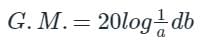
Gain Margin:
- The gain margin is a factor by which the gain of a stable system is allowed to increase before the system reaches the verge of instability.
- It is also defined as the reciprocal of the gain at which the phase angle becomes 1800.
- The frequency at which the phase angle is 1800 is called the phase crossover frequency (ωpc).
Mathematically,
∠G(jω)H(jω) = -180º
If |G(jω)H(jω)| = a, at ω = ωpc
Then Gain margin,
Phase Margin:
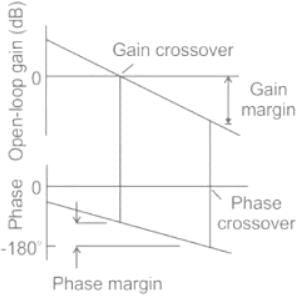
- It is the amount of additional phase lag (at gain crossover frequency) that is required to bring the system to the verge of instability.
- The frequency at which |G(jω)H(jω|, the magnitude of the open-loop transfer function is unity is called gain crossover frequency (ωpc).
At ωpc, |G(jω)H(jω| = 1
if, ∠G(jω)H(jω) = ϕ at ω = ωgc
Then, P.M. = 180 + ϕ
Analysis:
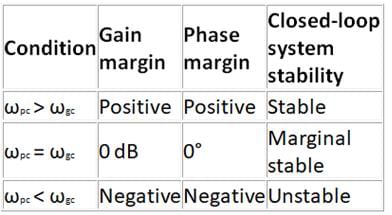
For stable systems,
|G(jωpc)H(jωpc| < 1, and
∠G(jωgc)H(jωgc) > -180
so that, gain margin and phase margin both are positive
which is possible when ωgc < ωpc
For marginally stable systems,
ωgc = ωpc
Hence option (b) is the correct answer.
if, ∠G(jω)H(jω) = ϕ at ω = ωgc
Then, P.M. = 180 + ϕ
Analysis:
For stable systems,
|G(jωpc)H(jωpc| < 1, and
∠G(jωgc)H(jωgc) > -180
so that, gain margin and phase margin both are positive
which is possible when ωgc < ωpc
For marginally stable systems,
ωgc = ωpc
Hence option (b) is the correct answer.
Note: For stable systems having two or more gain crossover frequencies, the phase margin is measured at the highest gain crossover frequency.
 | Explore Courses for Electronics and Communication Engineering (ECE) exam |  |
Top Courses for Electronics and Communication Engineering (ECE)View all




Top Courses for Electronics and Communication Engineering (ECE)
Question Description
System is said to be marginally stable, ifa)Gain crossover frequency > Phase crossover frequencyb)Gain crossover frequency = Phase crossover frequencyc)Gain crossover frequency < Phase crossover frequencyd)Gain crossover frequency ≠ Phase crossover frequencyCorrect answer is option 'B'. Can you explain this answer? for Electronics and Communication Engineering (ECE) 2026 is part of Electronics and Communication Engineering (ECE) preparation. The Question and answers have been prepared according to the Electronics and Communication Engineering (ECE) exam syllabus. Information about System is said to be marginally stable, ifa)Gain crossover frequency > Phase crossover frequencyb)Gain crossover frequency = Phase crossover frequencyc)Gain crossover frequency < Phase crossover frequencyd)Gain crossover frequency ≠ Phase crossover frequencyCorrect answer is option 'B'. Can you explain this answer? covers all topics & solutions for Electronics and Communication Engineering (ECE) 2026 Exam. Find important definitions, questions, meanings, examples, exercises and tests below for System is said to be marginally stable, ifa)Gain crossover frequency > Phase crossover frequencyb)Gain crossover frequency = Phase crossover frequencyc)Gain crossover frequency < Phase crossover frequencyd)Gain crossover frequency ≠ Phase crossover frequencyCorrect answer is option 'B'. Can you explain this answer?.
System is said to be marginally stable, ifa)Gain crossover frequency > Phase crossover frequencyb)Gain crossover frequency = Phase crossover frequencyc)Gain crossover frequency < Phase crossover frequencyd)Gain crossover frequency ≠ Phase crossover frequencyCorrect answer is option 'B'. Can you explain this answer? for Electronics and Communication Engineering (ECE) 2026 is part of Electronics and Communication Engineering (ECE) preparation. The Question and answers have been prepared according to the Electronics and Communication Engineering (ECE) exam syllabus. Information about System is said to be marginally stable, ifa)Gain crossover frequency > Phase crossover frequencyb)Gain crossover frequency = Phase crossover frequencyc)Gain crossover frequency < Phase crossover frequencyd)Gain crossover frequency ≠ Phase crossover frequencyCorrect answer is option 'B'. Can you explain this answer? covers all topics & solutions for Electronics and Communication Engineering (ECE) 2026 Exam. Find important definitions, questions, meanings, examples, exercises and tests below for System is said to be marginally stable, ifa)Gain crossover frequency > Phase crossover frequencyb)Gain crossover frequency = Phase crossover frequencyc)Gain crossover frequency < Phase crossover frequencyd)Gain crossover frequency ≠ Phase crossover frequencyCorrect answer is option 'B'. Can you explain this answer?.
Solutions for System is said to be marginally stable, ifa)Gain crossover frequency > Phase crossover frequencyb)Gain crossover frequency = Phase crossover frequencyc)Gain crossover frequency < Phase crossover frequencyd)Gain crossover frequency ≠ Phase crossover frequencyCorrect answer is option 'B'. Can you explain this answer? in English & in Hindi are available as part of our courses for Electronics and Communication Engineering (ECE). Download more important topics, notes, lectures and mock test series for Electronics and Communication Engineering (ECE) Exam by signing up for free.
Here you can find the meaning of System is said to be marginally stable, ifa)Gain crossover frequency > Phase crossover frequencyb)Gain crossover frequency = Phase crossover frequencyc)Gain crossover frequency < Phase crossover frequencyd)Gain crossover frequency ≠ Phase crossover frequencyCorrect answer is option 'B'. Can you explain this answer? defined & explained in the simplest way possible. Besides giving the explanation of System is said to be marginally stable, ifa)Gain crossover frequency > Phase crossover frequencyb)Gain crossover frequency = Phase crossover frequencyc)Gain crossover frequency < Phase crossover frequencyd)Gain crossover frequency ≠ Phase crossover frequencyCorrect answer is option 'B'. Can you explain this answer?, a detailed solution for System is said to be marginally stable, ifa)Gain crossover frequency > Phase crossover frequencyb)Gain crossover frequency = Phase crossover frequencyc)Gain crossover frequency < Phase crossover frequencyd)Gain crossover frequency ≠ Phase crossover frequencyCorrect answer is option 'B'. Can you explain this answer? has been provided alongside types of System is said to be marginally stable, ifa)Gain crossover frequency > Phase crossover frequencyb)Gain crossover frequency = Phase crossover frequencyc)Gain crossover frequency < Phase crossover frequencyd)Gain crossover frequency ≠ Phase crossover frequencyCorrect answer is option 'B'. Can you explain this answer? theory, EduRev gives you an ample number of questions to practice System is said to be marginally stable, ifa)Gain crossover frequency > Phase crossover frequencyb)Gain crossover frequency = Phase crossover frequencyc)Gain crossover frequency < Phase crossover frequencyd)Gain crossover frequency ≠ Phase crossover frequencyCorrect answer is option 'B'. Can you explain this answer? tests, examples and also practice Electronics and Communication Engineering (ECE) tests.
| Explore Courses for Electronics and Communication Engineering (ECE) exam | |
Top Courses for Electronics and Communication Engineering (ECE)
Explore Courses
Signup for Free!
Signup to see your scores go up within 7 days! Learn & Practice with 1000+ FREE Notes, Videos & Tests.
x![]()

Best way to Prepare for Electronics and Communication Engineering (ECE)
Learn | Test | Discuss | Repeat


